
 chinahuijue@gmail.com
 +1 (702) 204-9855
1 MWh Battery Storage Container: Applications, Configuration, and Buyer Checklist
Date: August 30, 2026
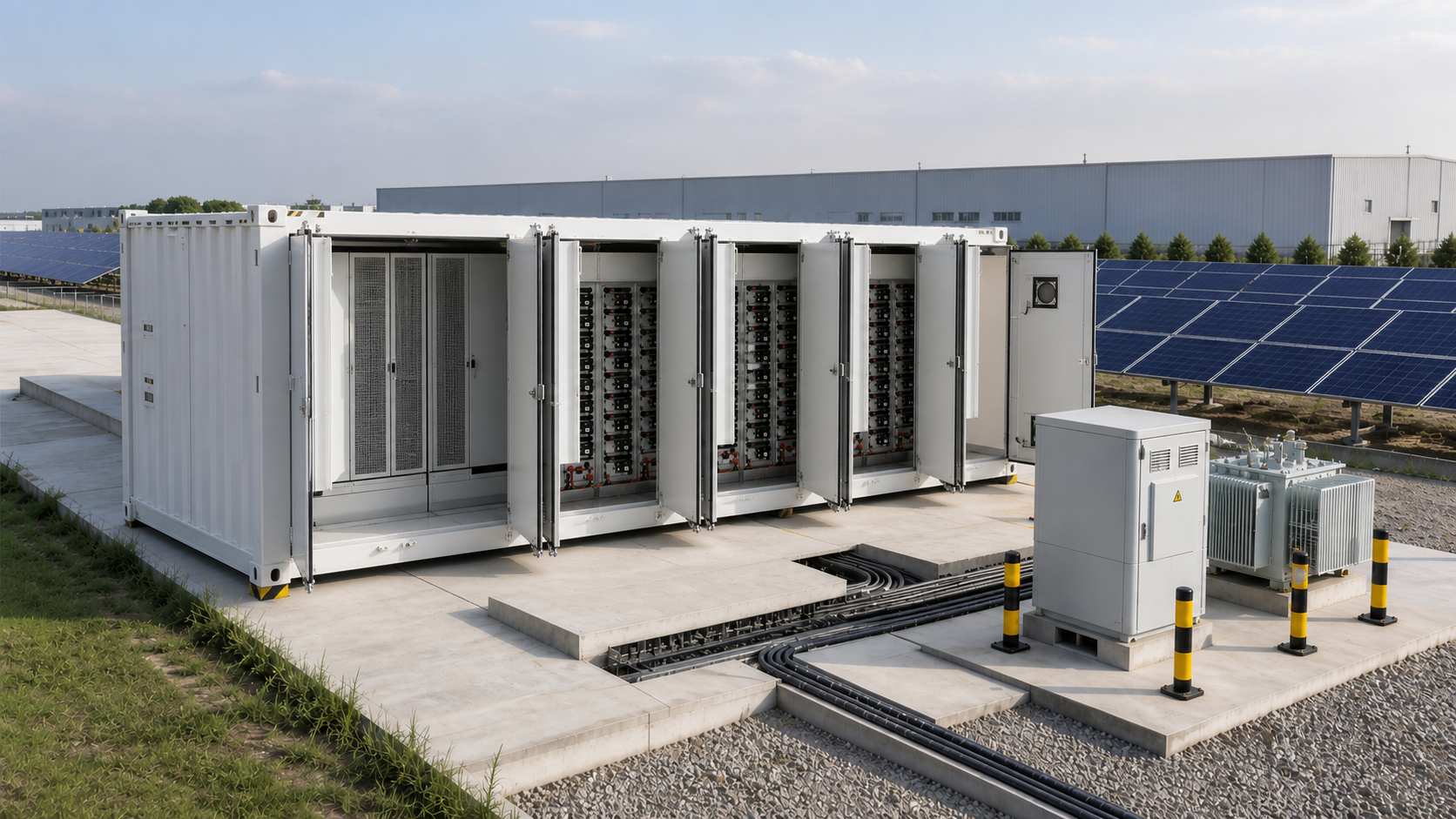
A 1 MWh battery storage container is becoming a practical option for commercial solar projects, industrial sites, microgrids, farms, telecom sites, and temporary power applications. Compared with small battery cabinets, a containerized system can provide higher capacity, easier transport, faster site deployment, and a more complete integration of batteries, PCS, BMS, EMS, cooling, fire protection, and monitoring.
But for project buyers, the key question is not only “how much is a 1 MWh battery?” A better question is:
What problem should this 1 MWh battery storage container solve every day?
The answer may be peak shaving, solar self-consumption, backup power, diesel reduction, grid support, or off-grid operation. Different applications require different power ratings, discharge durations, thermal designs, safety configurations, and control strategies.
What Does a 1 MWh Battery Storage Container Mean?
A 1 MWh battery storage container usually refers to a containerized battery energy storage system with around 1 megawatt-hour of usable or nominal energy capacity. In simple terms, it describes how much energy the battery can store.
However, energy capacity is only one part of the design. Buyers also need to confirm the system power rating.
For example:
- A 500 kW / 1 MWh system can discharge for about 2 hours at full power.
- A 250 kW / 1 MWh system can discharge for about 4 hours at full power.
- A 1 MW / 1 MWh system is closer to a 1-hour high-power application.
This is why two “1 MWh” systems may have very different prices, layouts, and use cases. The PCS rating, battery cell configuration, cooling system, protection design, EMS strategy, and grid connection requirements all affect the final solution.
For larger commercial and project-scale applications, a container energy storage system is often more suitable than a small standalone battery cabinet, especially when the site requires higher capacity, modular expansion, or centralized installation.
Common Applications for a 1 MWh Battery Storage Container
Commercial Solar Self-Consumption
Many commercial solar projects generate a large amount of electricity during the day, but the site may not consume all of it at the same time. Without battery storage, excess solar energy may be exported to the grid at a lower value or curtailed.
A 1 MWh battery storage container can store daytime solar generation and discharge it during evening peaks, high-tariff periods, or production hours. This can improve solar utilization and reduce dependence on grid electricity.
For this type of project, the design should consider:
- PV capacity
- Daytime load curve
- Export limitation
- Electricity tariff structure
- Desired discharge time
- Grid connection requirements
If the project is built around PV generation, Huijue’s solar + storage solution can be used as a reference for combining solar power, battery storage, inverter/PCS, EMS, and monitoring.
Factory Peak Shaving
Factories often face high demand charges when equipment, motors, compressors, or production lines start at the same time. In this case, the battery does not need to run all day. It may only need to discharge during short high-demand periods.
A 1 MWh battery storage container can help reduce peak demand if the power rating and EMS strategy are designed correctly. The system should be configured based on real load data, not only monthly electricity bills.
Before sizing the system, the project team should check:
- Maximum demand
- Peak duration
- Motor starting current
- Transformer capacity
- Production schedule
- Local demand charge rules
For some smaller factories or distributed installation points, a cabinet energy storage system may also be practical. But when the project needs higher capacity and centralized energy management, a containerized BESS is usually easier to scale.
Microgrids and Off-Grid Projects
Remote industrial sites, islands, farms, construction camps, and mining support areas may use diesel generators, solar power, and battery storage together. In this case, the 1 MWh battery storage container is not just a backup device. It becomes part of the daily power system.
The battery can help:
- Reduce diesel generator runtime
- Store solar energy during the day
- Stabilize power supply
- Support critical loads
- Reduce fuel logistics pressure
For off-grid or weak-grid sites, the EMS is especially important. It must coordinate PV output, battery charging and discharging, generator operation, load priority, and backup strategy.
Telecom and Remote Infrastructure
Telecom sites, communication hubs, and remote infrastructure projects may need reliable power where grid supply is unstable or expensive. A containerized battery system can support longer backup time and better centralized power management than small battery packs.
For these projects, buyers should pay attention to:
- Site access and transport conditions
- Outdoor protection level
- Cooling requirements
- Remote monitoring
- Maintenance convenience
- Compatibility with existing power equipment
Key Configuration Points Buyers Should Confirm
1. Battery Chemistry and Cycle Life
Most modern commercial BESS projects use lithium iron phosphate batteries because of their safety profile, cycle life, and suitability for stationary energy storage. But buyers should not only compare cell brand or nominal capacity.
They should ask:
- What is the usable capacity?
- What depth of discharge is recommended?
- What is the expected cycle life under project conditions?
- How does temperature affect degradation?
- What warranty conditions apply?
A lower initial price may not be the lowest lifecycle cost if usable capacity, degradation, and thermal control are not clearly defined.
2. PCS Power Rating
The PCS determines how much power the battery system can charge or discharge. This is one of the biggest differences between systems with the same 1 MWh capacity.
A project designed for peak shaving may need a higher PCS rating for short discharge periods. A solar self-consumption project may prefer a longer discharge duration with a moderate PCS size. An off-grid system may require more complex control logic for generator and PV coordination.
This is why buyers should provide the load profile before asking for a final quotation.
3. Thermal Management
Containerized BESS systems generate heat during operation. Cooling design affects safety, performance, and battery life.
Common questions include:
- Is the system air-cooled or liquid-cooled?
- What is the operating temperature range?
- Is the container suitable for hot, humid, dusty, or coastal environments?
- How is temperature monitored at battery module level?
- What maintenance is required for the cooling system?
For high-duty applications or hot regions, thermal management should not be treated as an optional detail.
4. Fire Protection and Safety Design
Safety is a core part of any 1 MWh battery storage container. A proper system should include electrical protection, battery-level monitoring, thermal management, fire detection, emergency shutdown logic, and suitable container design.
Buyers should confirm:
- BMS protection functions
- Smoke and temperature detection
- Fire suppression configuration
- Emergency stop design
- Ventilation or exhaust strategy
- Compliance requirements for the project location
The system should be evaluated as a complete energy storage solution, not just as battery modules inside a container.
5. EMS and Remote Monitoring
The EMS decides when the system charges, discharges, limits output, supports loads, or responds to grid conditions. For commercial projects, this can directly affect the project’s return.
An EMS should be able to support the selected application, such as:
- Solar self-consumption
- Peak shaving
- Backup power
- Time-of-use optimization
- Generator coordination
- Remote monitoring and alarms
For project owners, a clear EMS strategy is often more valuable than simply adding more battery capacity.
What Information Should Buyers Provide Before Requesting a Quote?
To get a useful quotation, buyers should avoid asking only for “1 MWh battery container price.” A project-specific quote needs enough technical and commercial background.
The most useful information includes:
- Project location
- Application scenario
- Required capacity and power
- Backup time requirement
- Existing PV capacity
- Grid condition
- Load profile
- Voltage level
- Outdoor environment
- Installation space
- Communication and monitoring needs
- Certification or grid connection requirements
- Expected delivery schedule
For a more accurate configuration, buyers can contact Huijue through the Huijue project inquiry page with project drawings, load data, and application requirements.
1 MWh Battery Storage Container vs Battery Cabinet
A battery cabinet and a containerized BESS can both be used for commercial energy storage, but they are not always suitable for the same project.
A cabinet system is usually better for:
- Smaller commercial sites
- Modular distributed installation
- Limited space
- Lower capacity requirements
- Easier indoor or outdoor cabinet deployment
A containerized system is usually better for:
- Larger capacity projects
- Centralized installation
- Microgrids
- Solar farms
- Industrial parks
- Utility or project-scale energy storage
- Faster transport and deployment
The choice should depend on power demand, capacity, installation space, future expansion, and maintenance strategy.
FAQ
Is a 1 MWh battery storage container suitable for home use?
In most cases, no. A 1 MWh battery storage container is usually designed for commercial, industrial, microgrid, telecom, agricultural, or project-scale applications. Home energy storage normally uses much smaller systems.
How many solar panels are needed for a 1 MWh battery?
There is no fixed number. It depends on solar panel wattage, local sunlight hours, battery recharge target, system losses, and daily load demand. The PV system should be sized based on an energy model, not a simple panel count.
Can a 1 MWh battery container work off-grid?
Yes, but the system must be designed for off-grid operation. It may need PV, diesel generator backup, PCS, EMS, load priority control, and suitable protection equipment.
Is liquid cooling necessary for a 1 MWh BESS?
Not always, but liquid cooling can be useful for higher-density systems, hot environments, frequent cycling, or projects requiring better temperature consistency. The right cooling method depends on duty cycle, climate, and system design.
What affects the price of a 1 MWh battery storage container?
Major cost factors include battery cells, PCS rating, cooling system, fire protection, EMS, container design, certification, shipping, installation support, and project-specific customization.
Conclusion
A 1 MWh battery storage container can be a strong solution for commercial solar projects, industrial peak shaving, microgrids, telecom infrastructure, and off-grid power systems. But buyers should not evaluate the system by capacity alone.
The best project result comes from matching battery capacity, PCS power, EMS strategy, thermal management, safety design, and site conditions.
For serious project planning, start with the application and load profile first. Then select the system configuration that fits the real operating conditions.
WordPress Publishing Information