
 chinahuijue@gmail.com
 +1 (702) 204-9855
100kWh Battery Storage Cost for Commercial Projects: What Affects the Final Quote?
Many buyers start with a simple question: how much does a 100kWh battery storage system cost?
It is a reasonable question. A 100kWh battery cabinet is often large enough for small commercial backup power, solar self-consumption, peak shaving, farms, workshops, telecom sites, retail buildings, and light industrial facilities.
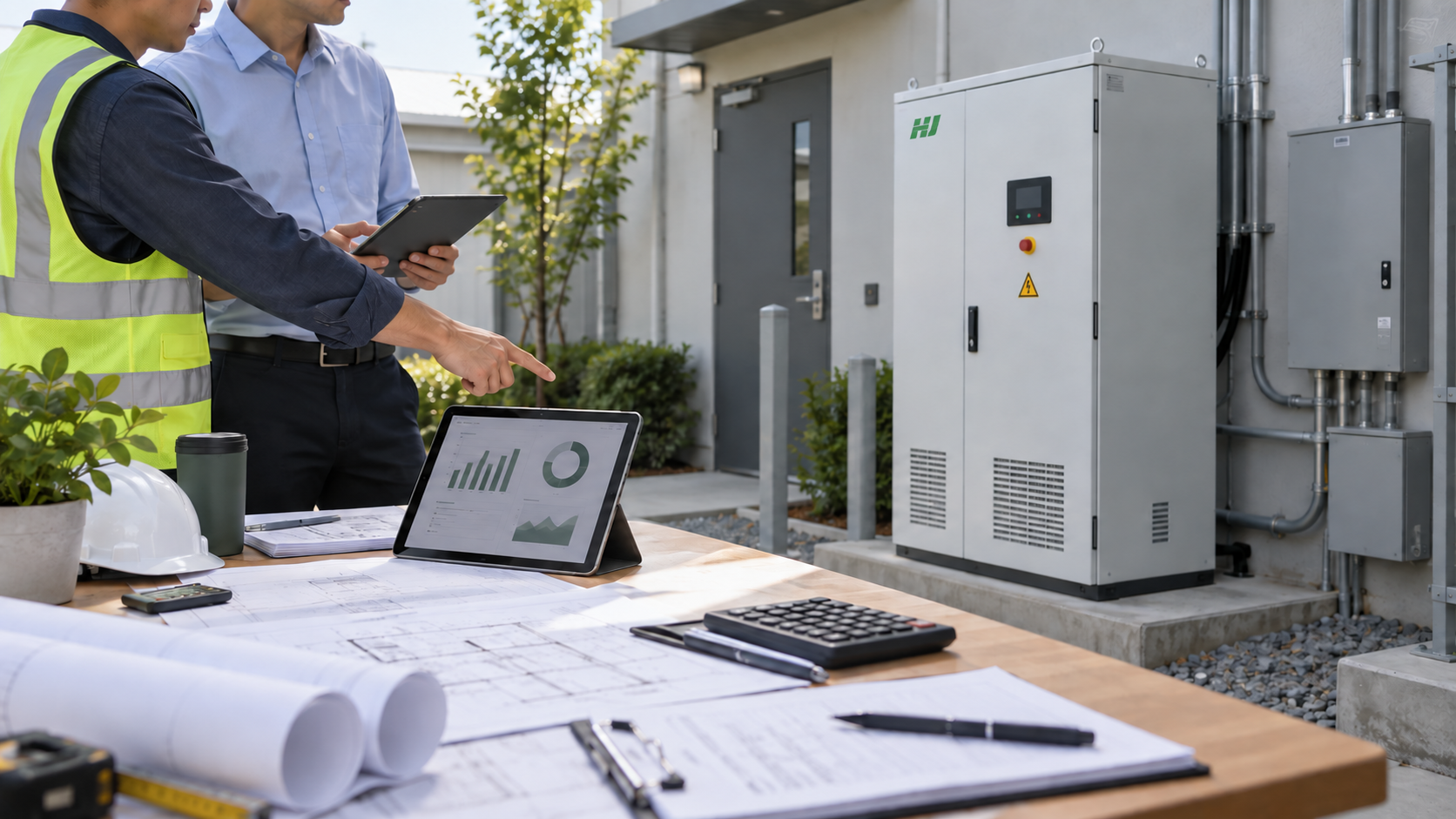
But in commercial projects, a 100kWh battery is not only a battery price. The final quote usually depends on the battery cabinet, PCS power, EMS, protection system, installation environment, shipping, certifications, and the way the system will be used.
For most commercial projects, the quote should not be compared by battery capacity alone. A 100kWh system price may change significantly depending on PCS power, cabinet protection level, shipping terms, and whether solar integration or backup control is required.
That is why two projects with the same 100kWh capacity can have very different prices.
100kWh Is the Energy Capacity, Not the Whole System
A 100kWh battery tells you how much energy the system can store. It does not fully describe how the system will perform.
For a commercial project, buyers usually need to confirm three basic points:
- How many kWh of energy storage are required?
- How many kW of output power are needed?
- How long should the battery support the load?
For example, a 100kWh battery can theoretically support a 50kW load for about two hours, or a 25kW load for about four hours. In real projects, the usable time may be lower because of depth of discharge, inverter efficiency, battery protection limits, and reserve capacity.
This is why a project should not be quoted only by “100kWh battery price.” The system must match the real load profile.
Main Factors That Affect a 100kWh Battery Storage Quote
1. Battery Chemistry and Cell Quality
Most commercial battery storage systems today use lithium iron phosphate batteries because LFP chemistry offers strong safety, long cycle life, and good thermal stability.
However, not all LFP battery systems are the same. Cell grade, cycle life, battery module structure, BMS quality, and thermal management all affect the final cost.
For commercial use, the cheapest battery is not always the best choice. If the system is used every day for peak shaving or solar self-consumption, cycle life and system reliability matter more than the lowest purchase price.
2. PCS Power Rating
A 100kWh battery cabinet still needs a power conversion system, often called PCS or hybrid inverter, to charge and discharge power.
A 100kWh system with a 30kW PCS will cost differently from a 100kWh system with a 50kW or 100kW PCS. Higher power output usually requires higher PCS capacity, stronger electrical protection, and sometimes more complex system design.
For this reason, a buyer should not only say “I need 100kWh.” It is better to also provide the required power in kW.
3. Backup Time Requirement
Some projects need the battery to support critical loads for one or two hours. Others need longer backup time for equipment, lighting, cold storage, communications, or production lines.
Backup time affects system sizing directly. If the load is too large, a 100kWh system may not be enough. The project may need a 200kWh, 400kWh, or larger battery system.
For larger commercial projects, a cabinet energy storage system or a modular multi-cabinet design may be more suitable than a single 100kWh cabinet.
4. Indoor or Outdoor Installation
Installation conditions also affect the quote.
An outdoor commercial battery cabinet usually needs a higher protection level, temperature control, waterproof design, dust protection, and safe electrical layout. Hot, humid, dusty, coastal, or high-altitude environments may require additional design considerations.
Indoor projects may need ventilation, spacing, fire safety planning, and local electrical compliance.
Before asking for a quote, it is useful to confirm whether the battery will be installed indoors or outdoors, and whether the site has temperature, dust, humidity, or space limitations.
5. EMS, Monitoring, and Control Functions
A basic battery cabinet can store and release energy. A commercial system often needs more control.
For example, the system may need to:
- charge from solar power during the day
- discharge during peak electricity price periods
- provide backup power during grid outages
- limit demand charges
- work with diesel generators
- support remote monitoring
- expand in the future
These functions usually require EMS control, communication interfaces, metering, and software configuration. The more complex the control logic, the more important the system design becomes.
For buyers comparing different suppliers, it is important to ask what control functions are included in the quote.
6. Solar Integration
Many customers search for “solar battery storage” because they want to combine solar panels with battery storage.
A 100kWh battery can be used with solar power, but the right system size depends on the PV capacity, daily generation, load curve, grid connection, and electricity price structure.
If the solar system is too small, the battery may not be fully charged. If the load is too large, the battery may discharge too quickly.
For projects that combine PV and storage, a complete solar + storage solution is usually better than buying the battery separately.
7. Shipping, Certification, and Local Project Conditions
Battery storage systems are heavy and require careful shipping. Freight cost, destination country, packaging, documentation, and local certification requirements can all affect the final price.
For international commercial projects, the final quote may also depend on:
- destination country
- delivery terms
- required certificates
- system voltage
- grid standard
- installation support
- after-sales requirements
- whether local commissioning is needed
This is why a factory quote and a delivered project quote may be different.
When Is a 100kWh Battery Storage System Suitable?
A 100kWh battery storage system is often suitable for small and medium commercial projects where the load is not extremely high.
Common applications include:
- small factories and workshops
- commercial buildings
- farms and agricultural sites
- telecom and communication sites
- retail stores and supermarkets
- solar self-consumption projects
- backup power for selected critical loads
- peak shaving for moderate electricity demand
For larger factories, industrial parks, utility projects, or long-duration backup power, a 100kWh system may be too small. In these cases, buyers may need a larger cabinet system or containerized BESS solution.
100kWh vs. 200kWh, 400kWh, and Containerized BESS
If your project only needs backup for several essential loads, 100kWh may be enough.
If your site has heavy machinery, cold storage, EV charging, pumps, large motors, or long backup requirements, a larger system may be needed.
A practical way to compare options is:
- 100kWh: small commercial backup, solar self-consumption, light peak shaving
- 200kWh to 500kWh: factories, farms, commercial buildings, larger solar storage projects
- 1MWh and above: industrial parks, microgrids, large commercial energy storage, utility-scale applications
For buyers who are still choosing between battery cabinets and containers, Huijue can provide a commercial and industrial energy storage solution based on the project load, application scenario, and site conditions.
What Information Should You Provide Before Asking for a Quote?
To get a more accurate 100kWh battery storage quote, prepare the following information:
- project country and city
- application scenario
- required battery capacity in kWh
- required output power in kW
- backup time requirement
- current solar panel capacity, if any
- daily electricity consumption
- main equipment or load type
- grid condition
- installation environment
- indoor or outdoor installation
- whether diesel generators are used
- whether future expansion is required
If you are not sure about the exact capacity, you can provide your load list and project goal. A technical team can help calculate whether 100kWh is enough or whether a larger system is more suitable.
Why the Lowest 100kWh Battery Price May Not Be the Best Choice
For commercial energy storage, the lowest price can sometimes create higher project risk.
A reliable system should consider battery safety, PCS matching, BMS control, thermal management, protection design, installation conditions, and long-term service.
If the system is undersized, it may not support the load. If the PCS is too small, the battery may not deliver the required power. If the cabinet design is not suitable for the environment, the system may face reliability problems later.
A good quote should explain what is included, what application the system is designed for, and what conditions may affect final pricing.
Conclusion
A 100kWh battery storage system can be a practical starting point for commercial solar storage, backup power, and peak shaving projects. It is especially suitable for small factories, farms, workshops, telecom sites, and commercial buildings with moderate backup or load-shifting needs.
However, the final cost depends on more than battery capacity. PCS power, backup time, cabinet protection level, EMS functions, solar integration, installation environment, shipping, and local project requirements can all change the final quote.
Before comparing prices, confirm your load power, backup time, installation environment, solar capacity, grid condition, and project location. This will help suppliers recommend the right system instead of giving a rough price that may not fit the project.
If you are planning a commercial battery storage project, Huijue can help you evaluate whether a 100kWh battery cabinet is enough or whether a larger C&I energy storage system would be more suitable.
Contact Huijue to share your project details and get a technical recommendation based on your real site conditions.
FAQ
How long can a 100kWh battery storage system run?
It depends on the load. A 100kWh battery may support a 50kW load for about two hours or a 25kW load for about four hours in theory. Actual runtime depends on usable capacity, inverter efficiency, depth of discharge, and reserve settings.
Is a 100kWh battery enough for a factory?
It depends on the factory load. A 100kWh system may support lighting, office equipment, small machines, or selected critical loads. For heavy production lines, motors, cold storage, or long backup time, a larger system may be required.
Can a 100kWh battery work with solar panels?
Yes. A 100kWh battery can be used with solar panels for self-consumption, backup power, or peak shaving. The correct size depends on the PV capacity, daily generation, load curve, and grid connection.
What affects the price of a 100kWh battery storage system?
The main factors include battery cell quality, PCS power, BMS, EMS, cabinet design, thermal management, protection level, installation environment, shipping, certification, and project requirements.
Should I choose a battery cabinet or containerized BESS?
For smaller commercial projects, a cabinet system is often easier to install and expand. For larger industrial or utility projects, containerized BESS may be more suitable because it supports higher capacity and integrated system design.