
 chinahuijue@gmail.com
 +1 (702) 204-9855
Battery Energy Storage System (BESS): Complete Guide for Commercial & Industrial Use
A Battery Energy Storage System (BESS) is a rechargeable battery system that stores electrical energy from the grid or solar panels and dispatches it when needed. For commercial and industrial (C&I) facilities, a BESS delivers three core value streams: peak shaving to cut demand charges, backup power for grid outages, and self-consumption optimization for solar PV systems.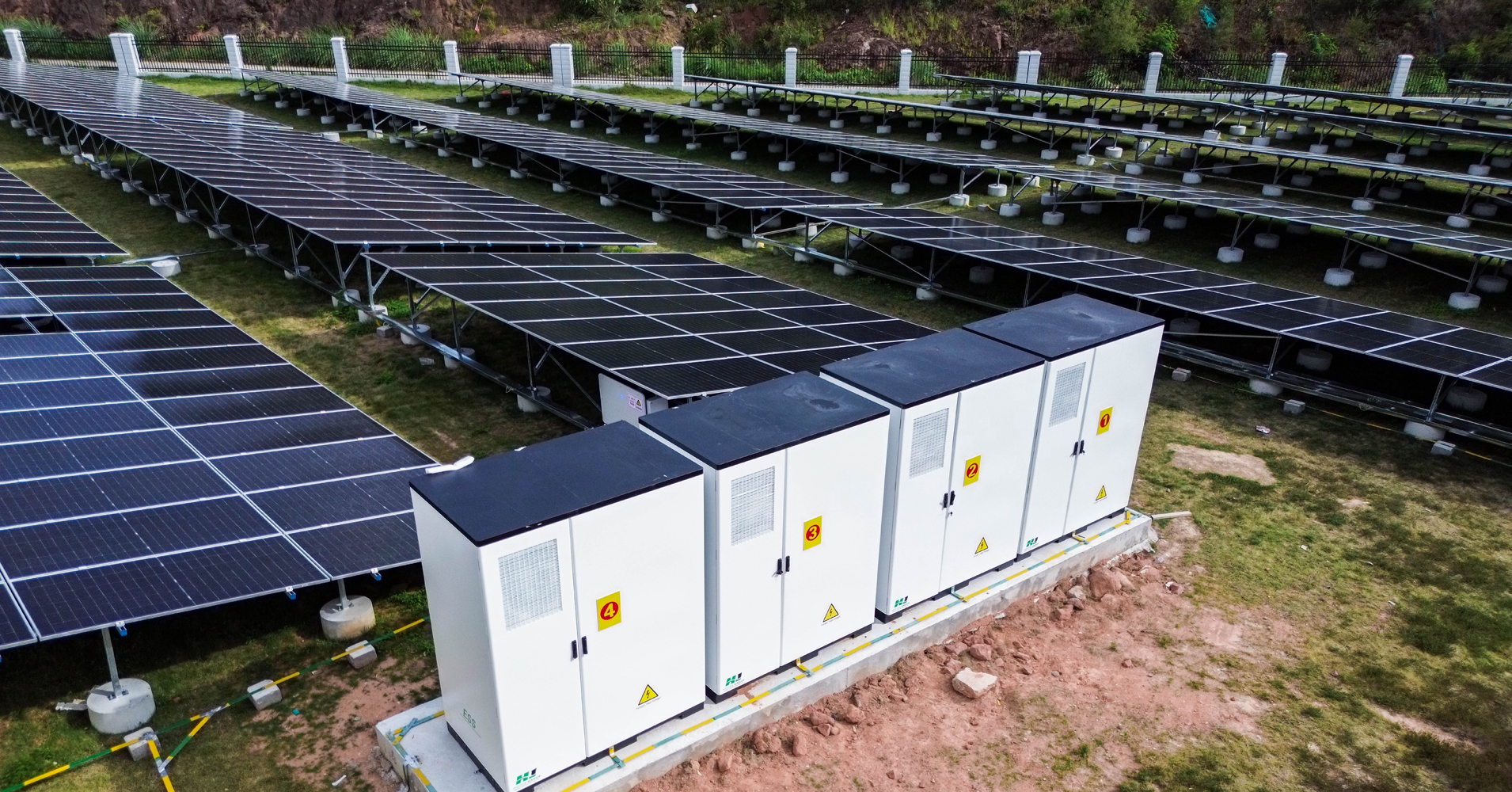
According to the BloombergNEF Energy Storage Market Outlook 2025, global BESS deployments reached 69 GW / 169 GWh in 2024, with C&I applications accounting for 18% of new installations. The market is projected to grow at a 21% CAGR through 2030, driven by falling lithium battery prices (down 40% since 2022) and rising electricity demand charges worldwide.
This guide explains what a BESS is, how it works, its key components, how to size the right capacity for your facility (from 100kWh to 1MWh+), and what to expect in terms of cost and ROI in 2025-2026.
What Is a Battery Energy Storage System (BESS)?
BESS stands for Battery Energy Storage System. It refers to the complete system that stores and dispatches electrical energy — not just the battery cells. A C&I BESS typically integrates four key subsystems:
- Battery modules — usually lithium iron phosphate (LFP) cells, rated by capacity (kWh) and power (kW)
- Battery Management System (BMS) — monitors cell voltage, temperature, and state of charge to ensure safety and longevity
- Power Conversion System (PCS / inverter) — converts DC battery power to AC grid power and vice versa
- Energy Management System (EMS) — the software “brain” that decides when to charge and discharge based on your energy strategy
In commercial and industrial applications, BESS capacity typically ranges from 50 kWh to several MWh. Smaller systems serve retail stores, small factories, and telecom towers; larger systems (1 MWh+) serve manufacturing plants, data centers, microgrids, and utility-scale projects.
How Does a BESS Work?
A BESS operates in three modes depending on your energy strategy and grid conditions:
1. Charging mode — The system draws electricity from the grid or solar PV during off-peak hours (low rates, low demand) and stores it as chemical energy in the battery cells. Charging is managed by the BMS to prevent overcharging and balance cell voltages.
2. Storage mode — The battery holds the stored energy with minimal self-discharge (typically 2-3% per month for LFP). The EMS continuously monitors state of charge, temperature, and grid conditions.
3. Discharging mode — When demand peaks, grid power fails, or electricity rates are high, the PCS inverts the stored DC power to AC and supplies it to your facility. Switchover time is typically <20 milliseconds — fast enough to protect sensitive equipment like servers and medical devices.
The EMS orchestrates this cycle automatically based on pre-set rules (peak shaving, TOU arbitrage, backup) or real-time signals (utility demand response events, solar generation forecasts).
Key BESS Components Explained
| Component | Full Name | Function | Key Specs |
|---|---|---|---|
| Battery | Lithium Iron Phosphate (LFP) pack | Stores electrical energy as chemical energy | 50kWh–5MWh, 280–800V DC, 6,000+ cycles |
| BMS | Battery Management System | Monitors & protects individual cells | Cell balancing, SOC/SOH, thermal cutoff |
| PCS | Power Conversion System (Inverter) | Converts DC ↔ AC | 50kW–2MW, 97%+ efficiency, grid-forming |
| EMS | Energy Management System | Optimizes charge/discharge logic | Peak shaving, TOU, demand response, VPP |
| HVAC | Heating, Ventilation & Air Conditioning | Maintains optimal battery temperature | -20°C to +55°C operating range |
| Fire suppression | Aerosol / clean agent system | Detects and suppresses thermal events | UL9540A compliant |
BESS Architecture: Behind-the-Meter vs Front-of-Meter
Behind-the-Meter (BTM) BESS — Installed on the customer side of the utility meter. Used for self-consumption, peak shaving, and backup power. The owner captures the full retail value of stored energy. This is the most common C&I configuration.
Front-of-Meter (FTM) BESS — Installed on the utility side of the meter. Operates as a grid asset providing frequency regulation, capacity, and ancillary services. Revenue comes from wholesale markets or utility contracts.
Most C&I buyers are looking at BTM systems for direct cost savings and energy resilience. FTM projects are typically developed by independent power producers (IPPs) or utilities.
LFP vs NMC: Which Battery Chemistry for C&I?
Lithium Iron Phosphate (LFP) is the dominant chemistry for C&I and utility-scale BESS. Compared to NMC (Nickel Manganese Cobalt), LFP offers:
- Higher safety — thermal runaway threshold ~270°C vs ~210°C for NMC; no cobalt or nickel
- Longer cycle life — 6,000–10,000 cycles at 80% DoD vs 2,000–3,000 for NMC
- Lower cost — LFP cell prices dropped below $80/kWh in 2025 vs $110+/kWh for NMC
- Better high-temperature performance — degrades slower in hot climates (Africa, Middle East, Southeast Asia)
NMC’s advantage is higher energy density (more kWh per kg), which matters for electric vehicles but is rarely decisive for stationary storage where weight and size are less constrained.
Recommendation: For C&I applications, choose LFP unless you have specific space or weight constraints.
BESS Container Solutions: Modular & Scalable
A BESS container is a complete battery storage system housed inside a standard shipping container (10ft / 20ft / 40ft). It integrates battery racks, BMS, PCS, HVAC, fire suppression, and controls into a single transportable unit.
Why choose a containerized BESS?
- Rapid deployment — delivered pre-assembled, commissioned in days not months
- Scalable — parallel multiple containers to reach 10 MW / 40 MWh+
- Transportable — standard ISO container can be shipped globally
- Lower installation cost — no custom building required
Standard sizing:
| Container Size | Capacity Range | Typical Application |
|---|---|---|
| 10 ft | 100–500 kWh | Small commercial, telecom |
| 20 ft | 500 kWh–2 MWh | Medium C&I, microgrids |
| 40 ft | 2–5 MWh | Large C&I, utility-scale |
Sizing Your BESS: 100kWh to 1MWh+
Sizing a BESS correctly is critical to project ROI. Undersize and you miss peak-shaving savings; oversize and you waste capital. Follow this 4-step process:
Step 1: Identify your peak demand (kW) from the last 12 months of utility bills. Look for the highest monthly demand charge.
Step 2: Determine discharge duration (hours) — how many hours do you need to shave the peak or run on backup?
Step 3: Calculate required capacity:
Required kWh = Peak kW × Hours × 1.2 (safety margin)
Step 4: Match to a standard BESS size:
| Facility Type | Peak Demand | Backup Need | Recommended BESS |
|---|---|---|---|
| Small retail / office | 30–80 kW | 2–4 h | 100–250 kWh |
| Small factory | 80–200 kW | 2–3 h | 200–500 kWh |
| Medium industrial | 200–500 kW | 1–2 h | 500 kWh–1 MWh |
| Large industrial / data center | 500 kW–2 MW | 1–2 h | 1–4 MWh |
| Microgrid / utility | 2 MW+ | 2–4 h | 5–20 MWh |
For a 100 kWh battery system, expect to pay $30,000–$50,000 turnkey. For a 1 MWh container, expect $300,000–$500,000 turnkey (2025-2026 pricing).
BESS Cost Analysis 2025-2026
Battery storage costs have fallen sharply. The levelized cost of storage (LCOS) for LFP BESS now ranges from $130–$220 per MWh, competitive with new gas peaker plants in many markets.
Price breakdown (typical 1 MWh / 20ft container):
| Component | % of Total Cost | 2025 Cost Range |
|---|---|---|
| Battery cells (LFP) | 45–55% | $130,000–$200,000 |
| BMS + EMS + controls | 10–15% | $30,000–$60,000 |
| PCS / inverter | 12–18% | $40,000–$80,000 |
| Enclosure + HVAC + fire | 8–12% | $25,000–$50,000 |
| Installation + commissioning | 8–10% | $25,000–$50,000 |
| Total turnkey | 100% | $300,000–$500,000 |
Key cost drivers:
- Battery cell prices (LFP dropped from $140/kWh in 2022 to ~$80/kWh in 2025)
- Container standard vs custom design
- Local labor and installation costs
- Shipping and import duties
Payback period: 4–7 years for commercial peak shaving, 3–5 years with solar PV + battery.
Solar PV + BESS Integration
Pairing solar PV with battery storage maximizes the value of both assets. During the day, solar panels generate power; excess charges the battery instead of being exported at low feed-in tariffs. At night or during peak rates, the battery discharges the stored solar energy.
Two integration architectures:
AC-coupled — Solar and battery each have their own inverter. Easier to retrofit onto existing solar systems. Efficiency ~93%.
DC-coupled — Solar and battery share a single hybrid inverter. More efficient (~97%) but requires compatible equipment. Better for new installations.
For commercial buildings with daytime loads (offices, factories, data centers), solar + storage can offset 60–90% of grid electricity consumption and eliminate demand charges.
Top BESS Manufacturers & How to Choose
The BESS market is dominated by Chinese manufacturers, who control ~75% of global LFP cell production. Tier 1 suppliers include:
| Manufacturer | Headquarters | Key Strength | Typical Market |
|---|---|---|---|
| CATL | China | Largest cell supplier, Tier 1 | Utility, EV, C&I |
| BYD | China | Integrated cell-to-system, vertical | C&I, residential |
| Sungrow | China | Power conversion + storage | C&I, utility |
| Huawei | China | Smart string ESS, AI EMS | C&I, utility |
| Huijue Group | China | C&I containers, OEM/ODM | C&I, telecom, microgrid |
| Tesla | USA | Megapack, software | Utility, large C&I |
| Fluence | USA/Germany | Grid-scale software | Utility |
| LG Energy Solution | South Korea | LFP cells, residential | Residential, C&I |
How to verify a supplier’s quality:
- BloombergNEF Tier 1 status
- Certifications: UL9540, IEC62619, UN38.3, CE
- Reference projects of similar size in your region
- Warranty: minimum 10 years, 70-80% capacity retention
- After-sales service network in your country
Frequently Asked Questions (FAQ)
Q1: What is a Battery Energy Storage System (BESS)?
A BESS is a rechargeable battery system that stores electrical energy for later use. A typical C&I BESS includes lithium-ion battery modules (usually LFP), a Battery Management System (BMS), a Power Conversion System (PCS), and an Energy Management System (EMS).
Q2: How much does a 1 MWh battery storage system cost?
A 1 MWh BESS costs approximately $300,000–$500,000 turnkey in 2025-2026, including container, PCS, BMS, EMS, and installation. At utility scale (>5 MWh), prices drop to $250–$350 per kWh.
Q3: How long do BESS batteries last?
LFP BESS batteries last 6,000–10,000 cycles at 80% depth of discharge — equivalent to 10–15 years of daily cycling. Most manufacturers offer a 10-year warranty with 70–80% capacity retention.
Q4: LFP vs NMC — which is better for C&I?
LFP is recommended for C&I due to higher safety (thermal runaway at ~270°C vs ~210°C for NMC), longer cycle life (6,000–10,000 vs 2,000–3,000 cycles), lower cost (LFP ~$80/kWh vs NMC ~$110/kWh), and better high-temperature performance.
Q5: How do I size a BESS for my facility?
Required kWh = Peak kW × Hours of discharge × 1.2 (safety margin). Example: 200 kW peak × 3 hours × 1.2 = 720 kWh → choose a 1 MWh system for headroom.
Need a Reliable BESS Supplier?
Huijue Group manufactures containerized battery energy storage systems from 100 kWh to 5 MWh+ with Tier 1 LFP cells, full certifications (UL9540, IEC62619, UN38.3), and 10-year warranty. Contact our engineering team for a custom quote and ROI analysis for your facility.