
 chinahuijue@gmail.com
 +1 (702) 204-9855
BESS Cost and Design Guide for Commercial Solar Projects
Date: August 25, 2026
Slug: bess-cost-design-guide-commercial-solar-projects
Excerpt: Learn how to evaluate BESS cost, EMS control, DC coupling, three-phase output, peak shaving, and battery capacity for commercial solar storage projects.
Meta Title: BESS Cost and Design Guide for Commercial Solar Projects
Meta Description: Compare BESS cost drivers, EMS functions, DC-coupled design, three-phase output, and sizing rules for commercial solar and industrial storage projects.
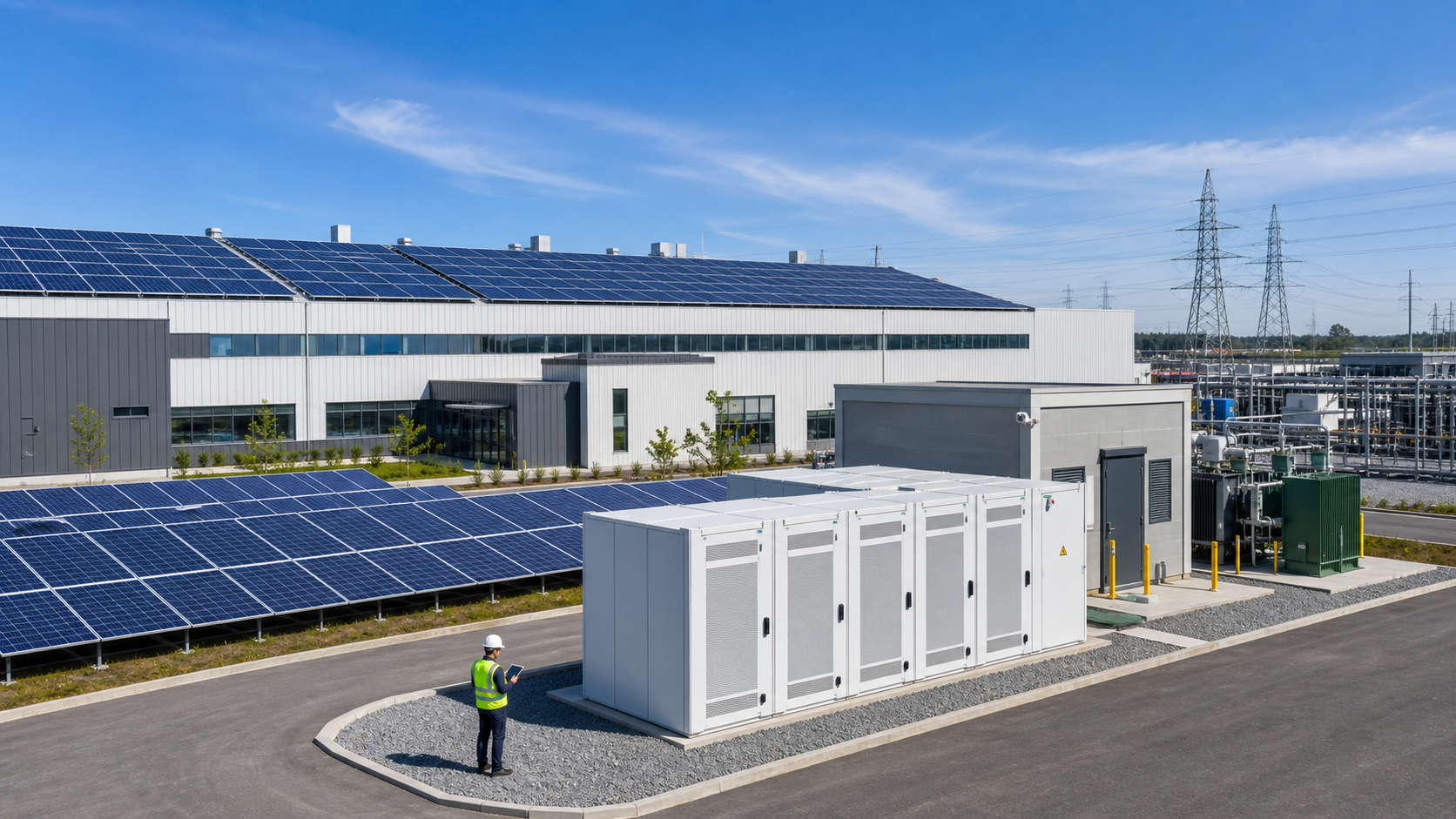
BESS Cost and Design Guide for Commercial Solar Projects
For commercial solar projects, battery energy storage is no longer only an optional backup device. A well-designed BESS can help a factory, commercial building, agricultural site, or solar project owner improve solar self-consumption, reduce peak demand, support backup power, and prepare for more flexible energy management.
But many buyers still start with a simple question: how much does a BESS cost? The better question is slightly different: what type of BESS architecture fits the load profile, PV system, grid condition, backup requirement, and long-term operation plan?
A battery price alone cannot define the value of a commercial energy storage project. Two systems with the same kWh capacity may perform very differently if the PCS rating, EMS logic, cooling design, grid connection, and installation scope are not the same.
Start With the Application, Not the Battery Size
The first step is to define what the system must do. Common commercial BESS applications include peak shaving, load shifting, solar self-consumption, backup power, diesel generator reduction, and microgrid operation.
For example, a 40 kW battery storage system may be enough for a small commercial load that needs short-duration peak control. A 60 kWh battery may support selected backup loads or solar smoothing. A 100 kWh to 400 kWh cabinet system may be more suitable for factories, farms, shopping facilities, warehouses, and commercial solar projects.
For larger industrial parks, utility projects, or multi-MWh applications, a container energy storage system may be more practical because it integrates batteries, PCS, thermal management, fire protection, monitoring, and site-level expansion in a standardized containerized format.
Key Components That Affect BESS Cost
A BESS quotation is not only a battery quotation. The total project cost is influenced by several major components:
Battery cells and battery modules determine the nominal energy capacity, cycle life, degradation behavior, and safety characteristics.
The PCS or hybrid inverter determines charge and discharge power, grid interaction, three-phase output, and whether the system can support the required load profile.
The BMS monitors battery voltage, temperature, current, SOC, SOH, and protection status.
The EMS coordinates battery charging, discharging, PV input, grid import, generator operation, time-of-use strategy, and peak shaving logic.
Thermal management, fire protection, enclosure rating, cable design, grid connection, installation, commissioning, and local compliance also affect the final cost.
This is why two suppliers may quote very different prices for a “100 kWh battery system.” One quote may only include battery racks, while another may include PCS, EMS, AC distribution, monitoring, cooling, and project engineering.
Why EMS Matters in a Commercial BESS
Searches such as “EMS for BESS” show that buyers are becoming more aware of system control. EMS is the brain of the energy storage system. Without a suitable EMS, the battery may operate, but it may not deliver the expected economic value.
For peak shaving, the EMS must monitor site load and discharge the battery when demand approaches a preset threshold. For solar self-consumption, it must decide when to store excess PV energy and when to discharge it. For backup applications, it must protect reserve capacity and coordinate with grid or generator status.
In commercial and industrial projects, EMS design should be discussed early. The supplier should understand the electricity tariff, demand charges, PV generation curve, load profile, transformer capacity, and backup priority. A good EMS strategy can turn a battery cabinet into a real energy management asset.
DC-Coupled or AC-Coupled BESS?
Another important design choice is whether to use a DC-coupled or AC-coupled architecture.
A DC-coupled BESS can be attractive when a new solar project is being designed together with storage. PV energy can be connected on the DC side before conversion, which may improve integration efficiency in some project designs. It can also be useful where PV and battery operation need to be optimized as one system.
An AC-coupled BESS is often easier for retrofit projects, existing commercial solar systems, factories, and sites where the PV system is already installed. The battery system connects on the AC side, making it more flexible for many commercial projects.
There is no single best answer. The right choice depends on whether the project is new or existing, how the PV system is connected, whether the site needs backup power, and how the local grid connection is arranged.
Three-Phase Battery Storage for Commercial Sites
Many commercial and industrial sites require three-phase power. This is why search terms such as “3 phase battery storage” often indicate a more serious project than small residential battery searches.
For factories, farms, workshops, warehouses, and commercial buildings, three-phase output may be required for motors, pumps, HVAC systems, production equipment, elevators, or site-level distribution. In these cases, the PCS capacity and phase balancing must be reviewed carefully.
A buyer should not only ask for kWh capacity. They should also confirm rated power, overload capability, grid-forming or grid-following requirements, backup load list, response time, and whether the system can support the actual site electrical architecture.
Cabinet or Container: Which Format Fits?
For many commercial solar and small industrial projects, cabinet energy storage systems are a practical starting point. Outdoor cabinets can integrate battery modules, BMS, PCS, cooling, fire protection, and monitoring in a compact footprint. They are suitable for commercial buildings, factories, farms, EV charging support, telecom-related power sites, and distributed solar projects.
For higher capacity projects, multiple cabinets can be combined, or the design can move toward a containerized BESS. Container systems are more suitable when the project requires MWh-level capacity, centralized power conversion, faster site deployment, and scalable expansion.
The decision should consider available space, target capacity, installation environment, maintenance access, cooling requirements, fire safety design, and future expansion plan.
How to Prepare a Useful BESS Inquiry
A useful BESS inquiry should include more than a requested battery size. Before asking for a quotation, prepare these project details:
Project country and installation environment.
Application: peak shaving, backup, solar self-consumption, microgrid, or diesel reduction.
PV capacity, grid connection, and existing inverter information.
Load profile, maximum demand, and critical backup loads.
Required power in kW and backup duration in hours.
Preferred battery capacity in kWh or MWh.
Indoor or outdoor installation requirement.
Communication, monitoring, and EMS requirements.
Any local certification, grid code, or installation standard.
With this information, the supplier can recommend a more accurate system configuration instead of simply quoting a generic battery price.
FAQ: BESS Cost and Design for Commercial Solar Projects
How much does a commercial BESS cost?
The cost of a commercial BESS depends on battery capacity, PCS power, cooling method, EMS functions, protection design, installation conditions, and required backup duration. A reliable quotation should include the full system scope, not only the battery price per kWh.
Is DC coupled BESS better than AC coupled BESS?
DC coupled BESS can be suitable for new solar-plus-storage projects where PV and battery design are planned together. AC coupled BESS is often easier for retrofit projects, existing PV plants, and sites that need flexible grid-side control.
What does EMS do in a BESS project?
EMS controls charging, discharging, peak shaving, load priority, grid interaction, and system monitoring. For commercial projects, EMS is important because it affects daily operation strategy and long-term project value.
Can a 40kW or 60kWh battery system support a commercial site?
It depends on the site load profile, peak demand, backup time, and operating purpose. A 40kW / 60kWh system may support selected commercial loads, but factories, telecom sites, and larger facilities often require a detailed load calculation before choosing capacity.
What information is needed for a BESS quotation?
A project quotation normally requires site location, load profile, peak power demand, daily energy consumption, PV capacity, grid condition, backup time requirement, installation environment, and communication or monitoring requirements.
Conclusion
BESS cost depends on more than battery capacity. A commercial energy storage project should be evaluated by application, power rating, usable energy, EMS strategy, AC or DC coupling, three-phase requirements, safety design, installation scope, and long-term operation value.
For small and medium commercial projects, an outdoor cabinet system may provide a flexible starting point. For larger industrial or utility-scale applications, a containerized system may be more suitable.
If you are planning a commercial solar storage project, send Huijue your site load profile, PV system information, required backup time, and project location through the Huijue project inquiry page. The engineering team can help evaluate a practical BESS configuration for your project.