
 chinahuijue@gmail.com
 +1 (702) 204-9855
100kWh and 200kWh Outdoor Battery Storage: How to Choose a Commercial BESS Cabinet
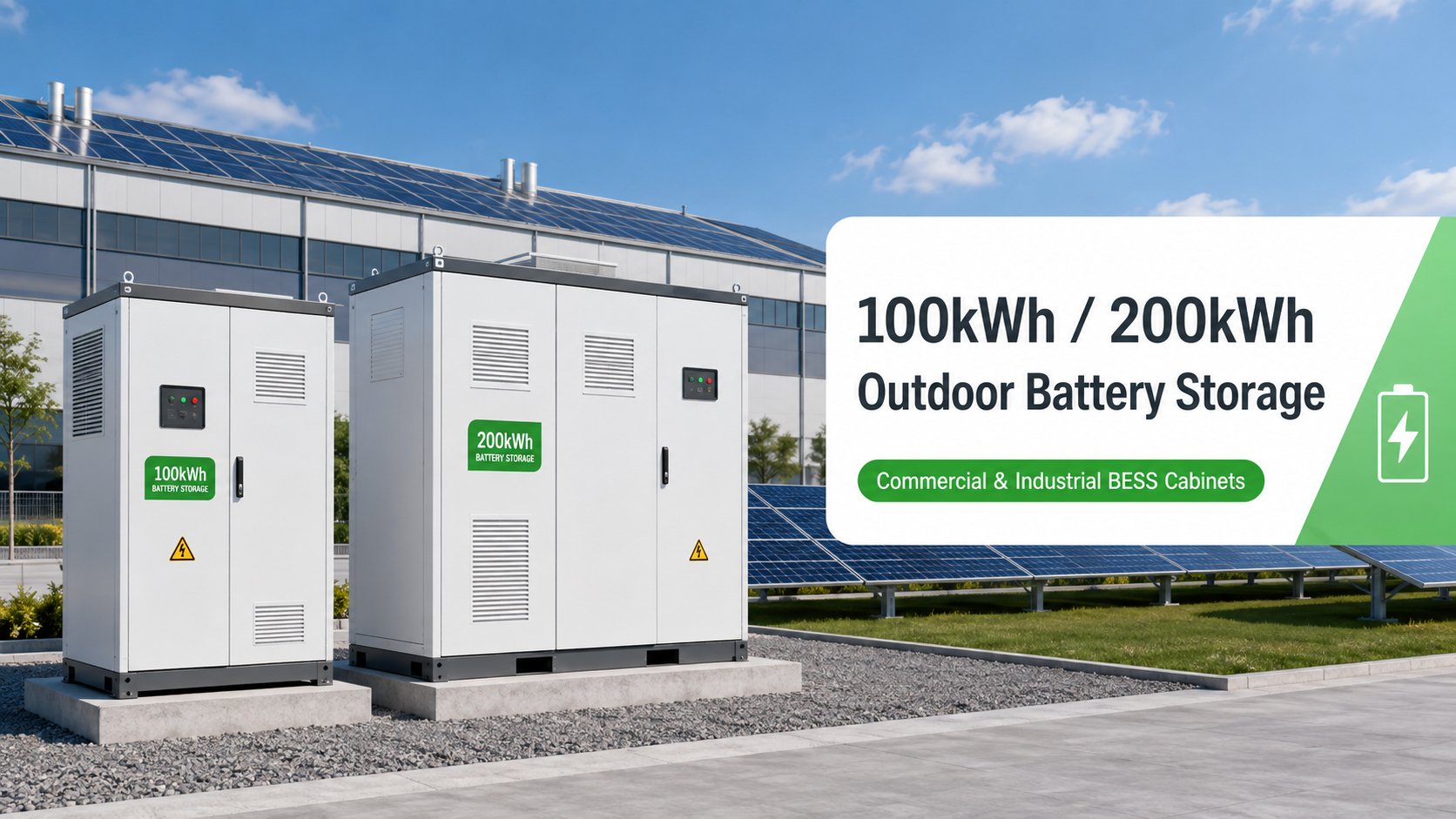
Many commercial solar projects do not need a full containerized battery system at the beginning. For factories, farms, commercial buildings, telecom sites, workshops, and small industrial parks, a 100kWh or 200kWh outdoor battery storage cabinet can be a more practical starting point.
Compared with small residential batteries, outdoor BESS cabinets are designed for higher power demand, longer operating hours, outdoor installation, and commercial energy management. They can work with solar PV, utility grid, diesel generators, or hybrid power systems to improve power reliability and reduce electricity costs.
This article explains where 100kWh and 200kWh battery storage systems fit, how to choose between different capacities, and what information buyers should prepare before asking for a commercial BESS quote.
What Is An Outdoor Battery Storage Cabinet?
An outdoor battery storage cabinet is an integrated energy storage system installed in a weather-resistant enclosure. It usually includes battery modules, battery management system, power conversion system, thermal management, fire protection, monitoring, and electrical protection components.
The cabinet design makes the system easier to install in outdoor commercial sites. It does not usually require the same footprint as a large containerized BESS. For many medium-sized projects, this makes outdoor battery cabinets suitable for fast deployment, flexible expansion, and distributed energy storage.
Common project sizes include 100kWh, 200kWh, 215kWh, 261kWh, and other customized configurations depending on site demand and battery design.
100kWh Vs 200kWh Battery Storage: What Is The Difference?
The difference between a 100kWh and 200kWh battery storage system is not only the battery capacity. The final design also depends on discharge power, backup duration, solar PV capacity, daily load curve, and operating purpose.
| Project Need | 100kWh Battery Storage | 200kWh Battery Storage |
|---|---|---|
| Typical Use | Small commercial backup, telecom site, small workshop, farm, or solar self-consumption | Factory load support, commercial peak shaving, larger PV storage, or weak-grid backup |
| Installation Space | More compact and easier to place near the load | Requires more space but provides longer storage time |
| Backup Duration | Suitable for selected key loads | Better for longer backup or higher daily energy demand |
| Expansion | Can be used as a starting system | Better when future growth is already expected |
For example, if a project only needs backup power for communication equipment, lighting, security systems, or basic office loads, a 100kWh cabinet may be enough. If the project needs to support production equipment, pumps, refrigeration, larger commercial loads, or solar power shifting, a 200kWh-class system may be more suitable.
Where Outdoor BESS Cabinets Are Commonly Used
Commercial Solar Energy Storage
In many commercial solar projects, solar power is produced during the day, but electricity demand may be higher in the evening or during peak tariff periods. An outdoor battery storage cabinet can store surplus solar energy and release it when the site needs it most.
This helps improve solar self-consumption and reduce dependence on the utility grid.
Backup Power For Business Continuity
Power outages can interrupt production, communication, refrigeration, water pumping, and daily business operations. A commercial BESS cabinet can provide backup power for selected critical loads and reduce the risk of downtime.
This is especially useful in weak-grid areas where voltage fluctuation or unexpected outages happen frequently.
Peak Shaving For Commercial And Industrial Users
For factories and commercial buildings, electricity bills may include peak demand charges. A battery storage system can charge during lower-cost periods or when solar power is available, then discharge during peak demand periods.
This helps reduce peak load pressure and improve overall energy cost control.
Hybrid Power With Solar And Diesel Generators
In remote areas or temporary project sites, diesel generators are still widely used. A battery energy storage cabinet can work with solar PV and diesel generators to reduce fuel consumption, stabilize power output, and improve operating efficiency.
Instead of running a generator all the time, the system can store energy and support loads when generator operation is not necessary.
This Is Not A Small Home Battery System
A 100kWh or 200kWh battery storage system is usually too large for ordinary home solar use. It is more suitable for commercial and industrial applications where the load demand, installation environment, and power management requirements are much higher.
If the project is only for one household, a residential battery may be more appropriate. But if the project involves business operation, factory equipment, commercial solar, telecom power, farm power, or weak-grid support, an outdoor BESS cabinet can be a better solution.
Key Factors Before Choosing A 100kWh Or 200kWh BESS Cabinet
Before selecting a battery cabinet, buyers should not only ask for the price. The correct system depends on the project’s real electrical data and operating goal.
- Daily Load: How much electricity the site uses each day.
- Peak Power: The highest power demand during operation.
- Backup Time: How many hours the system needs to support key loads.
- PV Capacity: Existing or planned solar panel capacity.
- Grid Condition: Stable grid, weak grid, off-grid, or hybrid operation.
- Installation Site: Temperature, humidity, dust, space, and outdoor protection requirements.
- Expansion Plan: Whether more battery capacity may be added later.
When Should You Choose A Battery Cabinet Instead Of A Container?
Outdoor battery cabinets are usually better for medium commercial projects, distributed energy storage, telecom power sites, farms, small factories, and projects with limited installation space.
Containerized BESS is usually more suitable for larger MWh-level projects, utility-scale storage, industrial parks, or large solar-plus-storage stations. If your project is between small commercial storage and MWh-level container storage, a 100kWh to 200kWh outdoor BESS cabinet can be a balanced choice.
What Information Is Needed For A Quote?
To receive a more accurate battery energy storage proposal, it is better to prepare the following information:
- Project country and installation location
- Application scenario, such as factory, farm, telecom site, commercial building, or solar project
- Required battery capacity, such as 100kWh, 200kWh, or larger
- Peak load and daily electricity consumption
- Required backup time
- Existing or planned solar PV capacity
- Grid condition and electricity tariff structure
- Outdoor environment and installation space
Conclusion
A 100kWh or 200kWh outdoor battery storage cabinet can be a practical solution for commercial and industrial projects that need solar energy storage, backup power, peak shaving, or weak-grid support.
For buyers who are not ready for a full containerized energy storage system, an outdoor BESS cabinet provides a flexible and scalable option. The final choice should be based on load profile, backup time, PV capacity, grid condition, and installation environment.
For project-specific commercial battery storage design, you can learn more here: Huijue Outdoor Cabinet Energy Storage Solutions.
If you are planning a commercial or industrial energy storage project, send your project location, load data, PV capacity, backup time, and installation requirements. Huijue can help evaluate a suitable 100kWh, 200kWh, or customized outdoor battery storage solution for your site.