
 chinahuijue@gmail.com
 +1 (702) 204-9855
Battery Energy Storage System Components: BESS Battery, PCS, BMS, EMS, Cooling and Safety
Date: August 31, 2026
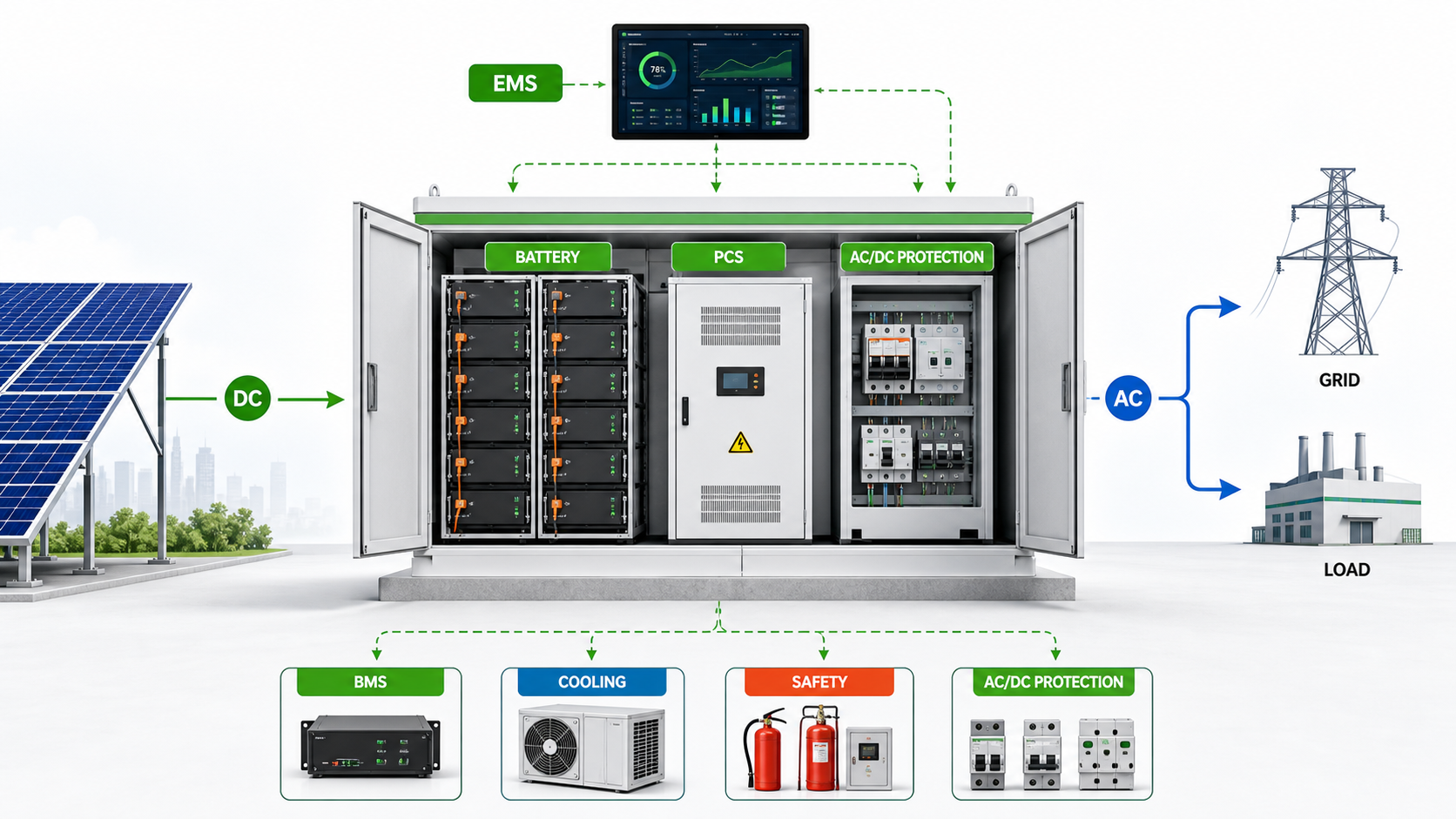
A battery energy storage system is not just a large battery pack. For commercial and industrial projects, a complete BESS must coordinate battery modules, PCS, BMS, EMS, thermal management, fire protection, communication, and site-level power control.
This is why two systems with the same capacity label may perform very differently in real projects. A 100 kWh, 261 kWh, 500 kWh, or 1 MWh battery system should not be evaluated only by energy capacity or unit price. Buyers also need to understand how the system charges, discharges, protects itself, connects to solar PV, and supports the actual load profile.
For EPCs, solar developers, factories, telecom operators, and project owners, understanding the main BESS components helps reduce procurement risk and makes quotations easier to compare.
What Is a Battery Energy Storage System?
A battery energy storage system stores electrical energy and releases it when needed. In commercial applications, it is commonly used for solar self-consumption, peak shaving, backup power, microgrids, off-grid sites, and grid support.
A complete BESS usually includes:
- Battery cells, modules, and racks
- Battery Management System
- Power Conversion System
- Energy Management System
- Cooling or thermal management
- Fire detection and suppression
- DC and AC protection
- Communication and monitoring
- Outdoor cabinet or container enclosure
For medium-scale commercial sites, a cabinet energy storage system is often suitable because it integrates batteries, PCS, BMS, EMS, cooling, and protection in a compact outdoor cabinet.
For larger projects, a container energy storage system may be more suitable when the site requires higher capacity, longer backup duration, or easier transportation and deployment.
Battery System: Capacity Is Only the Starting Point
The battery system determines how much energy can be stored, but capacity alone does not tell the full story.
A buyer may ask for a 100 kWh or 500 kWh battery, but the correct configuration depends on:
- Daily electricity consumption
- Maximum load demand
- Required backup time
- Charging source, such as solar PV or grid
- Number of charge/discharge cycles per day
- Ambient temperature
- Installation location
- Expansion plan
Lithium iron phosphate batteries are widely used in commercial BESS because of their safety, thermal stability, and long cycle life. However, buyers should still check the battery cell brand, warranty terms, usable capacity, depth of discharge, and degradation assumptions.
A quotation should clearly state whether the listed capacity is nominal capacity or usable capacity. This matters because the usable energy available to the load may be lower than the nominal battery size.
PCS: The Power Control Core of BESS
The PCS, or Power Conversion System, converts DC power from the battery into AC power for the load or grid. It also converts AC power back into DC power when charging the battery from the grid or solar inverter system.
For commercial projects, PCS selection affects:
- Maximum output power
- Grid-connected operation
- Off-grid operation
- Charging and discharging efficiency
- Response speed
- Power quality
- Compatibility with solar PV and diesel generators
For example, a 261 kWh battery cabinet with a 125 kW PCS is different from a 261 kWh system with a lower power PCS. The energy capacity may be similar, but the actual discharge power and application range can be different.
If the project requires peak shaving, the PCS power rating must be matched to the site’s peak demand. If the project requires backup power, the PCS must be able to support the critical load during outages.
BMS: Battery Protection and Cell-Level Management
The BMS, or Battery Management System, monitors and protects the battery system. It tracks cell voltage, current, temperature, state of charge, and system alarms.
A reliable BMS helps prevent:
- Overcharging
- Over-discharging
- Overcurrent
- Cell imbalance
- Overtemperature
- Abnormal battery behavior
For commercial and industrial BESS, the BMS should not be treated as a small accessory. It is one of the most important safety systems inside the energy storage cabinet or container.
When comparing quotations, buyers should check whether the BMS supports multi-level protection, real-time monitoring, fault alarms, and communication with PCS and EMS.
EMS: The Brain of the Energy Storage System
The EMS, or Energy Management System, controls how the BESS operates at the site level. It decides when the battery should charge, when it should discharge, and how the system should respond to load changes, solar generation, grid conditions, and electricity tariffs.
A good EMS can support:
- Solar self-consumption
- Peak shaving
- Time-of-use energy management
- Backup power priority
- Microgrid control
- Remote monitoring
- Alarm management
- Operating data analysis
For a factory, the EMS may focus on peak demand reduction. For a solar project, it may prioritize storing surplus PV power. For a telecom or remote site, it may prioritize power reliability and backup duration.
This is why the EMS strategy should be configured according to the actual project goal, not copied from a generic system template.
Cooling System: Why Thermal Management Matters
Battery temperature directly affects safety, performance, and service life. In commercial BESS projects, thermal management is especially important when the system operates outdoors, in hot climates, or with frequent charge and discharge cycles.
Common cooling methods include air cooling and liquid cooling.
Air cooling may be suitable for some smaller or lower-power systems. Liquid cooling is often preferred for higher energy density, better temperature uniformity, and more demanding operating conditions.
A liquid-cooled cabinet can help maintain more stable battery temperature, reduce temperature differences between battery modules, and support long-term system reliability.
For commercial solar storage projects, Huijue’s solar + storage solution can be configured with suitable cooling, PCS capacity, EMS strategy, and outdoor protection according to project conditions.
Fire Protection and Electrical Safety
BESS safety should be checked before price comparison. A low initial price may create higher project risk if protection systems are incomplete.
Commercial energy storage buyers should review:
- Battery cell safety
- BMS protection logic
- Fire detection system
- Fire suppression method
- Cabinet or container ventilation design
- DC protection
- AC protection
- Emergency stop function
- Grounding design
- Compliance with local electrical requirements
For outdoor installations, buyers should also check IP rating, corrosion resistance, temperature range, and site maintenance access.
Cabinet BESS or Container BESS: Which One Is Better?
There is no single answer. The correct form depends on capacity, power demand, site layout, transportation, and expansion needs.
A cabinet BESS is usually suitable for:
- Commercial buildings
- Small and medium industrial sites
- Solar self-consumption projects
- Peak shaving
- Distributed energy storage
- Telecom and remote power sites
- Projects requiring modular deployment
A container BESS is usually suitable for:
- Large commercial and industrial projects
- Utility-scale storage
- Microgrids
- Large solar farms
- Remote energy infrastructure
- Projects requiring MWh-level capacity
If the project starts from 100 kWh, 200 kWh, or 261 kWh, cabinet energy storage may be a practical starting point. If the project grows toward 1 MWh or above, containerized storage may become more suitable.
How to Compare a BESS Quotation
When reviewing a BESS quotation, buyers should not only compare the price per kWh. A professional quotation should make the full system scope clear.
Important items include:
- Nominal capacity and usable capacity
- PCS rated power
- Battery chemistry and cycle life
- Cooling method
- EMS functions
- BMS protection level
- Fire protection configuration
- IP rating and corrosion resistance
- Operating temperature range
- Communication protocol
- Warranty terms
- Installation and commissioning scope
- Expansion options
- Shipping and packaging
If these details are missing, a cheaper quotation may not really be cheaper at the project level.
Example: Commercial Solar + Storage Project
A commercial building may install solar PV during the day, but its electricity demand may continue into the evening. Without storage, part of the solar energy may be wasted or sold back to the grid at a low value.
In this case, a BESS can store surplus PV power and release it later when the building needs electricity. If the site also has peak demand charges, the EMS can be configured to discharge during high-load periods.
For this type of project, the buyer should provide:
- Daily load curve
- Maximum demand
- PV system capacity
- Electricity tariff
- Required backup time
- Available installation space
- Grid connection conditions
With this information, the system supplier can recommend a suitable battery capacity, PCS rating, cooling method, and EMS control strategy.
FAQ
Is BESS the same as a battery pack?
No. A battery pack is only one part of the system. A complete BESS includes battery modules, PCS, BMS, EMS, cooling, fire protection, enclosure, communication, and electrical protection.
What is the difference between kW and kWh in BESS?
kW refers to power, or how much electricity the system can deliver at one time. kWh refers to energy capacity, or how long the system can support the load. Both must be considered together.
Is liquid cooling necessary for every BESS project?
Not always. Air cooling may be enough for some smaller systems. Liquid cooling is more suitable for higher energy density, frequent cycling, high-temperature environments, and projects requiring better temperature consistency.
Can a 100 kWh battery storage system be used for commercial projects?
Yes, but it depends on the load. A 100 kWh system may support selected commercial loads, solar self-consumption, or short backup time. For larger factories or longer backup requirements, a higher-capacity system may be needed.
What information is needed before requesting a BESS quotation?
Buyers should provide site location, load profile, PV capacity, required backup duration, grid conditions, operating environment, available installation space, and project application.
Conclusion
A battery energy storage system should be evaluated as a complete power solution, not only as a battery capacity label.
For commercial and industrial projects, the real value of BESS comes from the coordination of battery, PCS, BMS, EMS, cooling, fire protection, and site-level energy strategy. Before selecting a system, buyers should define the application, calculate the load, confirm the required power and duration, and compare the full project scope.
Huijue provides cabinet and container energy storage systems for commercial solar, industrial energy storage, telecom sites, microgrids, and off-grid power projects. For a project-specific configuration, contact the Huijue project team with your load information, site conditions, and required backup time.