
 chinahuijue@gmail.com
 +1 (702) 204-9855
BESS Market 2026 Mid-Year Update: Why Commercial & Industrial Battery Storage Is Accelerating
The battery energy storage system (BESS) market is having a record-breaking year. According to the IEA Global Energy Review 2026 (published July 2025), 108 GW of new battery storage capacity was deployed worldwide in 2025 — a 40% increase over 2024 and more than eleven times the installed base from just three years ago. Total energy storage systems reached 275.3 GWh, a 61.3% year-over-year jump.
And the momentum is only accelerating. On July 1, 2026, Wood Mackenzie released its annual global BESS integrator market share report, revealing that Chinese system integrators now capture 76% of the global BESS market, with eight of the world’s top ten suppliers headquartered in China. Just one day later, on July 2, Socomec launched two new BESS platforms specifically targeting commercial & industrial (C&I) and grid-scale storage. On July 8, a 100 MW BESS began operation in Aruküla, Estonia — once again proving that battery storage is no longer a niche technology but a fundamental pillar of modern energy infrastructure.
For commercial and industrial facility owners, this means three things: more choices, lower costs, and faster deployment than ever before. This article breaks down the key market developments shaping C&I battery storage in mid-2026, what they mean for your project, and how to position your procurement strategy accordingly.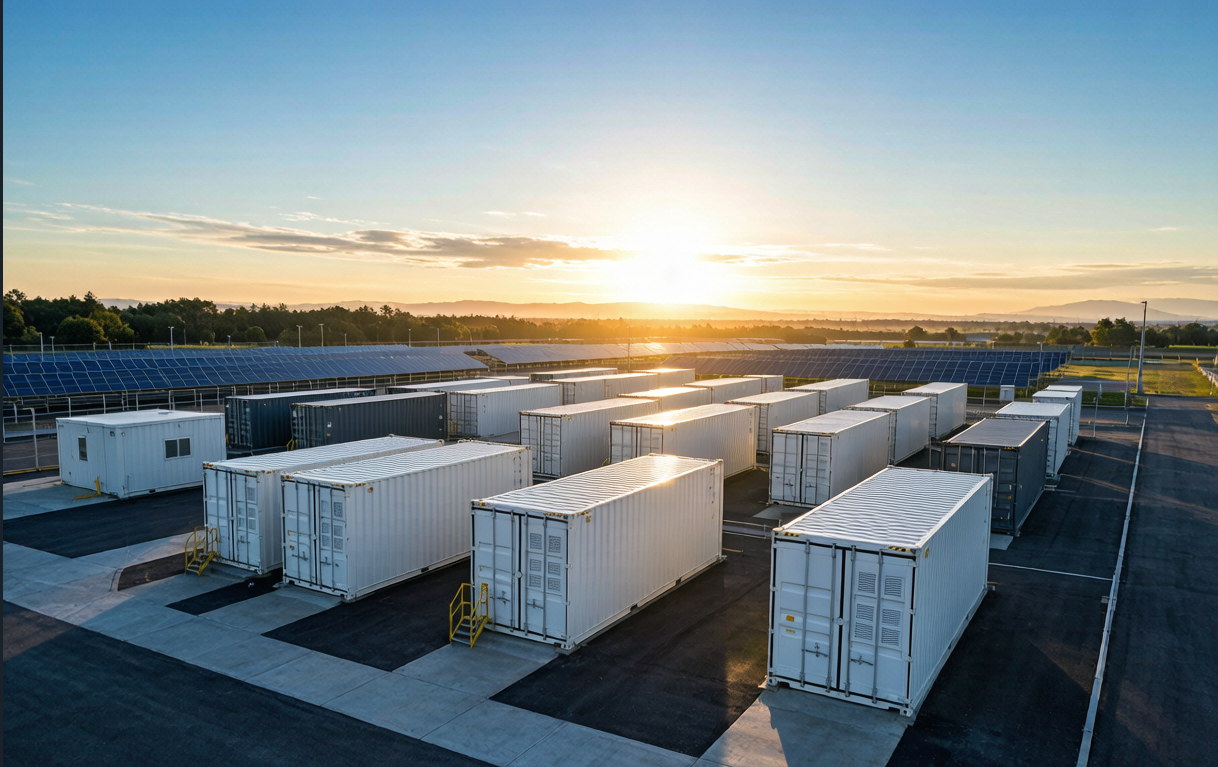
1. Global BESS Market: Record Growth in Numbers
The scale of deployment in 2025-2026 has surpassed even the most optimistic forecasts. Here’s where the market stands at mid-year 2026:
| Metric | 2024 | 2025 | 2026 (Forecast) | Source |
|---|---|---|---|---|
| New battery storage capacity | 77 GW | 108 GW | 145 GW | IEA |
| Total installed energy | 170.6 GWh | 275.3 GWh | ~400 GWh | BNEF |
| Global market value | $52B | $68B | $78.3B | BNEF |
| LFP cell price | $95/kWh | $80/kWh | ~$70/kWh | BNEF |
| C&I share of new deployments | 15% | 18% | ~22% | Wood Mackenzie |
Key takeaway for C&I buyers: Battery cell prices have fallen 40% since 2022, and system-level costs (including BMS, PCS, and enclosure) have dropped correspondingly. A 1 MWh BESS container that cost $600,000 in 2022 now costs $300,000–$500,000 turnkey — finally competitive with diesel generators on a 10-year total cost of ownership basis.
2. Chinese BESS Integrators Dominate: What It Means for Buyers
The Wood Mackenzie report (July 1, 2026) confirms what industry insiders have watched unfold: Chinese BESS integrators have cemented their dominance of the global market.
Global Top 5 BESS Integrators (2025)
| Rank | Manufacturer | HQ | Global Market Share | Key Strength |
|---|---|---|---|---|
| 1 | Tesla | USA | ~11% | Megapack, Autobidder software |
| 2 | Sungrow | China | ~9% | Power conversion + storage, #1 in Europe |
| 3 | BYD | China | ~7% | Vertical integration, cell-to-system |
| 4 | CRRC | China | ~5% | #1 in Asia-Pacific |
| 5 | HyperStrong | China | ~4% | #2 in Asia-Pacific |
Regional Highlights
- Europe: Top 3 are all Chinese (Sungrow, BYD, Huawei), market expanding from UK/Germany/Italy to Bulgaria, Romania, Belgium, Greece
- Middle East: BYD + Sungrow hold a combined 87% market share; UAE has launched 5.2 GW solar paired with 19 GWh storage; Saudi Arabia is procuring 5 GW / 20 GWh in two rounds
- Asia-Pacific: Chinese integrators hold ~85% share; Southeast Asia (Philippines, Vietnam, Indonesia, Thailand, Malaysia) is the fastest-growing sub-region
- North America: Tesla leads, but the OBBBA FEOC compliance rules (55% non-FEOC procurement by 2026, 75% by 2030) are creating barriers for Chinese suppliers
- Latin America: Chile leads with mature regulation; BYD signed 6.5 GWh deal with Grenergy
What This Means for C&I Buyers
If you’re procuring a BESS for a commercial or industrial project in Africa, Southeast Asia, the Middle East, or Latin America, Chinese integrators offer the best combination of price, technology maturity, and supply chain reliability. The competitive landscape among Chinese Tier 1 suppliers also means buyers have more negotiating power than ever.
For projects in North America or Europe, compliance considerations (FEOC, NZIA, EU Battery Regulation) may require careful supplier evaluation — but Chinese manufacturers with localized assembly or certified partners remain viable.
3. C&I Energy Storage: The Fastest-Growing Segment
While utility-scale projects grab headlines, the C&I segment is quietly becoming the fastest-growing BESS category. According to Wood Mackenzie, C&I deployments grew from 15% of new installations in 2024 to 18% in 2025, and are projected to reach 22% in 2026.
Why C&I BESS Is Booming
Three converging forces are driving C&I adoption:
1. Soaring electricity demand charges. In markets across Africa, Southeast Asia, and the Middle East, demand charges account for 30–70% of commercial electricity bills. A BESS performing peak shaving can reduce these charges by 20–40%, delivering payback in 4–7 years.
2. Grid reliability concerns. Industrial facilities in Nigeria, Kenya, South Africa, Pakistan, the Philippines, and Bangladesh face frequent grid outages. Battery backup systems provide seamless power (switchover <20ms) without the noise, emissions, and fuel logistics of diesel generators.
3. Solar PV integration. As solar panel prices continue to fall, more C&I facilities are installing rooftop or ground-mounted PV. Adding battery storage transforms excess daytime solar into usable nighttime energy, achieving 60–90% grid energy offset.
Real Search Demand: What Buyers Are Looking For
Our analysis of 703,974 search terms from Google Ads data reveals exactly what C&I buyers are searching for:
| Search Term Category | Top Queries | Total Impressions | Conversions |
|---|---|---|---|
| Industrial backup power | “industrial backup generator”, “industrial backup power” | 8,700+ | 47 |
| Solar + battery backup | “grid tied solar system with battery backup” | 3,400+ | 44 |
| Off-grid systems | “off grid generator battery system” | 1,300+ | 34 |
| Commercial battery backup | “commercial battery backup systems” | 930+ | 9 |
| BESS systems | “battery energy storage system”, “bess” | 4,500+ | 21 |
| Solar PV + storage | “solar pv battery systems”, “solar battery storage” | 3,800+ | 19 |
The data is clear: buyers are actively searching for integrated solutions that combine solar generation, battery storage, and backup power — not standalone products.
4. Regional Hotspots: Where C&I BESS Demand Is Surging
Africa: Entering the GWh Era
Africa’s C&I energy storage market crossed the GWh threshold in 2026, according to industry reports. Key drivers:
- South Africa: Multiple large-scale solar + storage projects going live, addressing chronic load-shedding
- Nigeria, Kenya, Uganda, Ghana: Strong demand for off-grid solar + battery systems, telecom tower solarization
- Egypt, Morocco: Arabic-language searches for solar companies and storage solutions are growing rapidly
Search data confirms this momentum: “solar panel prices in uganda” generated 697 impressions and 9 conversions, while “lithium battery price in kenya” and “solar panels prices in kenya” show consistent buyer intent across East Africa.
Southeast Asia: The New Growth Frontier
Wood Mackenzie identifies Southeast Asia as a critical growth market, with the Philippines, Vietnam, Indonesia, Thailand, and Malaysia all advancing regulatory frameworks for energy storage.
Search data reveals specific demand: – Philippines: “hybrid off grid inverter philippines” (159 impr / 3 conv), “solar battery price philippines” (159 impr) – Indonesia: “pt unified advanced battery system indonesia” (161 impr total) – Bangladesh: “solar battery price in bangladesh”, “solar panel price in bangladesh”, “solar inverter price in bangladesh” — consistent buyer-intent queries
Middle East: Mega Projects Driving Market Transformation
The Middle East has entered an era of ultra-large-scale BESS procurement:
| Project | Country | Capacity | Status |
|---|---|---|---|
| UAE Solar + Storage Program | UAE | 5.2 GW PV + 19 GWh BESS | Procurement |
| Saudi Round 1 + 2 | Saudi Arabia | 5 GW + 20 GWh | Tendering |
| Aruküla BESS | Estonia | 100 MW | Operational (July 8, 2026) |
For C&I buyers in the region, the mega-projects create a halo effect: local supply chains, certified installers, and regulatory frameworks are all maturing rapidly, making it easier and cheaper to deploy smaller-scale C&I systems.
5. Technology Trends Shaping C&I BESS in 2026
LFP Chemistry Dominance
Lithium iron phosphate (LFP) has decisively won the chemistry war for stationary storage. With cell prices below $80/kWh and cycle life exceeding 6,000–10,000 cycles, LFP offers the best combination of safety, longevity, and cost for C&I applications. The thermal runaway threshold of ~270°C (vs ~210°C for NMC) makes LFP the clear choice for indoor and outdoor cabinet installations.
Containerized BESS: The Preferred Form Factor
The BESS container — a complete storage system inside a standard 10ft, 20ft, or 40ft shipping container — has become the dominant deployment format for medium-to-large C&I projects. Benefits include:
- Rapid deployment: Pre-assembled and tested at the factory, commissioned in 1–2 weeks
- Scalability: Parallel multiple containers from 500 kWh to 20+ MWh
- Global transportability: Standard ISO containers ship anywhere
- Lower installation cost: No custom building construction required
For smaller C&I applications (<500 kWh), outdoor battery cabinets remain the preferred option, offering compact footprint and flexible placement.
Grid-Forming Inverters: The New Differentiator
Wood Mackenzie’s report highlights grid-forming capability as a key competitive differentiator among BESS integrators. Unlike traditional grid-following inverters, grid-forming inverters can establish voltage and frequency independently — enabling BESS to support microgrids, islanded operation, and weak grid scenarios common in Africa and Southeast Asia.
For C&I buyers in regions with unstable grids, grid-forming BESS is becoming an essential feature rather than a nice-to-have.
AI-Driven Energy Management
The convergence of BESS with artificial intelligence is accelerating. Modern EMS platforms now use machine learning to:
- Forecast solar generation and load patterns
- Optimize charge/discharge schedules in real-time
- Participate in demand response and virtual power plant (VPP) programs
- Predict battery degradation and schedule maintenance
This intelligence layer is what transforms a battery from a simple backup device into a revenue-generating asset.
6. Cost Update: What C&I BESS Costs in Mid-2026
Battery cell prices have continued their downward trajectory, bringing system-level costs to new lows:
| BESS Capacity | Form Factor | Turnkey Price Range | Price per kWh |
|---|---|---|---|
| 100 kWh | Outdoor cabinet | $25,000–$45,000 | $250–$450 |
| 200 kWh | Outdoor cabinet | $45,000–$80,000 | $225–$400 |
| 500 kWh | 10ft container | $120,000–$200,000 | $240–$400 |
| 1 MWh | 20ft container | $300,000–$500,000 | $300–$500 |
| 5 MWh | 40ft container | $1,400,000–$2,200,000 | $280–$440 |
Payback periods vary by application and region:
| Application | Typical Payback | Key Revenue/Savings |
|---|---|---|
| Peak shaving (demand charge reduction) | 4–7 years | 20–40% bill reduction |
| Solar self-consumption optimization | 3–5 years | 60–90% grid offset |
| Backup power (replacing diesel) | 5–8 years | Fuel + maintenance savings |
| Off-grid solar + battery | 3–6 years | Eliminates diesel entirely |
7. How to Choose a C&I BESS Supplier in 2026
With the market evolving rapidly, here’s an updated checklist for C&I buyers:
1. Verify Tier 1 Status and Certifications
- BloombergNEF Tier 1 classification (requires 6+ projects >1MW operational for 2+ years)
- Certifications matching your market: UL9540/UL9540A (North America), IEC62619 (international), CE (Europe), UN38.3 (transport)
- Fire safety compliance: NFPA 855 (US), local equivalents
2. Evaluate Grid-Forming Capability
- Can the BESS operate in island mode during grid outages?
- Does the inverter support black start?
- Is the system certified for weak grid conditions?
3. Assess EMS Software Sophistication
- Does the EMS support TOU arbitrage, peak shaving, and demand response simultaneously?
- Can it integrate with solar PV forecasts and building management systems?
- Is there a mobile app or web dashboard for remote monitoring?
4. Check Regional Compliance
- North America: FEOC compliance under OBBBA (55% non-FEOC by 2026)
- Europe: NZIA and EU Battery Regulation compliance
- Middle East/Africa/Asia: Verify local certification requirements and import regulations
5. Confirm Warranty and Service
- Minimum 10-year warranty with 70–80% capacity retention
- Local service partner or remote diagnostics capability
- Spare parts availability in your region
6. Compare Total Cost of Ownership
- Not just upfront price — include installation, grid connection, maintenance, and end-of-life recycling
- Ask for a 10-year TCO comparison with diesel generator alternatives
Frequently Asked Questions (FAQ)
Q1: How big is the global BESS market in 2026?
The global battery energy storage market is expected to reach approximately $78.3 billion by the end of 2026, with total installed capacity surpassing 400 GWh. In 2025, 108 GW of new capacity was deployed — a 40% year-over-year increase, according to the IEA Global Energy Review 2026.
Q2: How much does a commercial battery storage system cost in 2026?
A 1 MWh BESS container costs approximately $300,000–$500,000 turnkey in mid-2026. Smaller systems (100 kWh outdoor cabinets) start from $25,000–$45,000. LFP cell prices have dropped below $80/kWh, down 40% since 2022.
Q3: Why do Chinese manufacturers dominate the BESS market?
Chinese BESS integrators captured 76% of the global market in 2025 (Wood Mackenzie, July 2026), driven by China’s control of 80%+ of global LFP cell production, mature supply chains, competitive pricing (20–40% lower than Western brands), and proven large-scale deployment experience.
Q4: What is the payback period for a C&I BESS?
Typical payback periods are 4–7 years for peak shaving, 3–5 years for solar self-consumption optimization, and 5–8 years for backup power replacing diesel generators. In regions with high demand charges or expensive diesel (Africa, islands, remote areas), payback can be as short as 3 years.
Q5: Should I choose a BESS container or an outdoor cabinet?
Choose a cabinet for applications under 500 kWh (small commercial, telecom towers, distributed sites). Choose a container for applications over 500 kWh (medium-to-large C&I, microgrids, utility-scale). Containers offer faster deployment, easier scalability, and lower installation costs per kWh.
Q6: Is LFP or NMC better for commercial energy storage?
LFP (Lithium Iron Phosphate) is strongly recommended for C&I applications. It offers higher safety (thermal runaway at ~270°C vs ~210°C for NMC), longer cycle life (6,000–10,000 vs 2,000–3,000 cycles), lower cost (~$80/kWh vs ~$110/kWh), and better high-temperature performance — critical for deployments in Africa, the Middle East, and Southeast Asia.
Planning a C&I Energy Storage Project?
Huijue Group manufactures containerized and cabinet BESS solutions from 100 kWh to 5 MWh+, using Tier 1 LFP cells with full certifications (UL9540, IEC62619, UN38.3, CE). Our systems feature grid-forming inverters, AI-driven EMS, and 10-year warranty — deployed across Africa, Southeast Asia, the Middle East, and Europe.
Contact our engineering team for a custom BESS sizing analysis, ROI calculation, and competitive quote tailored to your facility’s energy profile and regional requirements.