
 chinahuijue@gmail.com
 +1 (702) 204-9855
Complete Solar Power Systems: 2026 Cost Guide, Components & Sizing for Homes and Businesses
By Huijue Group Engineering Team | Updated July 2026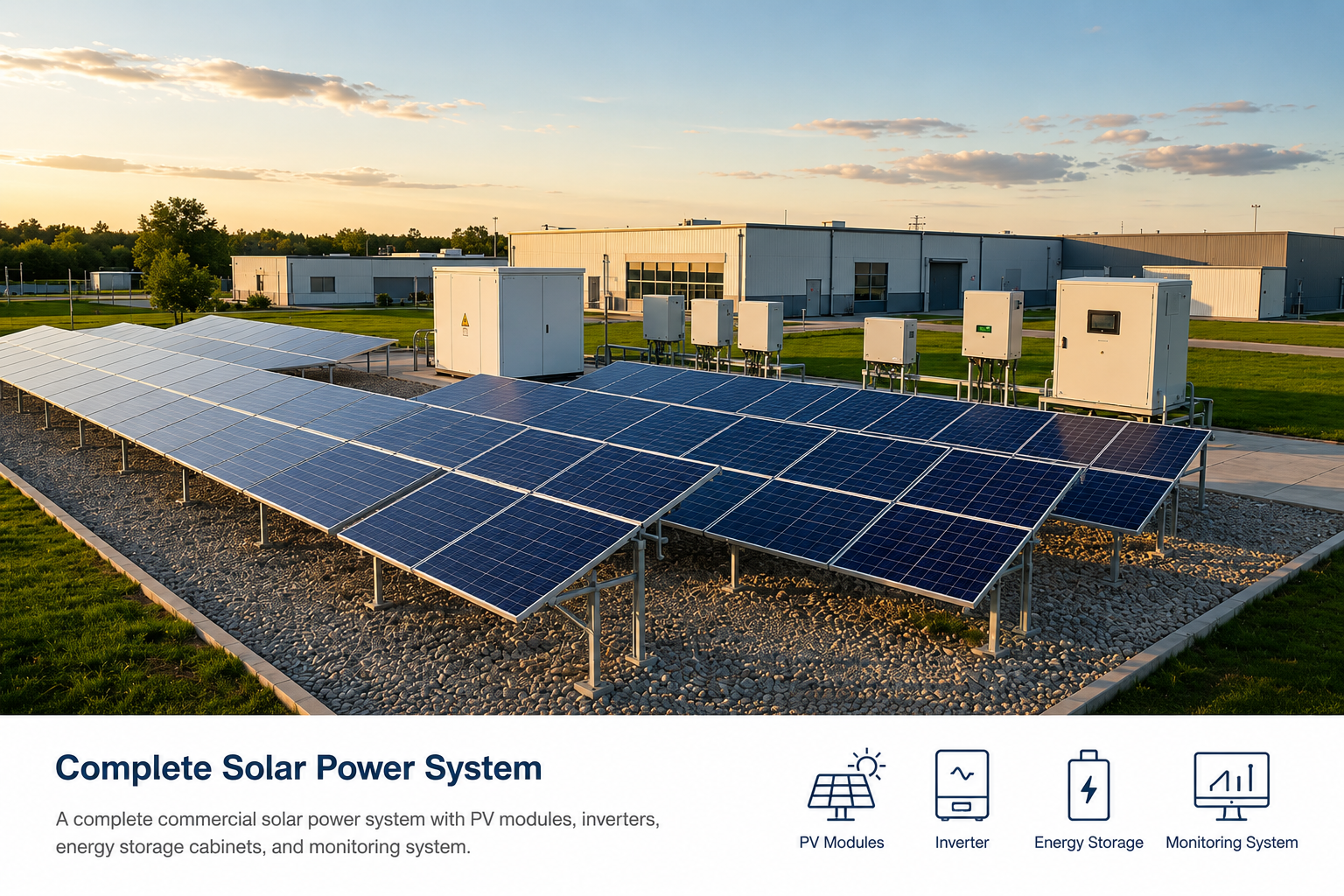
Solar power systems have become the most cost-effective energy solution for homes and businesses across the globe. Whether you’re a homeowner in Lagos looking to escape diesel generator costs, a factory manager in Bulgaria trying to cut peak-demand charges, or a telecom operator in Sudan needing reliable off-grid power — the question is the same: How much does a complete solar power system actually cost, and how do you size it correctly?
As a manufacturer that designs and ships solar-plus-storage systems to over 30 countries, we’ve seen what works and what doesn’t. This guide breaks down real 2026 pricing, component selection, sizing methodology, and deployment cases from our actual projects across Africa, Europe, and North America.
Quick Answer: 2026 Solar Power System Costs at a Glance
| System Type | Capacity Range | Cost (USD/W) | Typical Total Cost | Payback Period |
|---|---|---|---|---|
| Residential (Off-Grid) | 3-10 kW | $0.80-$2.00 (Africa) | $700-$15,000 | 1-5 years |
| Residential (Grid-Tied) | 5-15 kW | $2.50-$3.50 (US/EU) | $12,000-$45,000 | 8-12 years |
| Commercial Hybrid | 50-500 kW | $0.80-$1.50 | $40,000-$600,000 | 2-4 years |
| Utility/Container | 1-5 MW | $0.60-$1.00 | $600,000-$5M | 3-6 years |
Key takeaway: In diesel-dependent markets like Nigeria and Sudan, payback can be under 18 months. In grid-stable regions like Germany or the US, the math depends more on demand charge avoidance and self-consumption ratios.
What Is a Complete Solar Power System?
A complete solar power system is an integrated energy solution that captures sunlight, converts it to usable electricity, stores excess energy for later use, and manages power flow between generation, storage, and consumption. The word “complete” matters here — many buyers purchase panels and inverters separately, only to discover they’re missing critical components like battery management systems, surge protection, or proper cabling.
In our experience shipping containerized solar systems to Sudan, Ukraine, and Bosnia, the difference between a “kit” and a “complete system” often determines whether the deployment succeeds or fails in year two. A complete system includes every component needed from the panel to the wall outlet, pre-configured and tested before shipment.
Core Components of a Solar Power System
1. Solar Panels (PV Modules)
The foundation of any solar power system. In 2026, TOPCon (Tunnel Oxide Passivated Contact) panels dominate the market, offering 580W-730W per module at efficiencies exceeding 22%. Panel prices have hit historic lows — approximately $0.14-$0.30 per watt at factory gate in China, though final installed costs are 5-15× higher due to balance-of-system and labor.
For commercial and industrial applications, we recommend bifacial TOPCon modules (615W-730W) that capture reflected light from the ground, boosting yield by 5-15% depending on surface albedo. Our standard deployments use 580W-730W double-sided panels sourced from Tier 1 manufacturers.
2. Inverter (String, Micro, or Hybrid)
The inverter converts DC power from panels into AC power for your appliances. Three types dominate:
| Type | Best For | Cost Range | Efficiency |
|---|---|---|---|
| String Inverter | Grid-tied, uniform roofs | $0.25-$0.45/W | 97-98% |
| Microinverter | Complex roofs, shading | $0.40-$0.60/W | 96-97% |
| Hybrid Inverter | Solar+storage systems | $0.35-$0.55/W | 97-98% |
For systems with battery storage — which is most of what we deploy in Africa and emerging markets — hybrid inverters are the clear choice. They manage both solar input and battery charging/discharging in one unit, reducing complexity and cost.
3. Battery Storage System
This is where the solar industry has changed most dramatically. Lithium iron phosphate (LFP/LiFePO4) batteries have become the default choice, offering 6,000+ cycles at 80% depth of discharge. Over a 10-year period, LFP total cost of ownership is approximately 44% lower than lead-acid, despite costing 2-3× more upfront.
LFP vs. Lead-Acid: 10-Year Cost Comparison (Nigeria, 10kWh storage)
| Option | Initial Cost | Replacements (10yr) | Total 10-Year Cost |
|---|---|---|---|
| Gel/AGM Lead-Acid | $1,300 | 3× ($3,900 + $190 labor) | ~$5,390 |
| LFP (LiFePO4) | $3,000 | 0 | ~$3,000 |
Source: Market data from Jiji Nigeria, SolarQuest Kenya, BloombergNEF Q1 2026
4. Charge Controller (MPPT)
Maximum Power Point Tracking (MPPT) controllers optimize the power harvest from solar panels, especially under variable weather conditions. Modern MPPT controllers achieve 98-99% tracking efficiency, extracting 20-30% more energy than older PWM controllers. For systems above 3kW, MPPT is non-negotiable.
5. Mounting Structures
Often overlooked but critical for system longevity. Ground-mounted systems use galvanized steel or aluminum structures rated for 120+ km/h wind loads. Roof-mounted systems require proper waterproofing and structural assessment. In our containerized solar deployments, mounting is pre-installed inside the container, reducing on-site construction time from weeks to hours.
6. Balance of System (BOS)
Cables, breakers, surge protection devices (SPD), DC disconnects, MC4 connectors, and monitoring equipment. BOS typically adds 15-25% to total equipment cost — a figure that surprises first-time buyers. In our complete systems, all BOS components are pre-sized, pre-cut, and labeled to eliminate guesswork during installation.
7. Energy Management System (EMS)
The brain of a modern solar power system. An EMS monitors generation, storage, and consumption in real-time, optimizing when to charge batteries, when to sell to the grid, and when to draw from storage. For commercial customers, EMS can reduce electricity bills by an additional 10-20% through peak shaving and load shifting.
Types of Solar Power Systems
Grid-Tied Systems
The simplest and cheapest option — panels connect to an inverter that syncs with the utility grid. Excess power flows back to the grid (net metering). No batteries needed. Best for regions with stable grids and favorable net-metering policies like Germany, Bulgaria, and parts of the US.
Limitation: Zero backup power. When the grid goes down, so does your system (anti-islanding safety requirement).
Off-Grid Systems
Completely independent from the utility grid. Requires battery storage sized for 2-3 days of autonomy. Essential for remote sites — telecom towers, rural clinics, mining operations. Our Sudan and Ukraine deployments are off-grid systems designed for areas where grid infrastructure doesn’t exist or is chronically unreliable.
Cost premium: 30-50% more than grid-tied, primarily due to battery bank sizing.
Hybrid Systems
The fastest-growing category. Hybrid systems connect to the grid but include battery storage for backup power and peak shaving. During normal operation, they optimize self-consumption; during outages, they seamlessly switch to battery power. This is what we recommend for most commercial customers in Africa and Eastern Europe.
How Much Does a Solar Power System Cost in 2026?
Solar power system costs vary dramatically by region, system type, and scale. Here’s a detailed breakdown based on our deployment data and market research across three key regions.
Cost in Africa (Nigeria, Kenya, Uganda, Sudan)
Africa represents the fastest-growing solar market, driven by expensive diesel generation and unreliable grids. Nigeria installed 803 MW of new solar capacity in 2025 — a 141% increase year-over-year, making it Africa’s second-largest solar market after South Africa (BusinessDay, 2026).
| System Size | Nigeria (USD) | Kenya (USD) | Uganda (USD) | Payback |
|---|---|---|---|---|
| 1.5-2.5 kVA (Basic Home) | $406-$1,313 | $769-$3,077 | $500-$1,500 | 4-7 years |
| 3.5-5 kVA (Full Home) | $688-$2,250 | $2,308-$6,154 | $1,200-$3,500 | 3-6 years |
| 5-10 kVA (Large Home/Small Biz) | $1,063-$2,688 | $3,846-$11,538 | $2,000-$6,000 | 3-5 years |
| 50 kW Commercial | $40,000-$75,000 | $40,000-$75,000 | $35,000-$65,000 | 2-4 years |
Sources: Jiji Nigeria, SolarQuest Kenya, solartoafrica.com market data, Huijue project records
Why is payback so fast in Nigeria? A Lagos household spending ₦180,000/month ($113) on generator fuel can replace it with a $1,750 solar system — paying back in just 15.6 months. Diesel at $1.20-$1.80/liter in many African countries makes solar the cheapest electricity source by a wide margin.
Cost in Europe (Germany, Bulgaria, Bosnia)
European solar costs are higher per watt due to labor, permitting, and component quality standards. However, strong policy support and high retail electricity prices ($0.30-$0.45/kWh) make solar economically attractive.
| System Size | Germany (EUR) | Bulgaria (EUR) | Bosnia (EUR) | Payback |
|---|---|---|---|---|
| 5 kW Residential | €12,000-€16,000 | €8,000-€12,000 | €7,000-€10,000 | 7-10 years |
| 10 kW Residential | €22,000-€30,000 | €15,000-€22,000 | €13,000-€18,000 | 6-9 years |
| 100 kW Commercial | €80,000-€120,000 | €60,000-€90,000 | €50,000-€75,000 | 5-7 years |
| 1 MW Utility | €600,000-€800,000 | €450,000-€650,000 | €400,000-€550,000 | 6-8 years |
Source: SolarDataAtlas CAPEX Europe 2026, range €460-€1,620/kWp by segment
European incentives vary significantly. Germany offers KfW loans and feed-in tariffs. Bulgaria provides net metering for systems under 5 MW. Bosnia’s regulatory framework is less developed but offers lower installation costs. Our Bulgaria and Bosnia projects (detailed below) demonstrate how commercial solar-plus-storage achieves 5-7 year payback in these markets.
Cost in the United States
The US market saw a significant shift in 2026. The federal Investment Tax Credit (ITC), which provided 30% off system costs, expired at the end of 2025. This increased net costs by approximately 43% for residential systems.
| System Size | Cost (Pre-Incentive) | Cost Per Watt | Annual Savings | Payback |
|---|---|---|---|---|
| 6 kW | $18,600 | $3.10/W | $1,497 | ~12.5 years |
| 8 kW | $24,800 | $3.10/W | $1,995 | ~12.5 years |
| 10 kW | $31,000 | $3.10/W | $2,493 | ~12.5 years |
| 50 kW Commercial | $75,000-$120,000 | $1.50-$2.40/W | $8,000-$15,000 | 5-8 years |
Source: TheGreenWatt, ConsumerAffairs, NLR Solar Market Research (June 2026)
US Tax Credit Update: The 30% federal ITC expired December 31, 2025. An 8 kW system that cost $17,360 after credit in 2024 now costs $24,800 — pushing payback from ~9 years to ~12.5 years. State-level incentives (California SGIP, New York NY-Sun) still apply but vary widely.
Solar Power System Sizing Guide
Proper sizing is the single most important factor in system performance and ROI. An undersized system won’t meet your needs; an oversized system wastes money. Here’s our engineering team’s methodology, refined across hundreds of deployments.
Step 1: Calculate Daily Energy Consumption
List every appliance, its wattage, and daily run hours. For residential systems in Africa, a typical breakdown looks like:
| Appliance | Wattage | Hours/Day | Daily Wh |
|---|---|---|---|
| LED Lights (×8) | 10W each | 6 | 480 Wh |
| Ceiling Fans (×3) | 75W each | 10 | 2,250 Wh |
| Refrigerator | 150W | 24 (cycling) | 1,800 Wh |
| TV (LED 43″) | 70W | 5 | 350 Wh |
| Washing Machine | 500W | 1 | 500 Wh |
| WiFi Router | 10W | 24 | 240 Wh |
| Total | 5,620 Wh (5.6 kWh/day) |
Step 2: Size the Solar Array
Divide daily consumption by local peak sun hours (PSH). In Nigeria, average PSH is 4.5-5.5 hours; in Germany, 3.0-3.5 hours; in Sudan, 6.0-6.5 hours.
Array Size (kW) = Daily Consumption (kWh) ÷ PSH × 1.25 (system loss factor)
Example: 5.6 kWh ÷ 5.0 PSH × 1.25 = 1.4 kW minimum array
For this African household, we’d specify a 2 kW array (4× 500W panels) to provide margin for cloudy days and future expansion.
Step 3: Size Battery Storage
For off-grid systems, size batteries for 2-3 days of autonomy. For hybrid systems, 1 day is usually sufficient.
Battery Capacity (kWh) = Daily Consumption × Days of Autonomy ÷ DoD × Inverter Efficiency
Example: 5.6 kWh × 2 days ÷ 0.80 (LFP DoD) ÷ 0.95 = 14.7 kWh battery bank
We’d round up to a standard 15 kWh LFP battery configuration, such as our 50kWh outdoor cabinet for commercial applications or modular 5.12 kWh stacking batteries for residential use.
Step 4: Size the Inverter
Inverter capacity should handle the maximum simultaneous load plus a 20-30% safety margin. If all appliances might run at once (3,200W peak), specify a 5 kVA hybrid inverter minimum.
Solar + Storage: Why Battery Backup Matters
The solar power system market has shifted fundamentally. Five years ago, batteries were optional — a luxury add-on for off-grid enthusiasts. In 2026, they’re essential. Here’s why:
Grid reliability: In Nigeria, the national grid experienced 206 partial and total collapses between 2010 and 2024. In Bosnia, winter ice storms regularly knock out power for days. Battery storage isn’t just about saving money — it’s about keeping the lights on.
Demand charge management: Commercial customers in the US and Europe pay demand charges based on peak 15-minute usage. A solar-only system might not align with peak demand, but solar-plus-storage can shave peaks by 30-50%, directly reducing demand charges that often account for 30-60% of commercial electric bills.
Self-consumption optimization: Without storage, excess solar generation flows back to the grid at wholesale rates (often 30-50% of retail). With storage, that energy is retained for evening use, displacing retail-rate purchases. In Germany, where feed-in tariffs have dropped below retail rates, self-consumption is the only path to positive ROI.
Our energy storage product line spans from 5 kWh residential stacking batteries to 6.25 MWh container systems, covering the full spectrum of solar-plus-storage applications.
Residential Solar Power Systems
The “home solar system” keyword cluster generated over 180 inquiries in our Google Ads account — making it the single largest demand category. Here’s what homeowners need to know.
Africa: Escaping Generator Costs
In Lagos, a typical 3-bedroom household runs a 5-8 kVA diesel generator for 8-12 hours daily, consuming 4-8 liters of diesel at $1.20-$1.50/liter. Monthly fuel cost: $288-$720. A 5 kVA hybrid solar system with 10 kWh LFP storage costs approximately $1,750-$3,500 installed — paying back in 12-24 months.
Our recommended residential configuration for African homes:
| Component | Specification | Purpose |
|---|---|---|
| PV Array | 3-6 kW (6-12× 580W panels) | Daily generation |
| Hybrid Inverter | 5 kVA, 48V | Power conversion + battery management |
| LFP Battery | 10-15 kWh | 1.5-2 days autonomy |
| MPPT Controller | 80A-100A | Maximum power harvest |
| EMS | WiFi-enabled | Remote monitoring |
Europe: Self-Consumption and Energy Independence
European residential solar is driven by high retail electricity prices (€0.30-€0.45/kWh) and declining feed-in tariffs. The strategy here is maximizing self-consumption — using as much of your own solar generation as possible rather than selling it back to the grid at low rates.
A 10 kW system with 15 kWh battery storage in Germany can achieve 60-70% self-sufficiency, reducing annual electricity bills by €1,200-€1,800. With system costs of €22,000-€30,000, payback runs 7-10 years — well within the 25-year panel warranty period.
United States: Navigating Post-ITC Reality
With the federal tax credit gone, US homeowners need to be more strategic. The best ROI now comes from: (1) states with strong net metering (California NEM 3.0 requires batteries), (2) utility territories with high time-of-use rate differentials, and (3) areas with frequent outages where battery backup adds insurance value.
Commercial & Industrial Solar Power Systems
Commercial solar is where the economics shine brightest. Larger scale means lower cost per watt, and commercial electricity rates include demand charges that solar-plus-storage can directly address. Our project portfolio includes deployments from 5 kW to 94 MW — here’s what we’ve learned.
Industrial Solar Power System: The 100-500 kW Sweet Spot
For factories, warehouses, and commercial buildings, the 100-500 kW range offers the best ROI. At this scale, system costs drop to $0.80-$1.50/W installed, and demand charge savings alone can justify the investment.
Our commercial system architecture typically includes:
- PV Array: 100-500 kW TOPCon bifacial panels
- Hybrid Inverter: 50-250 kW, 3-phase, grid-synchronized
- Energy Storage: 100-500 kWh LFP cabinet system (e.g., our 215kW/418kWh outdoor cabinet)
- EMS: Cloud-based platform with peak shaving, load shifting, and demand response
- STS (Static Transfer Switch): Seamless grid-to-battery switching for critical loads
Containerized Solar Systems: Plug-and-Play Deployment
For remote sites, mining operations, and rapid deployment scenarios, containerized solar systems offer a compelling alternative to traditional installation. Our folding-container solar systems (20-foot and 40-foot) arrive pre-wired, pre-tested, and ready to deploy within hours of delivery.
Real-World Case Studies
Case 1: Sudan — 129.6 kWp / 450 kWh Folding Container System
Location: Sudan | System: 40-foot folding PV + storage container
This deployment serves an industrial facility in Sudan where grid power is intermittent and diesel generation was the primary energy source. The system integrates a 129.6 kWp photovoltaic array with 450 kWh LFP battery storage in a single transportable container.
Key components: Folding PV modules, integrated solar-plus-storage inverter, LFP battery system, intelligent EMS. The system operates in self-consumption mode, with excess energy stored in batteries for nighttime use — reducing diesel generator runtime by approximately 70%.
Result: Estimated annual diesel savings of 45,000-60,000 liters, translating to $54,000-$72,000/year at 2026 Sudan diesel prices. System payback: under 3 years.
Case 2: Bulgaria — 100 kW / 215 kWh Solar-Plus-Storage
Location: Bulgaria | System: Commercial rooftop + outdoor storage cabinet
A Bulgarian commercial facility needed to reduce peak demand charges and gain energy independence from an aging grid. The system features a 100 kW solar array paired with a 215 kWh outdoor energy storage cabinet, managed by multiple energy strategies including self-consumption, excess feed-in, peak shaving, and off-grid backup.
Key components: PV inverter, PCS (Power Conversion System), STS (Static Transfer Switch), MPPT controller, BMS, air conditioning, smart meter.
Result: The system implements multiple energy management strategies — self-consumption, grid feed-in, peak shaving, and off-grid backup — reducing grid electricity purchases by 55-65% annually.
Case 3: Ukraine — 46 kWp / 50 kWh Folding Container
Location: Ukraine | System: 20-foot folding PV container
Deployed in a region where grid infrastructure has been severely damaged, this system provides reliable power for community facilities and critical services. The containerized design allows rapid redeployment if security conditions change.
Key components: PV modules, mounting system, energy storage, integrated inverter, lightning protection, EMS.
Result: Provides 40-60 kWh/day of reliable electricity for essential services — medical facilities, communication equipment, and emergency operations — in a region where grid power is unavailable.
Case 4: Bosnia — 1 MW / 2 MWh Integrated Solar-Plus-Storage
Location: Bosnia and Herzegovina | System: Container-scale BESS + solar
Our largest European deployment to date. A 2 MW / 4 MWh containerized energy storage system paired with solar generation, featuring container-level fire suppression (Novec/Perfluorohexanone system), combustible gas detection, and cloud-based intelligent monitoring.
Key advantages: High system maturity, safety reliability, low LCOS (Levelized Cost of Storage), long cycle life, and strong environmental adaptability.
Result: The system provides grid stability services, peak shaving, and renewable integration for a utility-scale application — demonstrating that containerized solar-plus-storage is viable at the megawatt scale.
Case 5: United States — 5 kWp Mobile Emergency Power
Location: United States | System: Containerized solar + storage cabinet
A North American client required mobile emergency power for temporary construction sites and disaster response. The system combines a 5 kWp solar array with an energy storage cabinet and EMS in a compact, transportable format.
Result: Provides silent, emission-free power for construction sites and emergency response — replacing diesel generators that required fuel logistics and produced noise and emissions.
All case studies above are documented on our project case page with technical specifications and deployment details.
How to Choose a Solar Power System Supplier
The solar supplier landscape is crowded, and not all manufacturers are equal. Based on our experience — and feedback from distributors across 30+ countries — here’s what matters:
1. Manufacturing vs. Trading
Many “solar system suppliers” are trading companies that buy components from various manufacturers and resell them. As a manufacturer with our own production facilities, we control quality at every stage — from battery cell selection to final system testing. This matters when something goes wrong (and eventually, something always does).
2. Solution Design Capability
Selling components is easy; designing a complete system that works reliably for 10+ years is hard. Look for suppliers who employ engineers, not just salespeople. We provide load analysis, system sizing, and electrical diagrams for every project — because a properly designed system from day one saves $10,000-$50,000 in avoided failures over its lifetime.
3. After-Sales Support
24-hour technical response: Solar systems don’t break during business hours. Our support team responds to technical inquiries within 24 hours globally, with remote diagnostics via cloud-connected EMS.
Warranty: Standard warranty is 5 years on batteries, 10 years on inverters, 25 years on panels. Premium LFP batteries carry 10-year warranties with 6,000+ cycle guarantees.
Local service coverage: We maintain service partners across Africa (Nigeria, Kenya, South Africa), Europe (Germany, Bulgaria), and the Middle East.
4. Certifications and Compliance
Verify that products carry relevant certifications: IEC 61215/61730 (panels), IEC 62109 (inverters), UN38.3 (battery transport), CE (Europe), UL (US). Third-party certifications from IEC, BloombergNEF Tier 1, and IEA benchmarks provide independent quality assurance.
ROI and Payback Period Analysis by Region
Return on investment depends on three variables: system cost, energy offset value, and incentives. Here’s our analysis based on deployment data and market research.
| Region | Scenario | Monthly Energy Cost Before | System Cost | Payback Period |
|---|---|---|---|---|
| Nigeria | Home replacing diesel generator | $113/month | $1,750 | 15.6 months |
| Kenya | Home, hybrid system | $138/month | $4,615 | 33 months |
| Ghana | Small business | $533/month | $8,000 | 15 months |
| South Africa | Home, grid + backup | $178/month | $10,000 | 56 months |
| Germany | Home, self-consumption | €150/month | €25,000 | 7-9 years |
| USA | Home, post-ITC | $166/month | $24,800 | 12.5 years |
| Bulgaria | Commercial 100kW | €2,500/month | €60,000 | 5-6 years |
| Sudan | Industrial 129kWp | $5,000/month (diesel) | $120,000 | 2-3 years |
Sources: Huijue project data, solartoafrica.com, TheGreenWatt, SolarDataAtlas Europe
2026 Solar Industry Trends Affecting Your Purchase Decision
Several developments in 2026 should influence your solar power system purchase timing and design:
1. Panel prices have bottomed. After dropping 90%+ over 15 years, module prices stabilized at $0.14-$0.30/W in early 2026. Some manufacturers have raised prices slightly due to China’s production capacity adjustments. Waiting for further price drops is no longer a winning strategy.
2. Battery costs continue declining. LFP cell prices fell to $60-$75/kWh in Q1 2026 (BloombergNEF), down from $140/kWh in 2023. This makes solar-plus-storage economically viable in markets where it wasn’t just two years ago.
3. US ITC expiration reshapes the market. Without the 30% federal tax credit, US residential solar payback periods have extended by 3-4 years. Commercial systems with demand charge management and accelerated depreciation still offer strong returns.
4. Africa emerges as the growth market. Nigeria’s 803 MW of new solar in 2025 (BusinessDay) signals a structural shift. With diesel at $1.20-$1.80/liter and grids that collapse regularly, solar-plus-storage isn’t just an environmental choice — it’s the only economically rational option.
Frequently Asked Questions
How much does a complete solar power system cost in 2026?
A complete residential solar power system costs $2.50-$3.50 per watt in the US (8kW system: $20,000-$28,000). In Africa, costs range from $0.80-$2.00/W for residential systems. Commercial systems cost $0.80-$1.50/W globally. Prices have dropped over 60% since 2010, though panel prices stabilized in 2026.
What components are included in a complete solar power system?
A complete solar power system includes solar panels (PV modules), an inverter (string, micro, or hybrid), a battery storage system (LFP preferred), a charge controller (MPPT), mounting structures, balance of system components (cables, breakers, surge protection), and an energy management system (EMS).
How long does it take for a solar power system to pay for itself?
Payback periods vary by region: 1-2 years in Nigeria (replacing diesel generators), 3-5 years in East Africa, 4-7 years in Europe, and 8-12 years in the US. Commercial systems typically pay back in 2-4 years due to scale economies and demand charge reduction.
What size solar power system do I need for my home?
For a typical household using 900-1,200 kWh/month, a 6-8 kW solar system with 10-15 kWh battery storage is sufficient. In Africa, a 3-5 kVA system covering lights, TV, refrigerator, and fans costs $700-$2,250 installed. Commercial facilities should size based on peak demand and daily consumption patterns.
Should I choose grid-tied, off-grid, or hybrid solar power system?
Grid-tied systems are cheapest but provide no backup power. Off-grid systems cost 30-50% more but offer complete energy independence. Hybrid systems combine grid connection with battery storage, offering the best of both worlds. In regions with unreliable grids (Africa, parts of Eastern Europe), hybrid or off-grid systems are recommended.
Is LFP or lead-acid battery better for solar power systems?
LFP (lithium iron phosphate) batteries last 10-15 years with 6,000+ cycles, while lead-acid batteries need replacement every 3-5 years. Over 10 years, LFP total cost is 44% lower than lead-acid despite higher upfront cost. LFP also offers better thermal stability and safety.
Key Takeaways
- Solar power systems cost $0.80-$3.50/W depending on region, scale, and system type — Africa is cheapest, US is most expensive
- Africa offers the fastest payback — 12-24 months when replacing diesel generators in Nigeria, Sudan, and similar markets
- LFP batteries are the clear choice — 44% lower 10-year cost than lead-acid, with 6,000+ cycle life
- Hybrid systems dominate — combining grid connection with battery storage offers the best ROI in most markets
- Containerized systems enable rapid deployment — our Sudan, Ukraine, and Bosnia projects demonstrate plug-and-play solar-plus-storage at scales from 5 kWp to 2 MW
- System sizing is critical — proper load analysis and PSH calculations prevent costly over- or under-sizing
- US ITC expiration changed the math — without 30% tax credit, US residential payback extended to ~12.5 years
- Choose a manufacturer, not a trader — solution design capability and after-sales support matter more than the lowest sticker price