
 chinahuijue@gmail.com
 +1 (702) 204-9855
How Does a Commercial Battery Energy Storage System Work? BESS Operation Modes Explained
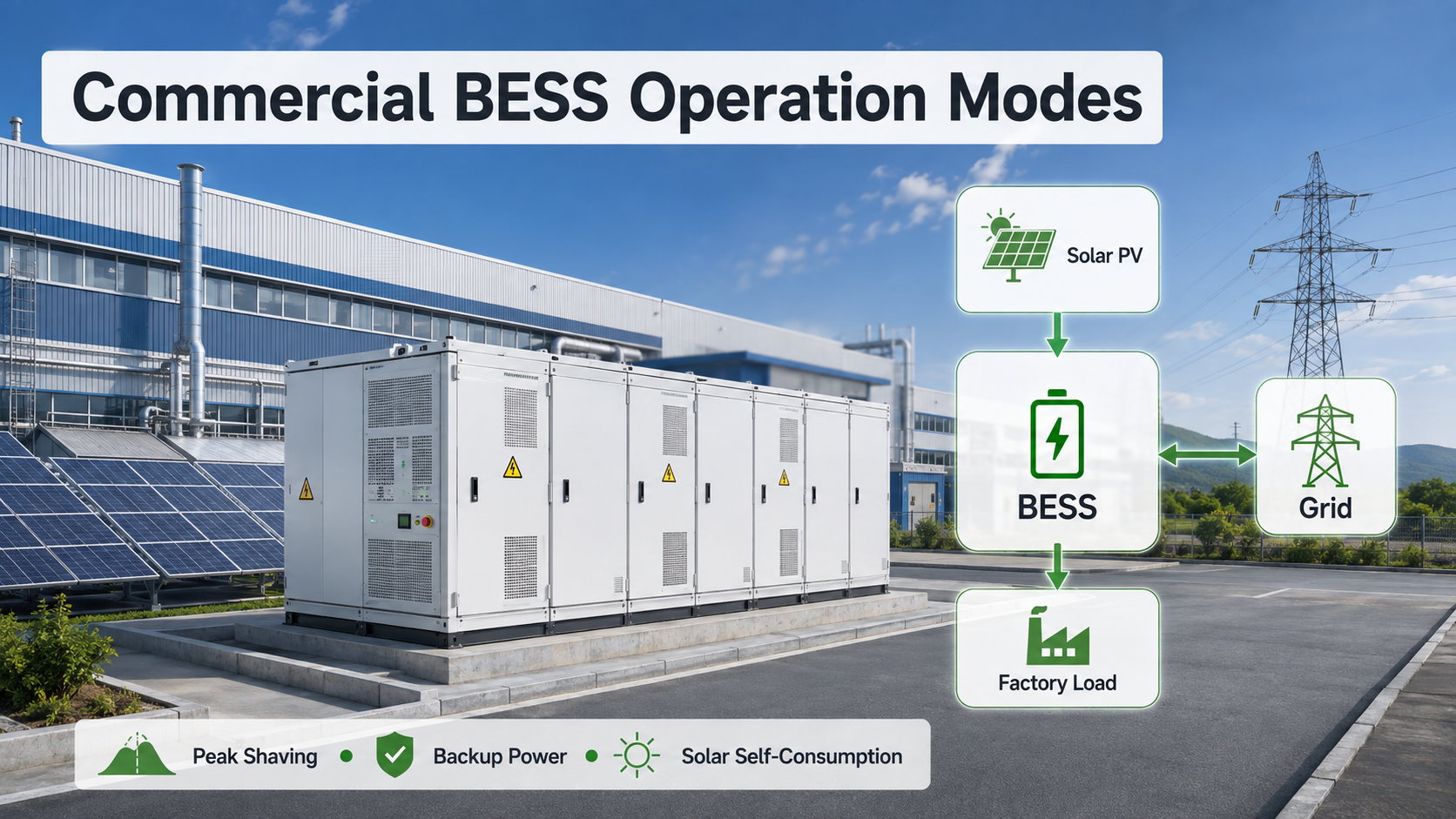
As more factories, commercial buildings, farms, telecom sites, and industrial parks install solar PV systems, battery storage is becoming an important part of commercial energy planning. A commercial battery energy storage system, often called a BESS, helps store electricity, manage power demand, reduce energy costs, and improve power reliability.
Unlike a small home battery, a commercial BESS is designed for higher loads, longer operating hours, outdoor installation, and more complex energy management. It can work with solar PV, the utility grid, diesel generators, or a hybrid power system depending on the project’s needs.
This article explains how a commercial battery energy storage system works and which operating modes are most common in real commercial and industrial projects.
What Is a Commercial Battery Energy Storage System?
A commercial battery energy storage system is an integrated power system that stores electrical energy and releases it when needed. It is normally used in commercial and industrial applications where power reliability, electricity cost control, and energy flexibility are important.
A complete BESS usually includes battery modules, battery racks, battery management system, power conversion system, energy management system, cooling system, fire protection, monitoring platform, and electrical protection devices.
The battery stores energy. The PCS controls charging and discharging. The BMS protects the battery cells. The EMS decides when the system should charge, discharge, standby, or support the grid. These parts work together to make the system safe, stable, and useful for business operation.
Main Components of a BESS
| Component | Main Function | Why It Matters |
|---|---|---|
| Battery Modules | Store electrical energy | Determine system capacity and backup duration |
| BMS | Monitors battery voltage, temperature, and safety status | Protects battery cells and improves operating safety |
| PCS | Converts DC battery power and AC site power | Controls charge and discharge power |
| EMS | Manages system operation strategy | Decides when to charge, discharge, or support loads |
| Cooling System | Controls battery operating temperature | Supports stable performance and longer service life |
| Fire Protection | Detects and responds to abnormal safety conditions | Improves system safety for commercial and industrial sites |
How Does a BESS Work With Solar PV?
In a commercial solar-plus-storage project, solar panels generate electricity during the day. Part of the solar power is used directly by the load, and the surplus power can be stored in the battery energy storage system.
When solar generation becomes lower, electricity prices rise, or the grid becomes unstable, the battery can discharge to support the site. This helps improve solar self-consumption and reduce wasted renewable energy.
For commercial users, this is especially useful when solar generation and electricity demand do not happen at the same time. A factory may generate enough solar power at noon, but its peak load may appear in the morning, evening, or during production shifts. Battery storage helps move solar energy to the time when it creates more value.
Common BESS Operation Modes
1. Solar Self-Consumption Mode
In this mode, the system stores surplus solar power and releases it later for local use. The goal is to use more self-generated solar electricity instead of sending excess power back to the grid or wasting it.
This mode is suitable for factories, commercial buildings, farms, and industrial users with rooftop solar or ground-mounted solar systems.
2. Peak Shaving Mode
In peak shaving mode, the battery charges during low-load or low-price periods and discharges during peak-demand periods. This helps reduce peak grid demand and can lower electricity costs where demand charges or peak tariffs are high.
This mode is common in industrial parks, manufacturing plants, shopping centers, cold storage facilities, and other sites with clear peak-load periods.
3. Backup Power Mode
When the grid fails or voltage becomes unstable, the BESS can provide backup power for selected critical loads. These loads may include production equipment, communication systems, lighting, security systems, pumps, or control rooms.
The backup time depends on battery capacity, discharge power, and the size of the connected load. This is why a project should not choose a battery system only by capacity. The load profile is just as important.
For example, Huijue’s Moldova 261kWh liquid-cooled energy storage cabinet project shows how an outdoor BESS cabinet can support commercial and industrial users in weak-grid conditions.
4. Hybrid Power Mode
In remote areas or weak-grid regions, a battery energy storage system can work with solar PV, diesel generators, and the utility grid. The system can store solar energy, reduce generator running time, stabilize output, and improve overall power efficiency.
This is suitable for mining sites, islands, construction sites, telecom stations, farms, and commercial facilities where grid supply is limited or unreliable.
5. Three-Phase Power Support
Many commercial and industrial projects require three-phase power. A properly designed BESS can support three-phase loads through suitable PCS configuration and electrical integration.
For factories and commercial buildings, this is important because many motors, pumps, compressors, and industrial devices operate on three-phase power. Before selecting a battery system, buyers should confirm voltage level, phase type, peak load, and equipment starting current.
Commercial BESS Is Not the Same as a Home Battery
Some buyers search for battery storage because they need a small residential backup system. A commercial BESS is different. It is designed for larger energy demand, stronger power output, outdoor operation, and professional energy management.
If the project is only for one home, a residential battery may be enough. But if the project involves a factory, farm, telecom site, commercial building, industrial park, or solar power station, a commercial battery energy storage system is more suitable.
How to Choose the Right BESS Configuration
The correct BESS configuration depends on the project’s operating purpose. A project for backup power is different from a project for peak shaving. A solar self-consumption project is different from a weak-grid hybrid power project.
For medium commercial and industrial projects, outdoor battery storage cabinets are often a flexible choice. They are compact, easier to install, and suitable for distributed energy storage applications.
For larger MWh-level projects, containerized BESS solutions may be more suitable. Container systems usually provide higher capacity, centralized installation, and easier expansion for large solar-plus-storage projects or industrial parks.
Before selecting the system, buyers should first clarify the following information:
- Project location and installation environment
- Application scenario, such as factory, farm, telecom site, commercial building, or solar project
- Daily electricity consumption
- Peak load and three-phase power requirements
- Existing or planned solar PV capacity
- Required backup time
- Grid condition and electricity price structure
- Available installation space
- Future expansion plan
With this information, the supplier can calculate the suitable battery capacity, PCS power, cooling method, cabinet or container structure, and energy management strategy.
Cabinet BESS or Containerized BESS?
For projects requiring 100kWh, 200kWh, or several hundred kWh of storage, an outdoor cabinet system may be a good starting point. It can be installed close to the load, supports flexible deployment, and is suitable for many commercial solar and backup power applications.
If the project requires 1MWh, 2MWh, or larger capacity, a containerized solution may be more appropriate. The final choice should depend on load profile, backup duration, site space, grid condition, and future expansion plan.
Conclusion
A commercial battery energy storage system helps businesses manage solar power, reduce peak electricity costs, improve backup capability, and support more stable operation in weak-grid areas.
The best BESS solution should be selected according to real project data, not only by battery capacity. Load profile, PV capacity, PCS power, backup duration, grid condition, and installation environment all affect the final system design.
If you are planning a commercial or industrial battery energy storage project, send your project location, load profile, PV capacity, grid condition, and backup power requirements. Huijue can help evaluate a suitable BESS solution for your site.