
 chinahuijue@gmail.com
 +1 (702) 204-9855
How Long Can a 261 kWh Battery Run? BESS Sizing Guide for Commercial Projects
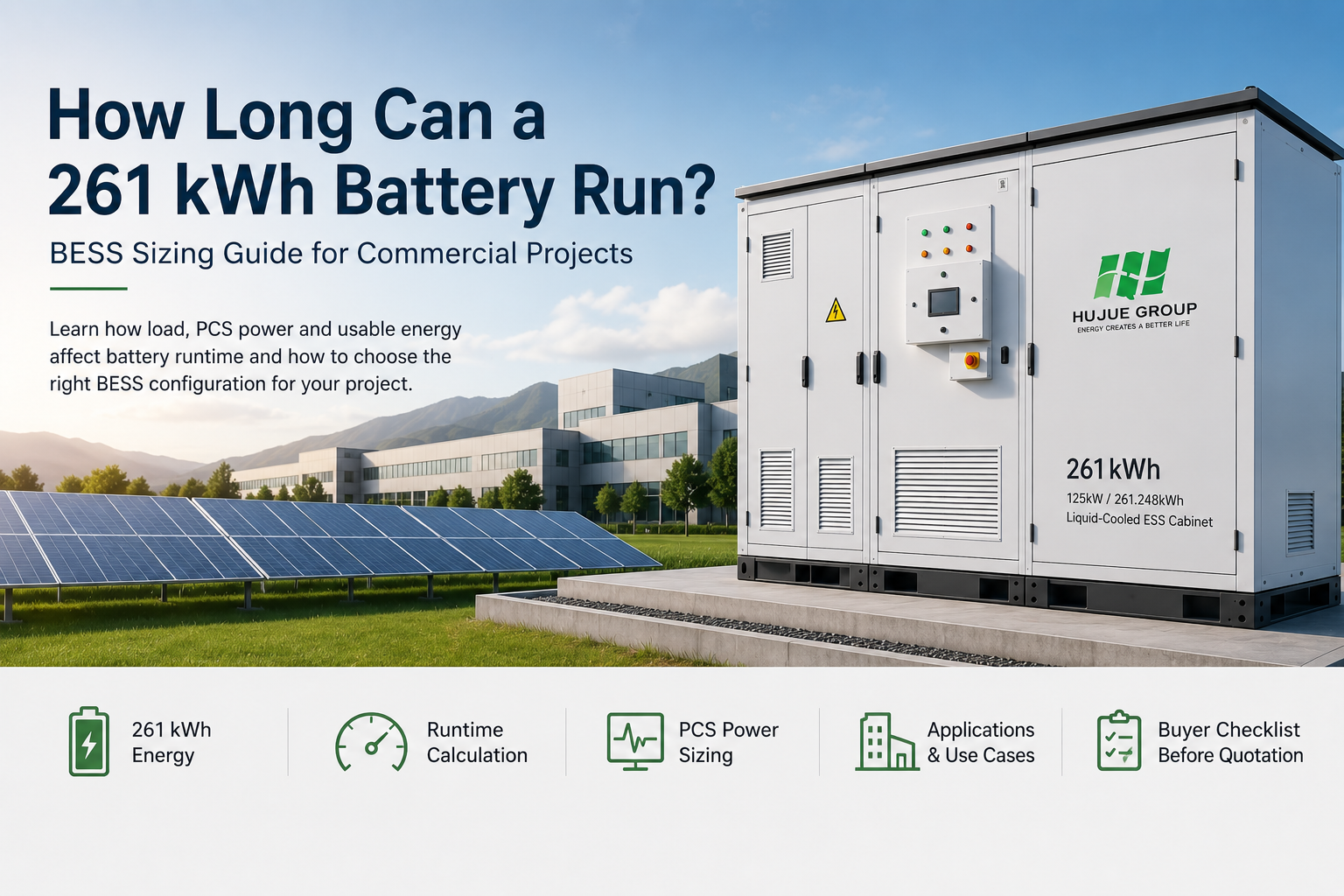
When buyers evaluate a 261 kWh battery storage system, one of the first questions is often:
How long can a 261 kWh battery actually run my facility?
The simple answer depends on the load.
A 261 kWh battery could theoretically support a 50 kW constant load for more than five hours, while a 200 kW load would consume the same nominal amount of stored energy much faster.
But battery capacity is only one part of commercial BESS sizing.
For factories, commercial buildings, EV charging sites and solar-plus-storage projects, buyers also need to consider PCS power, usable battery energy, load profile, backup requirements and operating strategy.
This guide explains how to estimate 261 kWh battery runtime, how kW and kWh work together, and what buyers should check before requesting a commercial BESS quotation.
What Does 261 kWh Actually Mean?
First, it is important to understand the difference between kW and kWh.
kWh (kilowatt-hours) tells you how much energy the battery can store.
kW (kilowatts) tells you how much power the system can deliver at a given time.
A battery rated at 261 kWh therefore has approximately 261 kilowatt-hours of nominal energy capacity.
That does not mean it automatically provides 261 kW of power.
Available charge and discharge power depends on the PCS configuration and overall system design.
This distinction matters because two commercial energy storage projects can use a similar battery capacity while requiring very different power ratings.
A project designed to reduce moderate demand peaks may have different PCS requirements from a system expected to support a large critical load during a grid outage.
How Long Can a 261 kWh Battery Run?
A simple theoretical calculation is:
Runtime (hours) = Battery Energy (kWh) ÷ Load (kW)
Using 261 kWh as the nominal battery energy:
| Load | Theoretical Runtime |
|---|---|
| 50 kW | 5.22 hours |
| 75 kW | 3.48 hours |
| 100 kW | 2.61 hours |
| 125 kW | 2.09 hours |
| 150 kW | 1.74 hours |
| 200 kW | 1.31 hours |
For example:
261 kWh ÷ 100 kW = 2.61 hours
So, in a simplified theoretical calculation, a 261 kWh battery could support a constant 100 kW load for approximately 2.61 hours.
However, 2.61 hours should not be treated as guaranteed real-world backup time.
Actual usable runtime depends on factors such as:
- Usable battery energy
- Allowed depth of discharge
- PCS and system efficiency
- Battery reserve settings
- Battery state of charge
- Temperature
- BMS and EMS control strategy
- Changes in the actual load
The theoretical calculation is therefore useful for preliminary evaluation, but detailed system sizing should use the project’s actual operating conditions.
Why Your Load Profile Matters
One of the biggest mistakes in commercial energy storage sizing is assuming that a facility always operates at its peak load.
Consider a factory with a recorded peak demand of 300 kW.
That does not necessarily mean the factory continuously consumes 300 kW.
Its daily load might rise and fall significantly depending on production schedules, HVAC equipment and other electrical loads.
If the objective is peak shaving, the battery may only need to discharge when demand exceeds a preset threshold.
If the objective is backup power, the project may only need to support selected critical equipment rather than the entire facility.
This is why simply telling a supplier:
“My factory needs a 261 kWh battery.”
is usually not enough information for proper system sizing.
A daily or hourly load profile can tell the system designer much more.
What PCS Size Does a 261 kWh BESS Need?
There is no universal PCS rating that must be paired with every 261 kWh battery system.
The required PCS power depends on how much power the project needs to charge or discharge.
Consider two simplified applications.
Project A: Peak Shaving
A facility wants to prevent grid demand from exceeding a specified threshold during short demand peaks.
The battery may need to provide moderate power for a defined period.
Project B: High-Power Load Support
Another facility needs the battery to provide significantly higher power for a shorter duration.
The two projects could use a similar amount of battery energy but require different PCS ratings.
Therefore, buyers should check at least two specifications when comparing BESS quotations:
Rated Energy — kWh
Rated Power — kW
A quotation showing only battery capacity does not provide enough information to understand how the complete system will perform.
Where Can a 261 kWh Battery Storage System Be Used?
A 261 kWh-class battery system falls within a capacity range that can be considered for various distributed commercial and industrial applications.
For projects where installation footprint, modularity and integrated system design are important, an energy storage cabinet can provide a practical format for C&I battery storage. Huijue’s current cabinet range covers multiple commercial and industrial capacity classes, including 261kWh systems.
The appropriate capacity still depends on the site’s load and operating requirements.
Factory Peak Shaving
Factories can experience short periods of high electricity demand when several machines operate simultaneously.
Where the applicable electricity tariff includes demand-related charges, an energy storage system may be configured to discharge when site demand approaches a defined threshold.
Proper evaluation requires information such as:
- Daily load curve
- Peak demand
- Peak duration
- Target demand limit
- Local electricity tariff structure
Battery capacity alone cannot determine whether peak shaving is technically or economically appropriate.
Commercial Backup Power
Warehouses, commercial buildings and industrial facilities may require backup power for selected critical loads.
Instead of asking whether 261 kWh can run the entire building, a more useful question is:
Which equipment must continue operating during an outage?
Critical loads might include selected lighting, IT equipment, security systems, refrigeration or production equipment.
Once the critical load and required backup duration are identified, the necessary battery energy can be evaluated more accurately.
Solar-Plus-Storage
Commercial facilities with solar PV may use battery storage to store surplus daytime generation for later consumption.
A solar-plus-storage project should therefore consider:
PV generation + load profile + battery capacity + PCS power + EMS strategy
together.
If the PV system frequently produces surplus electricity during the day while facility demand rises later, battery storage may help shift part of that energy to a more useful period.
EV Charging Infrastructure
Fast EV charging can create substantial short-duration power demand.
Where available grid capacity is limited, battery storage can potentially form part of the site’s power-management architecture.
In this application, PCS power can be particularly important because the battery may need to respond to relatively high instantaneous loads.
Microgrids and Weak-Grid Applications
Commercial battery storage can also be integrated into microgrids together with solar PV, grid electricity and other available power sources.
In these applications, system control becomes particularly important. BMS, PCS and EMS need to work together according to the intended operating strategy.
Why Is Liquid Cooling Used in C&I Battery Storage?
As battery systems become more energy-dense, thermal management becomes an important part of BESS design.
Battery cells generate heat during charging and discharging, and temperature differences within the system need to be managed.
Liquid cooling uses circulating coolant to transfer heat and maintain the battery system within its designed operating temperature range.
Huijue’s current 261kWh liquid-cooled energy storage cabinet, for example, is rated at 125 kW / 261.248 kWh and uses 314Ah LFP cells.
However, cooling technology should not be evaluated in isolation.
A complete commercial BESS may involve:
- Battery modules
- BMS
- PCS
- EMS
- Thermal management
- Fire protection
- Electrical protection
- Communication
- Remote monitoring
The objective is not simply to purchase a battery cabinet with a particular cooling technology.
The objective is to select a complete system that matches the project’s operating requirements.
261 kWh Cabinet or Containerized BESS?
Another question buyers may face is whether to use cabinet-based storage or move to a containerized system.
For distributed C&I projects requiring hundreds of kilowatt-hours of storage, cabinet systems can offer a compact and modular format.
As project requirements move toward the multi-MWh range, a containerized battery energy storage system may be more appropriate for larger industrial, renewable energy or microgrid applications. Huijue’s current container portfolio includes systems from the MWh scale upward.
The choice should consider:
| Factor | Cabinet BESS | Containerized BESS |
|---|---|---|
| Typical scale | Hundreds of kWh | Often MWh-scale |
| Layout | Distributed/modular | More centralized |
| Installation | Compact outdoor units | Dedicated container area |
| Expansion | Additional cabinets | Additional system blocks |
| Applications | Distributed C&I | Larger industrial/renewable projects |
These are general distinctions rather than fixed sizing rules.
A project should not start by deciding:
“I want a cabinet.”
or:
“I want a container.”
It should start with:
“What power and energy does my site actually require?”
Is 261 kWh Enough for Your Factory?
Suppose a factory needs 100 kW of critical load for two hours.
A simplified energy calculation would be:
100 kW × 2 hours = 200 kWh
At first glance, a 261 kWh battery may appear sufficient.
But the design cannot stop there.
The system designer still needs to consider usable battery energy, system efficiency, reserve requirements, PCS power, load changes and other operating conditions.
Now consider another factory requiring:
200 kW for two hours
The simplified requirement becomes:
200 kW × 2 hours = 400 kWh
A single nominal 261 kWh system would not satisfy that theoretical energy requirement.
This simple comparison demonstrates why buyers should begin with load × time, rather than selecting a battery capacity first.
What Should a 261 kWh BESS Quotation Include?
When comparing commercial energy storage quotations, price alone can be misleading.
Two suppliers may both quote a “261 kWh BESS,” while the actual system configurations differ.
A quotation should make the proposed system architecture clear.
Important information may include:
- Rated battery energy
- Usable energy, where specified
- Rated charge/discharge power
- PCS configuration
- Battery chemistry
- BMS
- EMS or control architecture
- Cooling method
- Fire protection
- Electrical protection
- Communication interfaces
- Enclosure protection
- Operating temperature range
- Dimensions and weight
- Warranty terms
- Delivery scope
- Installation requirements
- Commissioning responsibilities
For international projects, grid voltage, frequency and applicable project requirements should also be confirmed.
What Information Should You Send Before Requesting a Quote?
Instead of sending only:
“Please quote a 261 kWh battery.”
provide as much project information as possible.
For preliminary evaluation, useful information includes:
- Project country
- Application
- Peak load (kW)
- Daily energy consumption (kWh)
- Hourly load profile, if available
- Existing or planned PV capacity
- Required backup duration
- Grid voltage and frequency
- Installation environment
- Available installation space
For factories and commercial facilities, an electricity bill and daily load profile can be particularly useful.
This allows the proposed BESS to be evaluated around the project instead of simply matching a requested battery capacity.
FAQ
How long can a 261 kWh battery run a 100 kW load?
Using a simplified theoretical calculation:
261 kWh ÷ 100 kW = 2.61 hours
Actual backup time depends on usable battery energy, system efficiency, reserve settings, temperature, state of charge and operating conditions.
How long can a 261 kWh battery run a 50 kW load?
The theoretical calculation is:
261 kWh ÷ 50 kW = 5.22 hours
Again, this is a theoretical value based on nominal battery energy. Actual usable runtime can differ.
What PCS size is required for a 261 kWh battery?
There is no single PCS rating suitable for every 261 kWh system.
PCS power should be selected according to the required charge/discharge power, site load profile and intended application. Two projects using similar battery capacity may therefore require different PCS configurations.
Can a 261 kWh battery work with commercial solar PV?
Yes. A properly designed commercial BESS can be integrated with solar PV.
The system should be sized according to PV generation, facility load, battery energy, PCS power and the intended operating strategy.
How much does a 261 kWh battery storage system cost?
There is no reliable universal price based on battery capacity alone.
The final quotation can depend on battery configuration, PCS power, BMS and EMS architecture, thermal management, fire protection, electrical configuration, project requirements, destination and scope of supply.
For this reason, buyers should compare complete system configurations rather than only price per kWh.
Start With the Load, Not the Battery Capacity
A 261 kWh battery may be suitable for some commercial and industrial projects, but 261 kWh should not be the starting point for every system design.
A better sequence is:
Define the application → Analyze the load → Determine required power → Determine required energy → Select the system architecture
This helps avoid two common problems:
Undersizing, where the battery cannot support the required load or duration.
Oversizing, where additional capacity is purchased without a clear operational requirement.
For buyers, EPC contractors and system integrators, understanding the relationship between kW, kWh and runtime is more useful than comparing battery capacity alone.
Planning a Commercial Battery Storage Project?
If you are evaluating a commercial or industrial BESS, provide your:
- Project location
- Application
- Peak load
- Daily load profile
- PV capacity
- Required backup duration
- Grid voltage and frequency
Based on the available project information, Huijue can help evaluate the required battery energy, PCS power and system configuration for the application.