
 chinahuijue@gmail.com
 +1 (702) 204-9855
Off-Grid Solar System Sizing: 4-Step Calculation Guide for Cabins, RVs & Boats
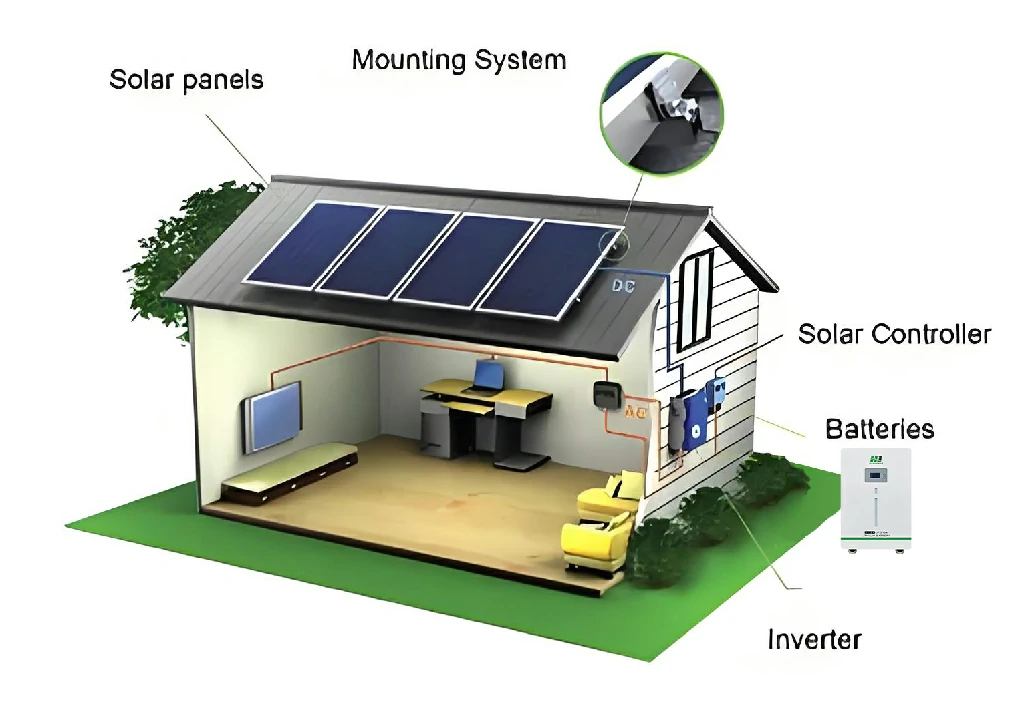
Whether it’s a mountain cabin, fishing boat, RV, or remote pastoral station — an off-grid solar system gives you energy independence without relying on the public grid. The good news? You don’t need to be an engineer to size one correctly. Master four formulas and you can calculate a system that’s both sufficient and reliable.
1. System Overview: The 4 Core Components
| Component | Role | Key Sizing Parameter | Formula |
|---|---|---|---|
| PV Modules | Generate electricity from sunlight | Total wattage (W) | Daily need × cloudy factor ÷ (sun hours × efficiency) |
| Inverter | Convert DC to AC for appliances | Continuous power (W) | (Resistive + Inductive × 5) × safety ÷ power factor |
| Battery Bank | Store energy for night/cloudy days | Capacity (Ah / kWh) | Daily need × autonomy ÷ (DOD × eff × voltage) |
| Charge Controller | Regulate charging from panels to battery | Max current (A) | PV power ÷ battery voltage |
2. Step 1: Calculate PV Module Power
The solar panels must generate enough electricity to cover your daily consumption, with margin for cloudy weather.
| Parameter | Typical Range | How to Determine |
|---|---|---|
| Daily energy need (Wh) | 500–10,000 Wh | Sum of (device wattage × hours used) for all loads |
| Cloudy day factor | 1.1–1.3 | Higher in cloudy climates; lower in arid regions |
| Sunshine hours/day | 3–6 hours | Local meteorological data (peak sun equivalent hours) |
| System efficiency | 0.75–0.80 | Accounts for cable, controller, inverter losses |
Worked Example
| Load | Power | Hours | Daily Energy | |
|---|---|---|---|---|
| LED lights | 10W × 5 | 5h | 50 Wh | |
| Refrigerator | 60W (avg) | 24h | 1,440 Wh | |
| TV + router | 120W | 4h | 480 Wh | |
| Phone/laptop charging | 50W | 6h | 300 Wh | |
| Water pump (intermittent) | 200W | 0.5h | 100 Wh | |
| Subtotals | 2,370 Wh → round to 3,000 Wh with margin |
Install ~1 kW of panels — for example, four 250W modules or two 550W TOPCon panels.
Regional Sunshine Hours Reference
| Region | Avg Peak Sun Hours | Recommended Cloudy Factor |
|---|---|---|
| North Africa (Egypt, Morocco) | 5.5–6.5 | 1.1 |
| Middle East (UAE, Saudi) | 5.0–6.0 | 1.1 |
| South Asia (Pakistan, India) | 4.5–5.5 | 1.2 |
| Sub-Saharan Africa (Kenya, Nigeria) | 4.5–5.5 | 1.2 |
| Southern Europe (Spain, Italy) | 4.0–5.0 | 1.2 |
| Northern Europe (Germany, UK) | 2.5–3.5 | 1.3 |
| Southeast Asia (Vietnam, Thailand) | 3.5–4.5 | 1.3 |
3. Step 2: Calculate Inverter Power
The inverter must handle your maximum simultaneous load, especially the inrush current of motor-driven appliances.
| Load Type | Examples | Starting Surge | Notes |
|---|---|---|---|
| Resistive | LED lights, kettle, heater, oven | 1× rated (no surge) | Direct wattage summation |
| Inductive | Refrigerator, water pump, AC, fan, power tools | 5–7× rated | Motor startup draws surge current for 1–3 seconds |
| Electronic | TV, computer, charger, router | 1.5–2× rated | Switching power supply inrush |
| Parameter | Range | Notes |
|---|---|---|
| Safety factor | 1.2–1.5 | Higher for systems with multiple inductive loads |
| Power factor | 0.8–0.9 | Use 0.85 for mixed loads; 0.9 for mostly resistive |
Worked Example
Choose a minimum 1.1 kW inverter; recommended 1.5 kW for stability headroom.
4. Step 3: Calculate Battery Capacity
The battery stores energy for nighttime use and cloudy periods. Size it based on how many days of autonomy you need.
| Battery Type | Recommended DOD | Cycle Life | Efficiency | Cost ($/kWh) | Best For |
|---|---|---|---|---|---|
| LFP (Lithium Iron Phosphate) | 0.80–0.90 | 4,000–6,000 | 95% | $400–600 | All new installations; long-term value |
| NMC (Lithium Nickel Manganese) | 0.80–0.90 | 2,000–3,000 | 93% | $350–500 | Space-constrained (RV, boat) |
| Lead-Acid (AGM/Gel) | 0.50–0.60 | 500–1,500 | 80% | $150–250 | Budget systems; short-term use |
| Lead-Acid (Flooded) | 0.50 | 300–800 | 75% | $100–180 | Not recommended — high maintenance |
Worked Example (48V LFP System)
That’s a 48V 154Ah battery pack = approximately 7.4 kWh of usable storage.
Autonomy Days Recommendation
| Application | Recommended Days | Reasoning |
|---|---|---|
| RV / boat (frequent mobility) | 1–2 days | Can relocate to sunny area; space/weight constrained |
| Mountain cabin (weekend use) | 2–3 days | Must survive cloudy weekends between visits |
| Full-time off-grid home | 3–5 days | Critical reliability; backup generator optional |
| Telecom / remote monitoring | 3–7 days | Zero downtime tolerance; extreme reliability |
5. Step 4: Calculate Charge Controller Specs
The controller regulates current from panels to battery. Its key spec is maximum input current.
MPPT vs PWM: Always Choose MPPT
| Feature | MPPT | PWM |
|---|---|---|
| Efficiency | 95–99% | 70–80% |
| Energy harvest | +20–30% more | Baseline |
| Cold/cloudy performance | Excellent — tracks max power point | Poor — fixed voltage |
| Cost (25A unit) | $80–200 | $20–50 |
| Series/parallel flexibility | Yes — can step down high voltage | No — panel voltage must match battery |
| Recommended for | All systems >100W | Small/cheap systems <100W only |
6. Complete System Configuration: Worked Example
For a 3,000 Wh/day off-grid cabin in a 4.5 peak-sun-hour climate:
| Component | Calculated | Recommended Purchase | Est. Cost |
|---|---|---|---|
| PV Modules | 1,026 W | 2 × 550W TOPCon panels (1,100W) | $330–450 |
| Inverter | 1,070 W | 1.5 kW pure sine wave inverter | $200–400 |
| Battery | 48V 154Ah (7.4 kWh) | 48V 100Ah LFP × 2 (9.6 kWh) | $1,800–2,800 |
| Charge Controller | 20.8A | 30A MPPT controller | $100–200 |
| Mounting, cables, fuses, BOS | — | Complete balance-of-system kit | $300–600 |
| Total | $2,730–$4,450 |
7. Cost by System Size
| System Size | Daily Energy | PV Array | Inverter | Battery | Total Cost | Best For |
|---|---|---|---|---|---|---|
| Small | 1,000 Wh | 300–400W | 600W | 12V 100Ah LFP | $800–$1,500 | RV, boat, tiny cabin |
| Medium | 3,000 Wh | 1,000–1,200W | 1,500W | 48V 100Ah LFP | $2,500–$4,500 | Weekend cabin, off-grid room |
| Large | 6,000 Wh | 2,000–2,500W | 3,000W | 48V 200Ah LFP | $5,000–$8,000 | Full-time off-grid home |
| X-Large | 10,000+ Wh | 4,000W+ | 5,000W+ | 48V 400Ah+ LFP | $8,000–$15,000 | Large cabin + workshop |
8. Practical Tips: Do’s and Don’ts
| Tip | Why It Matters |
|---|---|
| Add 10–20% margin to all calculated values | Handles degradation, unexpected loads, and weather variability |
| Choose MPPT over PWM — always | 20–30% more energy harvest pays back the price difference within months |
| Prioritize LFP batteries over lead-acid | 3–5× longer life, deeper discharge, zero maintenance — lower cost per cycle |
| Use 48V system for anything above 1kW | Lower current = thinner cables, less heat, lower BOS cost |
| Plan for future expansion from day one | Oversize controller/inverter 25%; leave panel space; use modular batteries |
| Don’t mix old and new batteries | Different internal resistances cause imbalance, reducing overall pack life |
| Use pure sine wave inverters | Modified sine wave damages motors, electronics, and voids warranties |
| Install proper fuses and breakers | DC faults can cause fires; every string and battery bank needs protection |
FAQ
How do I calculate the size of my off-grid solar system?
Size your system in 4 steps: (1) PV module power = (daily need × cloudy factor) ÷ (sun hours × efficiency); (2) Inverter power = (resistive + inductive × 5) × safety ÷ power factor; (3) Battery capacity = (daily need × autonomy days) ÷ (DOD × efficiency × voltage); (4) Controller current = PV power ÷ battery voltage. Add 10–20% margin to all results.
What size solar system do I need for a cabin?
For a typical off-grid cabin using 3,000 Wh/day: ~1,000W of solar panels, 1,500W inverter, 48V 154Ah (7.4 kWh) LFP battery, and 25A MPPT controller. Total cost: $2,500–$4,500 depending on component quality.
How many days of battery autonomy do I need?
2–3 days for most applications. In regions with frequent cloudy weather (Northern Europe), 3–5 days may be necessary. In sunny climates (Middle East, North Africa), 1–2 days suffices. More autonomy = larger battery = higher cost; balance reliability with budget.
Should I choose MPPT or PWM charge controller?
MPPT is strongly recommended for all systems above 100W. It extracts 20–30% more energy than PWM, especially in cold or cloudy conditions. The $50–150 price premium pays back within the first year through extra energy generation.
Lead-acid or lithium battery for off-grid solar?
LFP (lithium iron phosphate) is recommended for all new installations. Despite 2–3× higher upfront cost, LFP offers 3–5× longer cycle life (4,000–6,000 vs 500–1,500 cycles), 80–90% DOD (vs 50%), and 95% efficiency (vs 80%). Over 10 years, LFP is 30–50% cheaper per kWh stored.
Can I expand my off-grid solar system later?
Yes — but plan from the start. Size your controller and inverter 25% larger than initial needs. Choose 48V if you may exceed 2kW of solar. Use modular batteries for parallel expansion. Don’t mix old and new batteries — add in matched sets.
Conclusion: Calculate, Don’t Guess
Designing a small off-grid solar system is not about “buying a few panels and batteries” — it’s about matching four components to your actual energy needs through precise calculation. Master these four formulas and you’ll size a system that’s sufficient, stable, and cost-effective:
| Formula | What It Determines |
|---|---|
| PV Power = (Daily need × Cloudy factor) ÷ (Sun hours × Efficiency) | How much panel wattage you need |
| Inverter Power = (Resistive + Inductive × 5) × Safety ÷ PF | Minimum inverter capacity |
| Battery Ah = (Daily need × Autonomy) ÷ (DOD × Eff × Voltage) | Battery storage size |
| Controller A = PV Power ÷ Battery Voltage | Charge controller rating |
Add 10–20% margin to every result, choose LFP batteries and MPPT controllers, and plan for expansion from day one. Your off-grid system will deliver reliable power for years — whether you’re in a mountain cabin, on a boat, or on the road.
Ready to Build Your Off-Grid Solar System?
Huijue offers complete off-grid solar kits with matched components — PV panels, LFP batteries, MPPT controllers, and pure sine wave inverters. Contact our team for a free system sizing consultation, or explore our off-grid product range.
📖 Related: Folding Solar Containers | Solar Energy Storage Intermittency | PV Inverter Heat Protection