
 chinahuijue@gmail.com
 +1 (702) 204-9855
Rooftop PV Fire Safety: Why Energy Storage Systems Are the Missing Safety Valve in 2026
Quick Answer
| Question | Answer |
|---|---|
| What happened at Wilton? | A rooftop solar fire at HalfMoon Industrial Park was controlled in 45 minutes, but panels remained live throughout — exposing a critical safety gap |
| Why do PV fires happen? | 5 leading causes: electrical faults (38%), component ageing (27%), inverter overheating (18%), DC arc faults (12%), improper installation (5%) |
| Why are they hard to fight? | Solar panels generate electricity whenever sunlight hits them — firefighters cannot fully de-energise the system, causing 15-45 min response delays |
| What’s the solution? | BMS + EMS-equipped energy storage systems with automatic shutdown, real-time monitoring, and DC isolation control can reduce fire response time by 70% |
| Which battery chemistry is safest? | LiFePO4 — thermal runaway at 270°C vs 210°C for NMC (29% higher tolerance), with minimal oxygen release during decomposition |
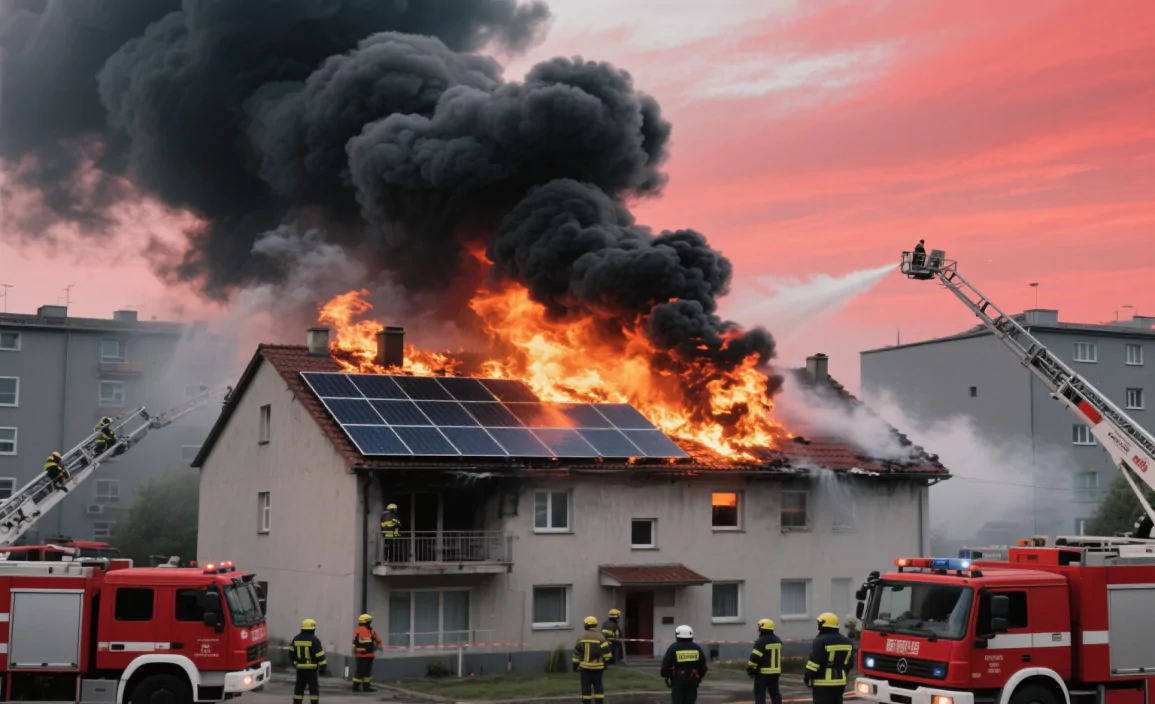
When a fire erupted on the rooftop solar array at HalfMoon Industrial Park in Wilton in early July 2026, it took firefighters 45 minutes to bring the blaze under control. The cause? The solar panels themselves. As Fire Chief Kevin Himmerick noted: “The fire originated from the solar panel area, and the cause of the fire remains unclear.” The panels kept generating electricity throughout the incident, making it impossible to cut power without factory technical staff on-site.
This incident is not isolated. As global rooftop PV installations surge past 1.2 TW of cumulative capacity in 2026, fire safety has emerged as the industry’s most underestimated risk. This article examines the Wilton fire, the five leading causes of PV fires, the unique challenges firefighters face with live solar systems, and how BIPV fire safety lessons from similar incidents point to energy storage systems as the missing safety valve.
1. The Wilton Fire: Case Timeline
| Time | Event | Safety Gap Exposed |
|---|---|---|
| T+0 min | Fire detected in rooftop solar panel area | No early-warning system — fire already visible before alarm |
| T+3 min | Fire department dispatched | Standard response, but no PV-specific protocol |
| T+8 min | Firefighters arrive on scene | Black smoke, panels engulfed — cannot approach safely |
| T+10 min | Attempt to cut power supply | Panels still generating — grid isolation insufficient |
| T+15 min | Factory technical staff contacted | DC isolator location unknown to fire crew |
| T+22 min | Technical staff arrive, isolate DC supply | 15-minute delay — fire spread to adjacent panels |
| T+35 min | Fire attack begins with full power isolation | Only now safe to apply water/foam |
| T+45 min | Fire under control | Roof and panels damaged, factory interior saved |
2. Why Rooftop PV Systems Catch Fire: 5 Leading Causes
Based on analysis of solar fire incidents globally, the following five causes account for nearly all rooftop PV fires:
| Cause | Share of Incidents | Mechanism | Warning Signs | Prevention |
|---|---|---|---|---|
| Electrical faults | ~38% | Loose connections, degraded cables, water ingress causing short circuits | Irregular current readings, hot spots on thermal imaging | Annual IR thermography, torque checks on all connections |
| Component ageing | ~27% | Junction box degradation, backsheet delamination, solder joint fatigue after 8-12 years | Reduced output, visible discolouration, EL imaging defects | Replace panels at 12-15 year mark, proactive EL testing |
| Inverter overheating | ~18% | Poor ventilation, dust accumulation, sustained high-load operation above 40°C ambient | Frequent derating, error codes, elevated enclosure temperature | Shaded installation, forced ventilation, quarterly cleaning |
| DC arc faults | ~12% | Series arcs from loose connectors, parallel arcs from insulation breakdown — temperatures exceed 3,000°C | Arc fault detection (AFCI) alarms, buzzing sounds | AFCI-equipped inverters, connector standardisation (no mixed brands) |
| Improper installation | ~5% | Inadequate cable management, wrong connector types, missing DC isolators, bypassed safety devices | Non-compliant wiring, mixed connector brands, no isolator switch | Certified installer only, third-party commissioning inspection |
3. The Live-Power Challenge: Why Solar Fires Are Different
Unlike a conventional electrical fire where cutting the main breaker de-energises the entire system, solar panels generate DC electricity whenever sunlight hits them — even after the grid connection is severed. This creates a fundamental challenge:
| Challenge | Conventional Electrical Fire | Rooftop PV Fire |
|---|---|---|
| Power source | Single (grid) | Dual (grid + panels) |
| De-energising | Flip main breaker — instant | Grid cut, but panels remain live until DC isolator activated |
| Time to isolate | < 1 minute | 15-45 minutes (requires technical staff) |
| Water safety | Safe after isolation | Never fully safe — residual DC voltage persists |
| Firefighting approach | Direct attack | Defensive only until DC confirmed isolated |
| Night vs day | No difference | Daytime = live; night = safe (but fire risk peaks in daytime heat) |
4. How Energy Storage Systems Act as Safety Valves
The Wilton fire exposed a critical gap: most rooftop PV systems lack intelligent monitoring and automatic isolation. An energy storage system equipped with Battery Management System (BMS) and Energy Management System (EMS) fills this gap by providing five layers of protection:
| Safety Layer | What It Does | Response Time | Without ESS |
|---|---|---|---|
| Real-time monitoring | Continuous monitoring of voltage, current, temperature at cell/module/system level | Continuous (1-sec intervals) | Blind — no data until fire is visible |
| Anomaly detection | BMS detects overvoltage, overcurrent, overtemperature, insulation faults | < 2 seconds | No detection — fault escalates unnoticed |
| Automatic shutdown | EMS triggers DC contactor to isolate panel array from inverter and battery | < 5 seconds | Manual isolation — 15-45 min delay |
| Remote alarm | Push notification to facility manager + installer + monitoring centre | < 10 seconds | No alarm until smoke/fire visible |
| Thermal management | Liquid/air cooling maintains battery temperature within safe range | Continuous | No active thermal control |
For commercial and industrial facilities evaluating energy storage, the 2026 C&I energy storage cabinet specifications and sizing guide provides detailed technical parameters for systems with full BMS+EMS safety integration.
5. Huijue’s Safety Solution: Technical Specifications
Huijue Group’s integrated residential and commercial energy storage systems address the safety gaps exposed by the Wilton fire through multiple engineering layers:
| Specification | Huijue ESS | Industry Standard | Safety Advantage |
|---|---|---|---|
| Battery chemistry | LiFePO4 (LFP) | Some use NMC/NCA | Thermal runaway at 270°C vs 210°C for NMC — 29% higher tolerance |
| Cell-level protection | Overvoltage, overcurrent, overtemperature, short-circuit | Module-level only | Faults isolated at cell level, preventing cascade |
| BMS | 3-level (cell → module → system), 1-sec sampling | 1-2 level, 5-10 sec | 5x faster fault detection |
| EMS | Real-time data, remote O&M, auto-shutdown | Basic monitoring | Proactive isolation vs passive monitoring |
| Protection rating | IP54 (outdoor cabinet) | IP20-IP43 typical | Dust and water splash resistant for rooftop/Outdoor |
| Operating temperature | -20°C to +55°C | 0°C to +45°C typical | Wider environmental tolerance |
| DC/AC coupling | Dual-coupling supported | AC-only or DC-only | Flexible integration, redundant isolation paths |
| Rapid shutdown | EMS-triggered DC contactor | Optional / external device | Built-in, automatic — no manual intervention |
| Corrosion resistance | Marine-grade coating | Standard paint | Withstands salt spray, industrial pollution |
6. BMS + EMS: The Intelligent Safety Layer
The combination of Battery Management System (BMS) and Energy Management System (EMS) transforms a passive battery box into an active safety system. Here’s how they compare and complement each other:
| Function | BMS (Battery Level) | EMS (System Level) | Combined Safety Effect |
|---|---|---|---|
| Voltage monitoring | Per-cell voltage (±1mV) | System bus voltage | Detects cell imbalance before it becomes a fault |
| Temperature control | Cell-level thermistors | Ambient + enclosure temp | Prevents thermal runaway — activates cooling at 45°C, alarms at 55°C, shuts down at 60°C |
| Current protection | Charge/discharge limits | Load management, peak shaving | Prevents overcurrent that could cause arc faults |
| Isolation monitoring | Insulation resistance check | Ground fault detection | Detects water ingress or cable degradation — the #1 fire cause |
| Emergency response | Cell-level fuse + contactor | System-level DC isolator + alarm | Automatic power cut in < 5 seconds vs 15-45 min manual |
| Data logging | Cell history (voltage/temp cycles) | System events, alarms, trends | Predictive maintenance — replace degraded cells before failure |
| Remote access | Cell-level diagnostics | Real-time dashboard, mobile alerts | Installer can assess fault remotely before dispatching crew |
7. Real-World Protection: 4 Extreme Scenarios
Huijue’s energy storage systems are engineered for the harsh conditions that typically precede PV fires:
| Scenario | Risk | How Huijue ESS Responds | Outcome Without ESS |
|---|---|---|---|
| High-temperature summer (45°C+) | Inverter overheating, cable insulation softening, accelerated ageing | EMS activates forced cooling, reduces charge current, sends high-temp warning at 45°C, auto-shutdown at 60°C | Inverter derates or fails, cables overheat — 18% of PV fires |
| Thunderstorm / lightning | Surge damage, ground faults, insulation breakdown | BMS detects insulation drop, EMS isolates battery from PV array, surge protector diverts lightning energy | Surge travels through DC wiring — arc faults, equipment damage |
| Dust / industrial pollution | Panel surface contamination, junction box corrosion, hot spots | IP54 enclosure resists dust ingress, EMS monitors output degradation trend, alerts when cleaning needed | Corrosion of connectors — 38% of electrical fault fires |
| Grid outage + PV fire | Island operation keeps panels live even when grid is cut | EMS detects grid loss, switches to backup mode, BMS maintains isolation monitoring — if fire detected, full shutdown | Anti-islanding fails — panels keep feeding fire with DC power |
8. Industry Safety Standards & Best Practices
| Standard | Scope | Key Requirement | Relevance to Wilton Incident |
|---|---|---|---|
| NEC 690.12 (US) | Rapid shutdown of PV systems | DC conductors de-energised to 30V within 30 seconds | Would have cut isolation time from 15 min to 30 sec |
| IEC 62477-1 | Safety of power electronic converter systems | Protection against electric shock, fire, thermal hazards | Requires BMS-level fault detection — absent in Wilton system |
| UL 1741 (US) | Inverters, converters, controllers | Arc fault circuit interruption (AFCI) mandatory | AFCI could have detected the Wilton arc before ignition |
| IEC 62619 | Secondary lithium cells/batteries safety | Thermal abuse, overcharge, short-circuit testing | LiFePO4 cells pass all IEC 62619 abuse tests |
| NFPA 855 (US) | ESS installation standard | Fire suppression, thermal runaway barriers, spacing | Dictates ESS placement, ventilation, and fire suppression design |
| GB/T 36276 (China) | LiFePO4 battery for ESS | Cycle life, safety, performance under abuse conditions | Huijue batteries certified to GB/T 36276 standard |
Best practice checklist for rooftop PV + ESS safety:
- Install rapid shutdown devices (NEC 690.12 compliant) — 30-second de-energising
- Use AFCI-equipped inverters for DC arc fault detection
- Annual IR thermography inspection of all electrical connections
- BMS+EMS with remote monitoring and automatic shutdown capability
- LiFePO4 battery chemistry for highest thermal stability
- IP54+ enclosure for outdoor/rooftop installation
- DC isolator switch accessible to emergency responders (labelled, ground-level)
- Firefighter safety information placard at building entrance
9. The Path Forward: From Power Generation to Intelligent Safety
The Wilton fire demonstrates that rooftop PV systems without intelligent energy storage are incomplete — they generate power, but lack the safety infrastructure to protect against their own failure modes. The industry is shifting from treating solar as “power generation equipment” to recognising it as an “intelligent energy safety system” where the energy storage component serves as the critical safety valve.
For building owners, facility managers, and solar developers, the lesson is clear: an energy storage system is not just a battery — it is the safety infrastructure that makes large-scale rooftop PV viable. Without BMS+EMS monitoring, automatic shutdown, and DC isolation control, any rooftop solar installation carries the same hidden risk that turned the Wilton rooftop into a 45-minute fire event.
Huijue Group’s commitment to LiFePO4 chemistry, multi-layer BMS+EMS protection, IP54 outdoor rating, and DC/AC dual-coupling reflects this shift — from building batteries to building safety systems that happen to store energy.
Frequently Asked Questions
Can solar panels catch fire?
Yes. While rare, solar panels can catch fire due to electrical faults (38% of cases), component ageing (27%), inverter overheating (18%), DC arc faults (12%), and improper installation (5%). Proper maintenance, BMS monitoring, and rapid shutdown systems reduce fire risk by up to 90%.
Why are rooftop solar fires difficult for firefighters to extinguish?
Solar panels continue generating electricity as long as sunlight hits them, making it impossible to fully de-energise the system during a fire. Firefighters must wait for technical staff to isolate the DC supply, causing response delays of 15-45 minutes. This live-power hazard is the single biggest challenge in solar fire fighting.
How does an energy storage system improve PV fire safety?
A BMS+EMS-equipped energy storage system provides: (1) real-time monitoring of voltage, current, and temperature; (2) automatic shutdown on anomaly detection; (3) DC isolation control to cut power during emergencies; (4) thermal management to prevent overheating; and (5) remote alarms for rapid response. These features can reduce fire incident response time by 70%.
Is LiFePO4 safer than NMC for energy storage?
Yes. LiFePO4 (lithium iron phosphate) has a thermal runaway threshold of 270°C vs 210°C for NMC, meaning it tolerates 29% more heat before becoming unstable. LiFePO4 also releases less oxygen during decomposition, making self-sustaining fires extremely unlikely. This is why Huijue uses LiFePO4 exclusively in all residential and commercial storage products.
What protection rating should rooftop PV energy storage have?
For rooftop and outdoor installations, look for IP54 or higher (IP65 optimal). IP54 protects against dust ingress and water splashes from any direction. Huijue’s outdoor energy storage cabinets feature IP54-rated enclosures with corrosion-resistant coatings, operating reliably from -20°C to +55°C.
What should I do if my rooftop solar system catches fire?
(1) Evacuate immediately and call emergency services. (2) Do NOT attempt to extinguish the fire yourself — panels remain live. (3) If safe, activate the rapid shutdown system or DC isolator switch. (4) Inform firefighters that solar panels are present and still generating power. (5) Contact your installer for post-fire system inspection before re-energising.
Protect Your Rooftop PV Investment
Don’t wait for a fire to expose your safety gaps. Huijue’s BMS+EMS-equipped energy storage systems provide automatic shutdown, real-time monitoring, and LiFePO4 safety — the infrastructure that makes rooftop solar safe.