
 chinahuijue@gmail.com
 +1 (702) 204-9855
Foldable Solar Container: Benefits, Structure, Transportation and Off-Grid Applications (2026 Guide)
Quick Answer: A folding solar container is a self-contained, transportable power station that integrates TOPCon bifacial solar panels, a lithium battery (LFP), an inverter, and an EMS into a standard shipping container. It deploys in hours (not weeks), operates fully off-grid, and saves 80%+ of construction time versus traditional off-grid builds. Ideal for remote communications, island electrification, mining sites, disaster relief, and temporary events.
What Is a Folding Solar Container?
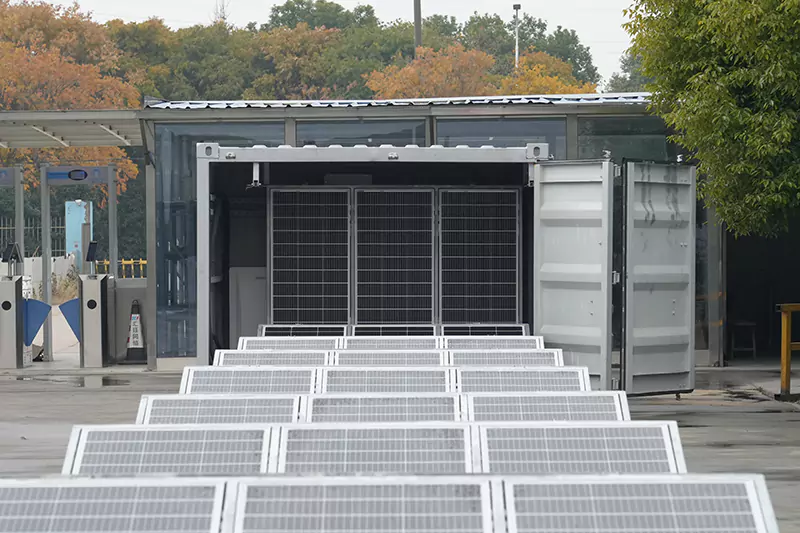
A folding solar container packages a complete off-grid solar power system — panels, battery, inverter, and energy management — into a standard 10ft, 20ft, or 40ft shipping container. The solar panels fold out from the container’s top or sides at the deployment site, eliminating the need for ground-mounted racking, concrete foundations, or on-site assembly of individual components.
| Spec | 10ft Container | 20ft Container | 40ft Container |
|---|---|---|---|
| Solar capacity | 10–20 kWp | 30–60 kWp | 60–120 kWp |
| Battery storage | 20–50 kWh (LFP) | 50–200 kWh (LFP) | 200–500 kWh (LFP) |
| Inverter output | 10–20 kW | 30–60 kW | 60–120 kW |
| Panel type | TOPCon bifacial, fold-out array | ||
| Deploy time | 2–4 hours (2-person crew) | ||
| Transport mode | Truck, rail, sea, or air (10ft/20ft) | ||
| Weight (fully loaded) | 3–5 tons | 8–12 tons | 15–22 tons |
What’s Inside: Core Components
| Component | Function | Why It Matters |
|---|---|---|
| Folding PV array | Captures solar energy | TOPCon bifacial panels deliver 24%+ module efficiency and 5–15% rear-side gain from ground albedo |
| LFP battery pack | Stores excess energy for night/cloudy periods | 3,000+ cycles at 80% DoD; high energy density; inherently safe (no thermal runaway risk like NMC) |
| Hybrid inverter | Converts DC to AC; manages charge/discharge | Pure sine wave output; supports both off-grid and grid-tied modes; typically 10–100 kW |
| EMS (Energy Management System) | Monitors and optimizes the entire system | Real-time SOC/SOH monitoring; AI-based load forecasting; anti-overcharge/overdischarge protection; remote access via 4G/WiFi |
| Climate control | Maintains battery temperature | Active cooling/heating keeps LFP cells in 15–35°C range; critical for desert or cold-climate deployments |
| Fire suppression | Safety | Automatic aerosol or gas suppression; smoke/heat detectors; explosion-proof vents |
Three Advantages Over Traditional Off-Grid Builds
1. Mobility — Power Wherever a Truck Can Reach
Standard container dimensions mean it ships by road, rail, sea, or air without special permits (in most jurisdictions). A 20ft unit fits on a standard flatbed truck and can reach mountain communications sites, remote islands, or mining camps that would be logistically impossible for a conventional solar build.
2. Rapid Deployment — Hours, Not Weeks
| Step | Traditional Off-Grid Build | Folding Solar Container |
|---|---|---|
| Site preparation | 3–7 days (leveling, concrete pad) | 0 days (drop on flat ground) |
| Racking installation | 2–5 days | 0 (panels fold out) |
| Panel mounting | 1–3 days | 30 minutes (unfold array) |
| Electrical wiring | 2–4 days | 15 minutes (plug in pre-wired connections) |
| Inverter + battery setup | 2–3 days | 0 (pre-installed and tested at factory) |
| Commissioning | 1–2 days | 30 minutes (EMS auto-configures) |
| Total | 10–21 days | 2–4 hours |
That’s an 80%+ time saving — critical for emergency response, disaster relief, or any project where power is needed yesterday.
3. Energy Independence — Zero Grid Dependency
Once deployed, the system is fully self-sufficient. Solar charges the battery by day; the battery powers loads at night. No fuel deliveries, no diesel generator noise, no fuel theft risk. A 20ft container with 50 kWp panels and 200 kWh storage can power a 200-person field camp, a 4G/5G base station, or a small village indefinitely.
Transportation: What to Watch For
| Risk | Mitigation |
|---|---|
| Shifting / tipping during transit | Secure with professional lashing straps, chains, and twist-locks to container corner castings. Verify tie-down at every rest stop. |
| Moisture damage (sea freight, rain) | Check container door seals; add desiccant bags inside; verify IP65 rating on electrical enclosures. For sea freight, use a sealed container with moisture barriers. |
| Vibration damage to panels and battery | Install rubber shock mounts between equipment and container frame. Use anti-vibration pads under battery racks. Avoid routes with severe unpaved sections where possible. |
| Route issues (bridge weight limits, narrow roads) | Pre-plan route with bridge weight clearance for the container’s loaded weight. A 40ft unit at 22 tons requires bridge-rated roads. Use GPS tracking for real-time monitoring. |
Where Folding Solar Containers Shine: Use Cases
| Application | Why a Folding Container? | Typical Size |
|---|---|---|
| Telecom / 4G-5G base stations | Remote mountain sites with no grid; rapid deployment to restore service | 10–20ft, 10–30 kWp |
| Mining & exploration camps | Mobile operation; moves as the site advances; replaces diesel generators | 20–40ft, 30–120 kWp |
| Disaster relief & emergency response | Deployable within hours of arrival; no construction needed; immediate power for medical, communications | 10–20ft, 10–50 kWp |
| Island & rural electrification | Shipped by boat; eliminates need for local construction crews; low maintenance | 20ft, 30–60 kWp |
| Construction site power | Temporary power during build phase; relocatable to next site when complete | 20ft, 30–60 kWp |
| Military & border outposts | Rapid deployment; silent operation (no generator noise); fuel-free logistics | 10–20ft, 10–50 kWp |
Folding Container vs Traditional Off-Grid: Cost Comparison
| Factor | Folding Solar Container (20ft) | Traditional Off-Grid Build (50 kWp) |
|---|---|---|
| Equipment cost | $45,000–$70,000 | $35,000–$50,000 |
| Site preparation | $500 (drop on flat ground) | $5,000–$15,000 (leveling, foundation) |
| Installation labor | $1,000 (2 persons × 4 hours) | $8,000–$15,000 (crew × 2-3 weeks) |
| Transport | $2,000–$5,000 (container freight) | $3,000–$8,000 (multiple shipments) |
| Commissioning | Included | $2,000–$5,000 |
| Total deployed cost | $48,500–$76,000 | $53,000–$93,000 |
| Time to power | 2–4 hours | 10–21 days |
| Relocatable? | Yes — fold, load, ship | No — permanent installation |
Key takeaway: While the container’s equipment cost is higher, the savings on site work, labor, and time make the total deployed cost comparable or lower — and you get a system you can move to a new site when the project ends.
FAQ: Folding Solar Containers
Q1: How long does it take to deploy a folding solar container?
A trained 2-person crew can deploy a standard 20ft folding solar container in 2–4 hours. This includes unfolding the PV array, connecting pre-wired cables, and powering on the EMS. No foundation work, racking assembly, or on-site electrical wiring is needed.
Q2: Can folding solar containers withstand extreme weather?
Yes. Quality containers are rated for operation from -40°C to +60°C, with wind resistance up to 120 km/h (panels deployed) and IP65 electrical enclosures. The LFP battery compartment includes active heating for cold climates and liquid or air cooling for hot environments. Always verify these ratings with the manufacturer for your specific deployment conditions.
Q3: How long do the batteries last?
LFP (lithium iron phosphate) batteries in folding solar containers typically deliver 3,000–6,000 cycles at 80% depth of discharge, translating to 8–15 years of daily cycling. The EMS extends battery life through intelligent charge management and temperature control. Replacement battery packs are available from the manufacturer.
Q4: Can I move the container to a new site after deployment?
Absolutely — that’s one of the biggest advantages. Fold the panels back, disconnect the load, and load the container onto a truck. The system is designed for repeated deployment with no degradation to the equipment. This makes it ideal for construction companies, military operations, and disaster relief agencies.
Q5: How does a folding solar container compare to a diesel generator?
While diesel generators have lower upfront cost, folding solar containers win on total cost of ownership within 2–4 years. No fuel costs, no fuel logistics, minimal maintenance (no oil changes, filters, or engine overhauls), silent operation, and zero emissions. For remote sites where fuel delivery is expensive or unreliable, the payback is even faster.
Conclusion
Folding solar containers solve the three biggest problems of off-grid power: logistics, time, and fuel dependency. By packaging a complete solar-plus-storage system into a shippable container with fold-out panels, they cut deployment from weeks to hours and eliminate the need for on-site construction expertise.
For telecom operators, mining companies, relief agencies, and remote communities, the math is straightforward: comparable total cost, 80% faster deployment, zero fuel logistics, and full relocatability. As TOPCon panel prices continue to fall and LFP battery costs decline, folding containers will only become more competitive.
Interested in a folding solar container for your project? Contact Huijue for configurations and pricing. Explore our solar and energy storage products or learn more about containerized solar power systems.
Looking for more? Read our Complete BESS Guide or our Top Solar Panel Manufacturers 2026 Guide.