
 chinahuijue@gmail.com
 +1 (702) 204-9855
Folding PV Container with Energy Storage: How to Measure Efficiency and ROI
Folding photovoltaic containers have taken a leading position in recent solar power solutions because of their unique flexibility and efficient performance. Not only are these containers deployable rapidly, but they can ensure a stable power supply against all kinds of environments. How would anyone go about accurately assessing the energy efficiency of a folding PV container?
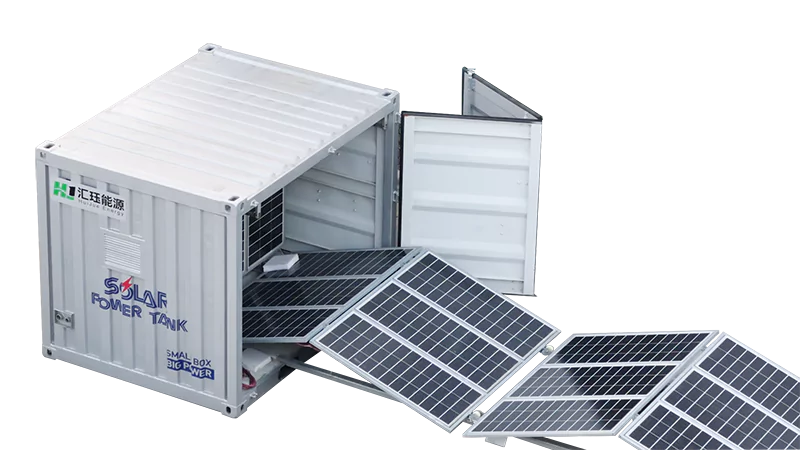
1. What Is a Folding PV Container?
A folding PV container is a mobile solar power system that integrates photovoltaic modules, battery storage, inverter and energy management technology into a transportable container structure.
Unlike traditional fixed solar installations, folding PV containers can be rapidly transported, deployed and connected, making them suitable for emergency power, remote areas, construction sites and industrial applications.
2. Why Energy Efficiency Matters for Folding PV Containers?
Energy efficiency assessment is one of the most important works for folding PV containers. It is related not only to the ROI of the equipment, but also directly to the stability and reliability of the power supply. An accurate energy efficiency assessment can help operators to optimize the system configuration and improve the power generation efficiency, thus reducing the operating cost.
3 Key Factors Affecting Folding PV Container Efficiency
3.1 Solar Module Performance and I-V Curve Testing
The I-V curve test is one of the important methods for appraising the electrical performance of PV modules. By measure of current and voltage in different light conditions, through which IV characteristic curve, it can plot and thus analyze such electrical performance parameters as short-circuit current (Isc), open-circuit voltage (Voc), maximum power point current (Impp), voltage (Vmpp) of a module, etc. These parameters are very necessary for testing the generating efficiency of folded PV containers. The concrete practices are as follows:
The I-V curve test evaluates the electrical performance of photovoltaic modules under different solar irradiation conditions.
Key parameters include:
• Maximum power output (Pmax)
• Open-circuit voltage (Voc)
• Short-circuit current (Isc)
• Maximum power point voltage and current (Vmpp/Impp)
These indicators help determine whether PV modules can achieve expected energy generation performance.
3.2 Battery Energy Storage Efficiency
For folding PV containers with integrated battery storage, the battery system efficiency directly affects overall performance.
Important evaluation factors include:
• Round-trip efficiency
• Battery cycle life
• Depth of discharge (DoD)
• Thermal management capability
• Battery management system (BMS)
A high-quality lithium iron phosphate (LiFePO4) battery system can provide safer operation, longer lifespan and more stable energy output.
3.3 Environmental Adaptability
These foldable PV containers are operating in many extreme environmental conditions; hence, this factor must be considered regarding the evaluation of energy efficiency, including the weather and temperature resistance of PV modules, and the thermal management capability of an energy storage system.
Weather resistance test: employed to test the performance of PV modules under different climatic conditions, such as the impact of environmental factors like high temperature, low temperature, and humidity on the performance of PV modules.
Thermal management capability test: test the thermal management capability of the energy storage system, including the heat dissipation and insulation performance of the battery.
3.4 Intelligent Energy Management System
A smart EMS improves folding PV container efficiency by optimizing:
• Solar generation
• Battery charging and discharging
• Load management
• Remote monitoring
Through intelligent control, operators can maximize renewable energy utilization and reduce unnecessary energy losses.
4 Test methods
4.1 On-site test
Field test is a direct method to check the energy efficiency of folded PV containers. It tests the equipment in the actual operating environment and collects real operating data, such as power generation efficiency, energy storage efficiency, and system stability. These data are so important for the assessment of energy efficiency.
4.2 Simulation Testing
Simulation testing refers to the utilization of computer simulation software for the simulation of folded PV containers’ operation. In other words, it’s a way to predict in advance the energy efficiency performance of equipment before it actually operates. It is able to consider a wide range of different environmental conditions and operating parameters for comprehensive data to support energy efficiency assessment.
4.3 Performance Comparison
The comparison for performance is made to evaluate the energy efficiency of the folding PV containers by benchmarking the performance of others. In this direction, it helps operators take a realistic view about how competitive their equipment could stand in the market and indicates avenues for improvements.
Folding PV Container Efficiency Evaluation Checklist
| Evaluation Item | Key Indicators |
|---|---|
| Solar Modules | Power output, efficiency, I-V curve |
| Battery System | Round-trip efficiency, cycle life |
| Thermal Management | Temperature control |
| EMS | Remote monitoring, optimization |
| Environment | Temperature, humidity, weather resistance |
| ROI | Energy savings and operating cost reduction |
Huijue Folding PV Container Solution
Huijue Group provides integrated folding PV container solutions combining solar generation, lithium battery storage, inverter technology and intelligent EMS.
Designed for rapid deployment scenarios, Huijue systems support:
• Emergency power supply
• Mining operations
• Remote areas
• Temporary construction sites
• Off-grid applications
With modular design and intelligent management, Huijue helps customers achieve reliable, flexible and cost-effective clean energy solutions.
Frequently Asked Questions
1. How efficient is a folding PV container?
The efficiency depends on PV module performance, battery efficiency, inverter conversion rate and environmental conditions.
2. Can folding PV containers work without grid connection?
Yes. With integrated battery storage, folding PV containers can provide off-grid power for remote locations and emergency applications.
3. What affects folding PV container energy output?
Major factors include solar irradiation, panel orientation, temperature, battery capacity and system management strategy.
4. How long does it take to deploy a folding PV container?
Compared with traditional solar installations, folding PV containers can be transported and deployed much faster, reducing installation time.
5. Can folding PV containers replace diesel generators?
Yes. In many temporary and remote applications, PV containers combined with battery storage can reduce diesel consumption and operating costs.