
 chinahuijue@gmail.com
 +1 (702) 204-9855
Solar Energy Storage System Safety: How Huijue Prevents Battery Fire Risks
As solar energy storage systems continue expanding worldwide, safety has become one of the most important considerations for developers, EPC companies, and energy storage investors.
As an energy storage system manufacturer with more than 23 years of industry experience, Huijue Group focuses on developing safer PV+storage solutions through advanced battery technology, intelligent control and lifecycle management. From commercial solar farms in Europe to industrial microgrids in Asia and Africa, customers are increasingly asking the same question:
How can we ensure photovoltaic energy storage systems operate safely throughout their entire lifecycle?
Recent battery storage incidents have highlighted the importance of battery chemistry, thermal management, intelligent control systems, and professional system design.
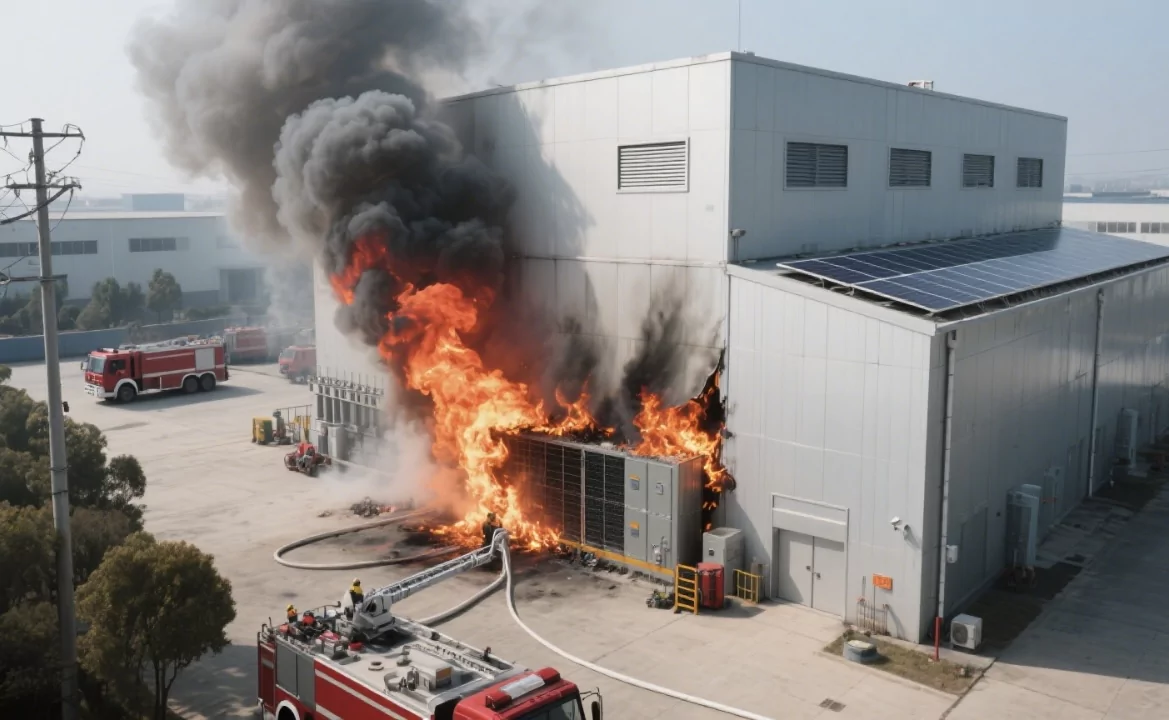
, South Chungcheong Province, South Korea, suffered a sudden fire, once again sounding the alarm on safety at energy storage stations. The fire occurred at a sandwich panel-structured photovoltaic energy storage building, where the blaze raged fiercely for nearly 11 hours. This resulted in the destruction of the entire energy storage system and damage to some solar panels. Fortunately, no casualties were reported among residents.
Previous investigations into energy storage incidents have shown that battery defects, improper thermal management, insufficient insulation protection, and coordination failures between BMS, EMS and PCS can significantly increase safety risks are closely linked to inherent defects in lithium-ion batteries themselves. Common contributing factors include folded electrodes, poor coating quality, inadequate insulation design, insufficient operational environment management, and poor coordination between key control systems (BMS/EMS/PCS). Furthermore, if the energy storage system is charging under high temperatures when a fire occurs, it can easily trigger dangerous phenomena such as thermal runaway and arc discharge, rapidly leading to extensive combustion.
While safety hazards are indeed alarming, they are preventable
Amidst the rapid advancement of energy storage systems, the industry must deeply contemplate how to develop safer, more reliable photovoltaic energy storage solutions. HuiJue Technology Group’s photovoltaic energy storage power station solutions may offer a valuable reference point for the sector.
HuiJue Energy Storage Station PV Solution: Eliminating Safety Hazards at the Root
As a technology enterprise with over 20 years of specialisation in the energy storage sector, Huijue Group has developed an integrated PV+storage solution centred on the concept of ‘full lifecycle safety management’. This solution combines safety, intelligence and efficiency, making it particularly suitable for diverse applications including industrial and commercial parks, microgrids, telecommunications sites and public buildings.
Core safety advantages include:
- High-Safety Lithium Iron Phosphate (LFP) Cells
HuiJue systems utilise high-performance LFP cells with inherent flame-retardant properties, effectively mitigating thermal runaway risks. Compared to traditional ternary batteries, they demonstrate superior stability under high-temperature and high-pressure conditions.
- Modular design + liquid-cooled thermal management system
Through modular architecture and advanced liquid cooling, Huijue energy storage equipment achieves balanced cell temperature control, mitigating overheating risks at source. This significantly extends system lifespan and enhances operational efficiency.
- Multi-tiered Active Protection Mechanism
The system incorporates a coordinated BMS+EMS+PCS linkage mechanism, continuously monitoring critical parameters including cell status, ambient temperature, current, and voltage. This enables millisecond-level fault identification and disconnection. Additionally, fire-resistant enclosures, fire suppression systems, and smoke detection are fully integrated.
- Full Lifecycle Digitalised Operations and Maintenance
Huijue has established a digital platform spanning from front-end deployment to post-deployment operations through its intelligent energy management system. Users can remotely monitor energy storage status, forecast consumption trends, and configure operational strategies, thereby ensuring safety while optimising energy dispatch.
Beyond Technology Lies Responsibility and Foresight
The promotion of photovoltaic energy storage has become a vital component in driving the green energy transition. However, safety hazards, should they occur, carry severe consequences and may even undermine public confidence in renewable energy. While the recent South Korean energy storage fire caused no casualties, it once again exposed dual shortcomings in equipment tiering and system management.
Rather than merely “closing the stable door after the horse has bolted” following incidents, we must “prepare for the worst” from the project design stage. This is precisely the core principle driving Huijue Group’s relentless refinement of product safety – adopting a scenario-oriented approach, leveraging data-driven insights, and using technology to fortify energy security defences.
Energy storage facilities are not mere battery stacks but complex energy control systems. Every incremental improvement in safety represents a commitment to future responsibility. Huijue Group will continue advancing photovoltaic storage systems towards greater safety, efficiency, and intelligence through pioneering products and professional services.
FAQ
Are LFP batteries safer for solar energy storage systems?
Yes. LFP batteries provide better thermal stability and lower thermal runaway risk compared with many traditional lithium battery chemistries.
How can energy storage systems prevent battery fires?
A safe system requires reliable battery cells, BMS monitoring, thermal management, fire protection and professional installation.
What safety certifications should a BESS system have?
Common certifications include IEC 62619, UN38.3 and UL9540A depending on the market requirements.