
 chinahuijue@gmail.com
 +1 (702) 204-9855
Recent BESS Projects Show Commercial Solar Storage Is Becoming Core Energy Infrastructure
Publish Date: August 28, 2026
Category: Industry News
Battery energy storage is moving quickly from an optional add-on to a core part of commercial and renewable energy infrastructure. Recent project announcements across Europe, Asia, and other major energy markets show that BESS is no longer being discussed only as a backup product. It is now being used to improve solar utilization, reduce grid pressure, support peak shaving, strengthen energy resilience, and create more flexible power systems.
For factories, industrial parks, commercial buildings, EPC contractors, telecom sites, and renewable energy developers, this trend has one clear message: solar power alone is often not enough. The real project value increasingly comes from how solar generation, battery storage, PCS, EMS, and grid connection are designed together.
Europe Is Accelerating Battery Storage Deployment
In August 2026, several European battery storage updates pointed in the same direction: BESS deployment is becoming larger, faster, and more closely connected with renewable energy assets.
One European renewable energy developer announced that it had brought 167 MW / 545 MWh of battery storage into operation during the first eight months of 2026. Many of these systems were co-located with renewable generation, showing how solar and wind projects are increasingly adding storage to improve asset economics and grid flexibility.
This is important because co-located storage changes the value of a renewable energy project. Instead of exporting power only when the sun or wind is available, project owners can store energy when generation is high and release it when demand or electricity prices are stronger.
For commercial and industrial users, the same logic applies at a smaller scale. A factory, warehouse, resort, farm, or industrial facility can use battery storage to improve solar self-consumption, manage peak demand, and reduce reliance on unstable grid supply.
Large-Scale BESS Projects Are Setting New Benchmarks
The UK market also continues to show strong momentum. A 500 MW / 1 GWh battery energy storage project in Scotland entered commercial operation in August 2026 and was reported as the largest operational BESS in Europe at the time of the announcement.
This type of project is grid-scale, but its significance goes beyond size. It shows that battery energy storage is becoming an accepted infrastructure asset, not just a pilot technology. Large BESS projects are being planned, financed, operated, and optimized as long-term energy assets.
At the same time, new long-duration battery storage projects are also receiving more attention. Recent UK project updates included storage systems designed for longer discharge durations, showing that the market is beginning to look beyond short backup time and toward broader grid and energy management applications.
For C&I project buyers, this matters because it changes how storage should be evaluated. A battery system should not be selected only by capacity. The more important questions are:
- What is the required discharge duration?
- What peak load must be supported?
- How will the EMS control charging and discharging?
- Will the system work with solar PV, grid power, or diesel generators?
- Is the project designed for backup, peak shaving, self-consumption, or off-grid operation?
Solar Growth Makes Storage More Valuable
Recent European grid discussions also highlighted a practical issue: high solar generation can help reduce electricity pressure during daytime hours, but storage is needed to shift excess solar energy into evening demand periods.
This is exactly where commercial battery energy storage becomes valuable.
Many solar projects generate the most power during the middle of the day, while factories, commercial facilities, and local grids may have different peak demand periods. Without storage, some solar energy may be exported at low value or even curtailed in certain markets. With BESS, project owners can use more of their own solar energy and improve overall energy flexibility.
For commercial solar projects, this means the battery should be planned together with the PV system from the beginning. A solar + storage solution can be more effective than treating the battery as a later accessory.
C&I Storage Is Becoming More Modular
Another important market signal is the growing focus on commercial and industrial battery storage systems in the 200 kWh to 700 kWh range. Recent product updates in the industry show more suppliers expanding modular C&I BESS portfolios for applications such as peak demand management, backup power, renewable energy integration, and energy cost optimization.
This capacity range is especially relevant for:
- Small and medium factories
- Commercial buildings
- Farms and agricultural processing sites
- Resorts and hotels
- Industrial workshops
- Telecom and remote power facilities
- Local solar + storage projects
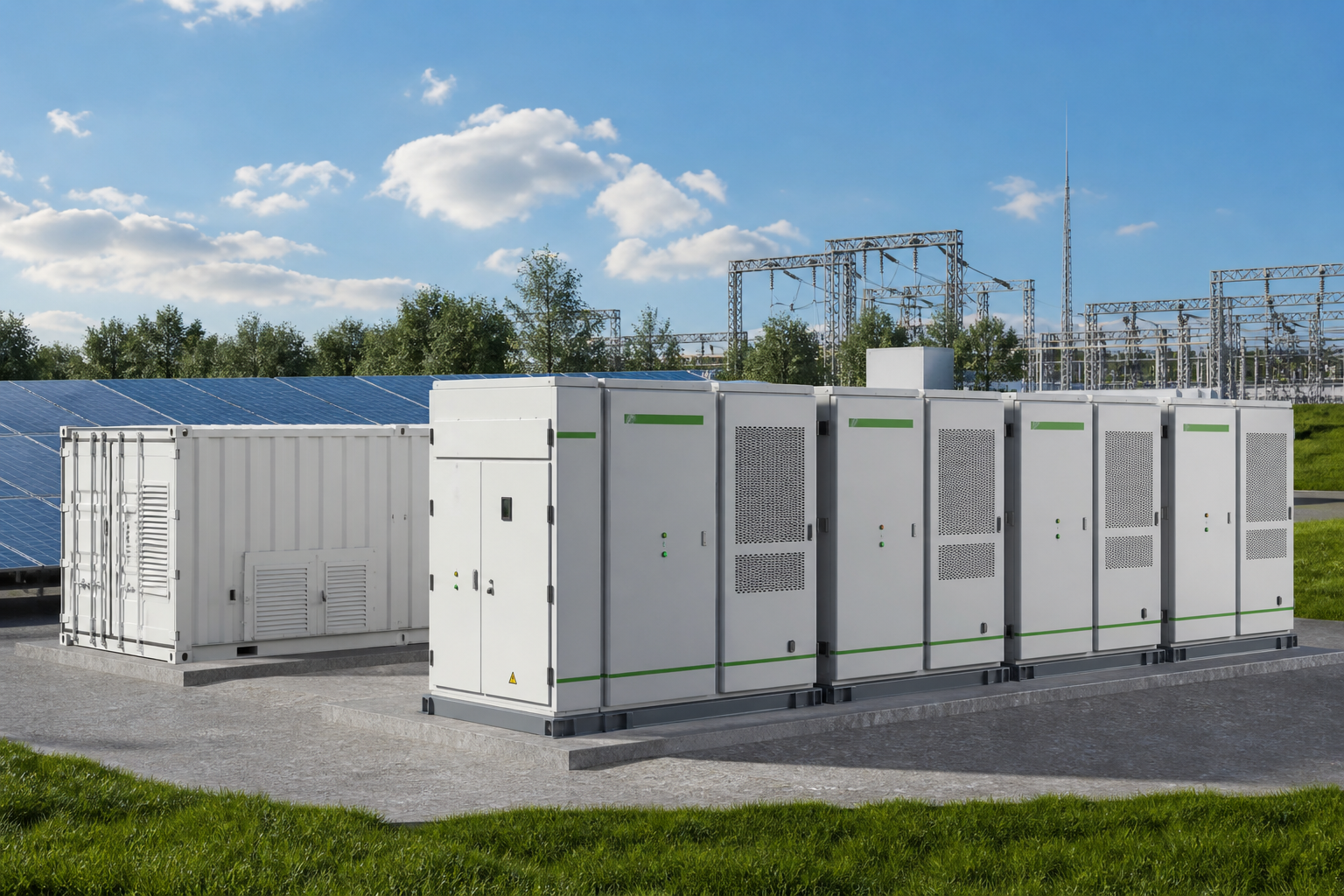
For these applications, a modular cabinet energy storage system is often more practical than a large containerized system. Cabinet ESS can be easier to deploy, expand, and maintain when the project does not require MWh-level capacity from the beginning.
Containerized BESS Still Leads Larger Projects
For larger projects, containerized BESS remains an important format. Container energy storage systems are widely used in solar farms, industrial parks, utility-scale projects, microgrids, and remote power infrastructure.
Compared with smaller cabinets, a container energy storage system can integrate battery racks, PCS, thermal management, fire protection, EMS, monitoring, and auxiliary systems into a more centralized solution.
This is especially useful when the project needs:
- MWh-level capacity
- Faster site deployment
- Centralized system management
- Outdoor installation
- Future expansion
- Integration with large PV or hybrid power systems
However, containerized BESS should still be selected based on project requirements, not just because it looks larger. The correct system format depends on load profile, site space, installation environment, grid connection, backup duration, and long-term operating strategy.
What This Means for Project Buyers
The recent BESS market news points to a clear conclusion: buyers should move from “battery price comparison” to “project configuration comparison.”
A serious BESS quotation should include more than battery capacity. It should clarify:
- Rated power, kW
- Energy capacity, kWh or MWh
- PCS configuration
- EMS control logic
- Battery chemistry and cycle life assumptions
- Cooling method
- Fire protection design
- Grid connection requirements
- PV integration method
- Communication and monitoring
- Installation environment
- Expansion plan
- After-sales and commissioning support
Without these details, two quotations with the same capacity may not describe the same system at all.
For example, a 500 kWh battery used for factory peak shaving is very different from a 500 kWh battery used for off-grid backup. A 1 MWh containerized BESS for a solar farm is different from a modular cabinet system for a commercial building. The capacity number is only the beginning of the design.
Huijue’s View: BESS Is Becoming a Project Solution, Not a Single Product
The latest market developments confirm what many project customers are already experiencing: energy storage is becoming more application-specific.
Commercial buyers are no longer asking only for batteries. They are asking for reliable energy systems that can support real operating needs.
For factories, the focus may be peak shaving and electricity cost control.
For solar EPCs, the focus may be PV integration and project return.
For remote sites, the focus may be power reliability and lower diesel use.
For telecom and infrastructure projects, the focus may be stable operation in harsh outdoor environments.
Huijue provides different energy storage formats for these different project needs, including cabinet ESS, containerized BESS, and solar + storage solutions. The right choice should be based on application, capacity, site conditions, and expansion requirements.
Project buyers can send site location, load profile, PV capacity, backup time, grid condition, and installation requirements through the Huijue project inquiry page to receive a more accurate system recommendation.
Conclusion
Recent global BESS news shows that battery storage is becoming essential energy infrastructure for renewable projects and commercial power users. The strongest trend is not only larger battery capacity, but smarter system integration.
For commercial and industrial projects, the next stage of solar development will not be only about installing more PV panels. It will be about using solar energy more effectively through storage, EMS control, and project-specific system design.
As BESS deployment continues to grow, buyers who define their application clearly will be better positioned to choose the right system, compare quotations correctly, and build energy storage projects that deliver long-term value.