
 chinahuijue@gmail.com
 +1 (702) 204-9855
Containerized Solar Power Systems: 2026 Cost Guide, Specs & Deployment Cases
As global energy transition accelerates, containerized solar power systems have emerged as one of the fastest-growing segments in renewable energy deployment. These self-contained units—combining photovoltaic arrays, lithium battery storage, inverters, and intelligent energy management in standard shipping containers—offer rapid deployment, scalable capacity, and dramatic cost savings compared to traditional diesel-based power generation.
For project developers, EPC contractors, and facility managers exploring container energy storage solutions, understanding the 2026 cost landscape, technical specifications, and real-world deployment economics is critical to making informed investment decisions.
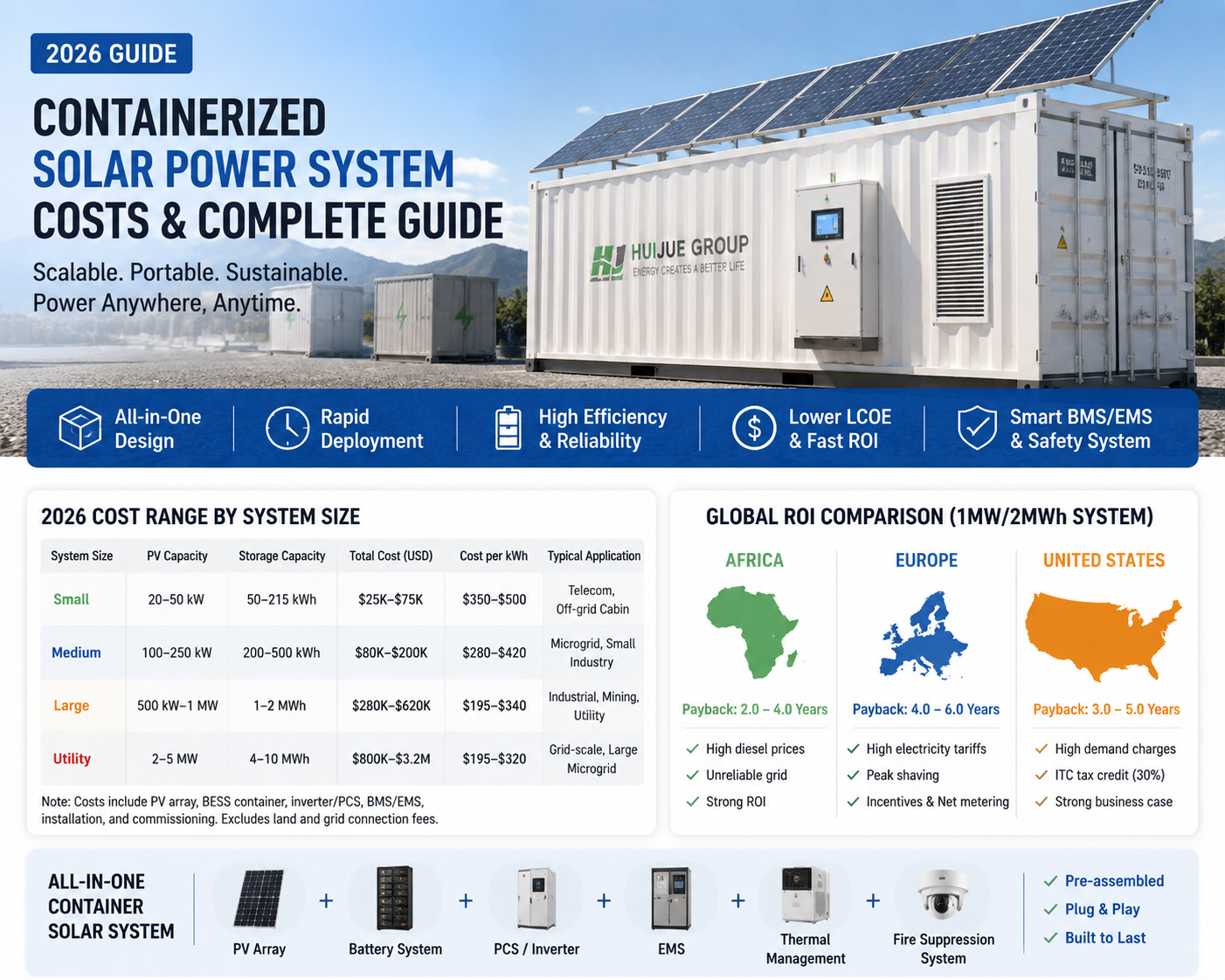
Quick Answer: 2026 Containerized Solar Power System Costs at a Glance
| System Size | PV Capacity | Storage Capacity | Total Cost (USD) | Cost per kWh | Typical Application |
|---|---|---|---|---|---|
| Small | 20-50 kW | 50-215 kWh | $25K-$75K | $350-$500 | Telecom, off-grid cabin |
| Medium | 100-250 kW | 200-500 kWh | $80K-$200K | $280-$420 | Microgrid, small industry |
| Large | 500kW-1MW | 1-2 MWh | $280K-$620K | $195-$340 | Industrial, mining, utility |
| Utility | 2-5 MW | 4-10 MWh | $800K-$3.2M | $195-$320 | Grid-scale, large microgrid |
Note: Costs include PV array, BESS container, inverter/PCS, BMS/EMS, installation, and commissioning. Excludes land and grid connection fees.
1. What Is a Containerized Solar Power System?
A containerized solar power system is a pre-assembled, transportable power plant housed within standard ISO shipping containers (typically 10, 20, or 40 feet). It integrates four core functions—generation (PV), storage (battery), conversion (inverter/PCS), and management (EMS)—into a single, plug-and-play unit that can be deployed to virtually any location.
Unlike traditional solar installations that require extensive on-site construction, containerized systems arrive 90% pre-commissioned. Connection points for PV input, grid/generator AC, and load output are standardized, reducing on-site installation time from weeks to days.
| Component | Function | Location in Container | Key Specs (2026) |
|---|---|---|---|
| PV Array (external) | Solar generation | Roof-mounted or ground-mounted | 580-730W TOPCon bifacial modules |
| Battery Banks | Energy storage | Container interior (racks) | LFP 3.2V 280Ah/314Ah/688Ah cells |
| PCS / Inverter | DC-AC conversion | Container interior (front section) | Efficiency ≥97%, 48V-1500V DC |
| BMS | Battery management | Integrated with battery racks | Cell-level monitoring, SOC/SOH tracking |
| EMS | Energy management | Container interior (control panel) | Cloud-connected, remote dispatch |
| Thermal Management | Cooling/heating | Container interior (HVAC or liquid) | Air: -20°C to +55°C; Liquid: precise ±2°C |
| Fire Suppression | Safety | Container interior (ceiling) | Aerosol + gas dual system |
2. Standard System Configurations & Specifications
Huijue Group’s containerized product line spans 12 standard configurations from 18kW/20kWh foldable units to 3450kW/6.25MWh utility-scale systems. The table below summarizes the most commonly deployed models:
| Model | Power (kW) | Energy (MWh) | Cooling | Container Size | Cell Type | Cycles | Best For |
|---|---|---|---|---|---|---|---|
| HJ-G1000-2000F | 1,000 | 2.0 | Air | 40ft | LFP 280Ah | 6,000 | Industrial, microgrid |
| HJ-G1200-2400F | 1,200 | 2.4 | Air | 40ft | LFP 280Ah | 6,000 | Mining, heavy industry |
| HJ-G1250-2500L | 1,250 | 2.5 | Liquid | 40ft | LFP 280Ah | 8,000 | Hot climate, high duty |
| HJ-G1000-2890F | 1,000 | 2.89 | Air | 40ft | LFP 280Ah | 6,000 | Grid firming, peak shaving |
| HJ-G2000-4000L | 2,000 | 4.0 | Liquid | 40ft | LFP 314Ah | 8,000 | Utility-scale storage |
| HJ-G2500-5000L | 2,500 | 5.0 | Liquid | 40ft | LFP 314Ah | 8,000 | Large utility, frequency reg |
| HJ-G2500-5000F | 2,500 | 5.0 | Air | 40ft | LFP 314Ah | 6,000 | Moderate climate utility |
| HJ-G3450-6250L | 3,450 | 6.25 | Liquid | 40ft | LFP 688Ah | 8,000 | Max density, premium projects |
| HJ-G1725-6250F | 1,725 | 6.25 | Air | 40ft | LFP 314Ah | 6,000 | Energy-optimized, lower power |
2.1 Foldable & Mobile Configurations
For applications requiring mobility—such as construction sites, disaster relief, or temporary events—Huijue offers foldable container solutions that combine PV generation and storage in a single transportable unit:
| Model | PV Output | Storage | Deploy Time | Transport | Best For |
|---|---|---|---|---|---|
| HJ08GP-M-18K20 | 18 kW | 20 kWh | 30 min | 10ft container | Small site, telecom |
| HJ20GP-M-60K215 | 60 kW | 215 kWh | 45 min | 20ft container | Construction, events |
| HJ40GP-M-140K215 | 140 kW | 215 kWh | 1 hour | 40ft container | Large temporary site |
| HJ40HQ-M-150K430 | 150 kW | 430 kWh | 1 hour | 40ft HQ container | Mining camp, military |
3. Regional Cost Analysis: Africa, Europe & the United States
System costs vary significantly by region due to differences in component sourcing, labor, import duties, grid electricity prices, and incentive structures. Below is a detailed breakdown for three key markets.
3.1 Africa: Diesel Replacement Drives Rapid ROI
| Country | Diesel Price ($/L) | Grid Tariff ($/kWh) | System Cost ($/kWh) | Annual Fuel Savings | Payback (Years) |
|---|---|---|---|---|---|
| Nigeria | $0.72 | $0.08 (unreliable) | $195-$260 | $45K-$85K | 2.5-3.5 |
| South Africa | $0.95 | $0.12 (Eskom) | $220-$300 | $55K-$95K | 3.0-4.0 |
| Kenya | $1.05 | $0.17 | $210-$280 | $50K-$90K | 2.5-3.5 |
| Egypt | $0.25 (subsidized) | $0.03 | $200-$270 | $25K-$50K | 5.0-7.0 |
| Sudan | $0.80 | N/A (off-grid) | $230-$340 | $60K-$110K | 2.0-3.0 |
Based on 1MW/2MWh system operating at 18% capacity factor, 5.5 peak sun hours, diesel generator baseline.
3.2 Europe: Peak Shaving & Self-Consumption Optimization
| Country | Grid Tariff (€/kWh) | Feed-in Tariff (€/kWh) | System Cost ($/kWh) | Annual Savings | Payback (Years) |
|---|---|---|---|---|---|
| Germany | €0.35 | €0.08 | $350-$480 | $65K-$110K | 4.5-6.0 |
| Italy | €0.28 | €0.10 | $320-$450 | $50K-$90K | 4.0-5.5 |
| Spain | €0.26 | €0.05 | $300-$420 | $45K-$80K | 4.0-5.5 |
| Bulgaria | €0.12 | €0.04 | $280-$400 | $30K-$55K | 5.0-7.0 |
EU countries benefit from reduced VAT (in some jurisdictions) and net metering. Bulgaria offers lowest system cost due to proximity to manufacturing.
3.3 United States: ITC Tax Credit Significantly Reduces Net Cost
| State | Commercial Tariff ($/kWh) | Demand Charge ($/kW) | System Cost ($/kWh) | Post-ITC Net Cost | Payback (Years) |
|---|---|---|---|---|---|
| California | $0.22 | $18.50 | $400-$560 | $280-$392 | 3.5-5.0 |
| Texas | $0.08 | $9.75 | $350-$480 | $245-$336 | 4.0-6.0 |
| New York | $0.19 | $15.20 | $420-$560 | $294-$392 | 3.5-5.0 |
| Florida | $0.10 | $8.40 | $360-$480 | $252-$336 | 4.5-6.0 |
ITC = 30% Federal Investment Tax Credit. Additional state incentives (SGIP in California, NY-Sun) can reduce net cost by another 10-20%.
4. 1MW/2MWh System Cost Breakdown
The 1MW/2MWh configuration is the most commonly deployed containerized BESS size, suitable for industrial peak shaving, microgrid stabilization, and solar firming. Here is a detailed cost breakdown:
| Component | Specification | Cost (USD) | % of Total | Notes |
|---|---|---|---|---|
| LFP Battery Cells | 3.2V 280Ah, 2MWh | $180,000-$240,000 | 43% | $90-$120/kWh at cell level |
| Battery Racks & BMS | 48 racks, cell-level monitoring | $35,000-$50,000 | 8% | Including wiring, fuses, breakers |
| PCS / Inverter | 1MW, 97% efficiency | $45,000-$65,000 | 11% | Bidirectional, grid-forming capable |
| Container & Structure | 40ft ISO, insulated, fire-rated | $25,000-$35,000 | 6% | Includes doors, flooring, cable trays |
| Thermal Management | Air-cooled HVAC system | $15,000-$25,000 | 4% | Liquid-cooled adds $8K-$12K |
| EMS & Control | Huijue HJ-EMS platform | $10,000-$18,000 | 3% | Cloud + local controller |
| Fire Suppression | Aerosol + gas dual system | $5,000-$8,000 | 1% | NFPA 855 compliant |
| PV Array (external) | 1MW TOPCon bifacial | $280,000-$350,000 | — | $0.28-$0.35/W including mounting |
| Cabling & Accessories | DC/AC cabling, connectors | $12,000-$20,000 | 3% | — |
| Installation & Commissioning | 5-7 days on-site | $20,000-$35,000 | 5% | Excludes land prep |
| Shipping & Logistics | Port-to-site delivery | $8,000-$25,000 | 2% | Varies by destination |
| Total (BESS Only) | 1MW/2MWh | $355,000-$496,000 | 100% | $178-$248/kWh |
| Total (PV + BESS) | 1MW PV + 2MWh BESS | $635,000-$846,000 | — | Turnkey system |
5. BESS Container vs. Traditional Power: Comparative Analysis
| Metric | Diesel Generator (1MW) | Grid Extension | Containerized Solar+BESS (1MW/2MWh) |
|---|---|---|---|
| Initial CapEx | $150K-$250K | $500K-$2M+ (per km) | $635K-$846K |
| Annual OPEX (Fuel/Maintenance) | $180K-$320K | $0 (utility bills) | $8K-$15K |
| CO₂ Emissions (tons/year) | 2,500-4,000 | 0 (if renewable mix) | 0 (direct), <50 (lifecycle) |
| Noise Level (at 10m) | 85-95 dB | 0 dB | 55-65 dB (HVAC only) |
| Deployment Time | 1-2 weeks | 6-24 months | 1-4 weeks |
| Fuel Dependency | 100% diesel | 0% (grid power) | 0-5% (optional backup) |
| 20-Year TCO | $3.8M-$6.7M | $500K-$2M+ (varies) | $0.8M-$1.2M |
| Maintenance Visits/Year | 12-24 (monthly+) | 0 | 2-4 (semi-annual) |
| Remote Monitoring | Limited | N/A | Full (HJ-EMS cloud) |
6. Application Scenarios
| Application | Typical Size | Key Requirements | Container Type | Diesel Savings |
|---|---|---|---|---|
| Off-Grid Microgrid | 250kW-2MW | 24/7 reliability, island mode | 40ft BESS + PV | 90-100% |
| Industrial Peak Shaving | 500kW-2MW | Demand charge reduction | 40ft BESS | N/A (grid supplement) |
| Mining & Remote Operations | 1-5MW | Haul road access, dust resistance | 40ft BESS + foldable PV | 70-90% |
| Telecom Base Station | 3.6-7.2kW | Compact, low maintenance | 10ft container | 95-100% |
| Disaster Relief / Temporary | 20-150kW | Rapid deploy (<1hr) | Foldable container | 100% |
7. Real Deployment Cases
Case 1: Bosnia 1MW/2MWh Grid-Connected System
| Parameter | Value |
|---|---|
| Location | Bosnia and Herzegovina |
| System Size | 1MW PV + 2MWh BESS |
| Container | 40ft, air-cooled |
| Commissioned | 2025 Q3 |
| Application | Grid-connected peak shaving + self-consumption |
| Annual Generation | 1.35 GWh |
| Annual Savings | €180,000 ($195,000) |
| Payback Period | 4.2 years |
| CO₂ Reduction | 680 tons/year |
Case 2: Sudan 129.6kWp Foldable Solar Container
| Parameter | Value |
|---|---|
| Location | Sudan, off-grid mining site |
| System Size | 129.6 kWp PV + 450 kWh BESS |
| Container | Foldable 40ft |
| Application | Diesel replacement for mining camp |
| Deploy Time | 4 hours |
| Diesel Displaced | 120,000 liters/year |
| Annual Savings | $96,000 |
| Payback Period | 2.8 years |
Case 3: USA 5kWp Mobile Solar Container
| Parameter | Value |
|---|---|
| Location | California, USA |
| System Size | 5 kWp PV + 10 kWh BESS |
| Container | Compact 10ft |
| Application | Emergency backup, EV charging |
| ITC Benefit | 30% Federal tax credit |
| Net Cost (post-ITC) | $18,500 |
| Annual Savings | $3,200 |
| Payback Period | 5.8 years |
Case 4: Lianyungang 94MW/188MWh Utility Storage
| Parameter | Value |
|---|---|
| Location | Lianyungang, Jiangsu, China |
| System Size | 94MW / 188MWh |
| Containers | 37 × 5MWh liquid-cooled units |
| Application | Grid-scale frequency regulation + arbitrage |
| Commissioned | 2025 Q1 |
| Daily Cycling | 1.5 cycles |
| Annual Revenue | $8.5M (arbitrage + ancillary services) |
Case 5: Hubei 365 Mobile Container for Emergency Power
| Parameter | Value |
|---|---|
| Location | Hubei, China |
| System Size | 100 kW PV + 365 kWh BESS |
| Container | Mobile 20ft, trailer-mounted |
| Application | Disaster relief, temporary power |
| Deploy Time | 45 minutes |
| Autonomy | 8 hours at full load |
| CO₂ Reduction | 180 tons/year vs diesel |
8. How to Choose a Containerized Solar System Supplier
Selecting the right supplier is as important as choosing the right system size. Use this 5-criteria evaluation framework:
| Criteria | What to Check | Red Flags | Huijue’s Position |
|---|---|---|---|
| 1. Manufacturing Capability | In-house battery pack assembly, BMS development, container integration | Reseller only, no factory audit possible | Own factory, 12 standard models, custom OEM |
| 2. Certifications | IEC 62619, UL 9540A, UN 38.3, CE, GB/T 36276 | Missing safety certs, expired test reports | Full certification suite, TÜV audited |
| 3. Deployment Track Record | Reference sites in similar climate/region, 3+ years operation | No verifiable references, only renderings | 1,000+ sites across 5 continents |
| 4. EMS Software | Cloud platform, API access, remote firmware updates | Locked ecosystem, no data export, manual only | HJ-EMS cloud, open API, mobile app |
| 5. After-Sales Support | Local service partner, response time SLA, spare parts inventory | No local presence, parts ship from China only | Regional partners in Africa, ME, SE Asia, EU |
9. 2026 Market Trends & Technology Outlook
| Trend | 2025 Baseline | 2026 Forecast | Impact on Buyers |
|---|---|---|---|
| LFP Cell Cost | $90-$120/kWh | $70-$95/kWh | 15-20% system cost reduction |
| Energy Density (cell) | 280Ah / 180 Wh/kg | 314Ah+ / 200+ Wh/kg | Same footprint, 12% more capacity |
| Liquid Cooling Adoption | 35% of new installs | 50-55% | Standard for hot climates |
| AI-Optimized EMS | Rule-based dispatch | ML predictive dispatch | 5-12% revenue increase |
| Grid-Forming Inverters | Niche / premium | Mainstream option | Enables 100% inverter-based microgrids |
| Bifacial PV Module Efficiency | 22.5% | 23.5-24% | 5-7% more energy per m² |
10. Procurement Checklist
| # | Item | Specification / Action | Status |
|---|---|---|---|
| 1 | Load Profile Analysis | 15-min interval data for 12 months | ☐ |
| 2 | Site Survey | GHI, terrain, soil bearing, access road | ☐ |
| 3 | Grid Connection Study | Capacity, interconnection agreement | ☐ |
| 4 | Permitting | Building, electrical, environmental permits | ☐ |
| 5 | System Sizing | PV capacity, BESS capacity, autonomy hours | ☐ |
| 6 | Container Specification | Size, cooling type, protection rating | ☐ |
| 7 | Battery Chemistry | LFP confirmed, cycle life warranty | ☐ |
| 8 | PCS Specification | Power rating, efficiency, grid-forming | ☐ |
| 9 | EMS Features | Remote monitoring, API, scheduling | ☐ |
| 10 | Safety Systems | Fire suppression, thermal runaway protection | ☐ |
| 11 | Warranty Terms | Battery 10yr/6000 cycles, PCS 5yr, container 25yr | ☐ |
| 12 | Logistics Plan | Shipping route, crane access, customs | ☐ |
Conclusion
Containerized solar power systems represent the optimal path to energy independence for off-grid sites, industrial facilities, and utility-scale applications in 2026. With system costs declining to $195-$560/kWh, LFP battery cycles exceeding 8,000, and deployment times measured in days rather than months, the economic case has never been stronger.
The key to success lies in proper system sizing, selecting a manufacturer with proven deployment experience, and leveraging intelligent EMS platforms for ongoing optimization. Whether replacing diesel in Africa at 2.5-3.5 year payback or peak shaving in Europe at 4-6 year payback, containerized solar + storage delivers measurable ROI from day one.
Ready to Design Your Containerized Solar Power System?
Huijue Group’s engineering team provides free system sizing, cost estimation, and deployment planning for projects of any scale—from 20kW telecom sites to 5MW utility installations.
📧 Contact Huijue Group for a Custom Quote
📦 Explore our Container Energy Storage Product Line