
 chinahuijue@gmail.com
 +1 (702) 204-9855
Energy Storage Cabinet: 2026 Specs, Sizing & Cost Guide for C&I
Last updated: July 20, 2026 | Reading time: 10 minutes
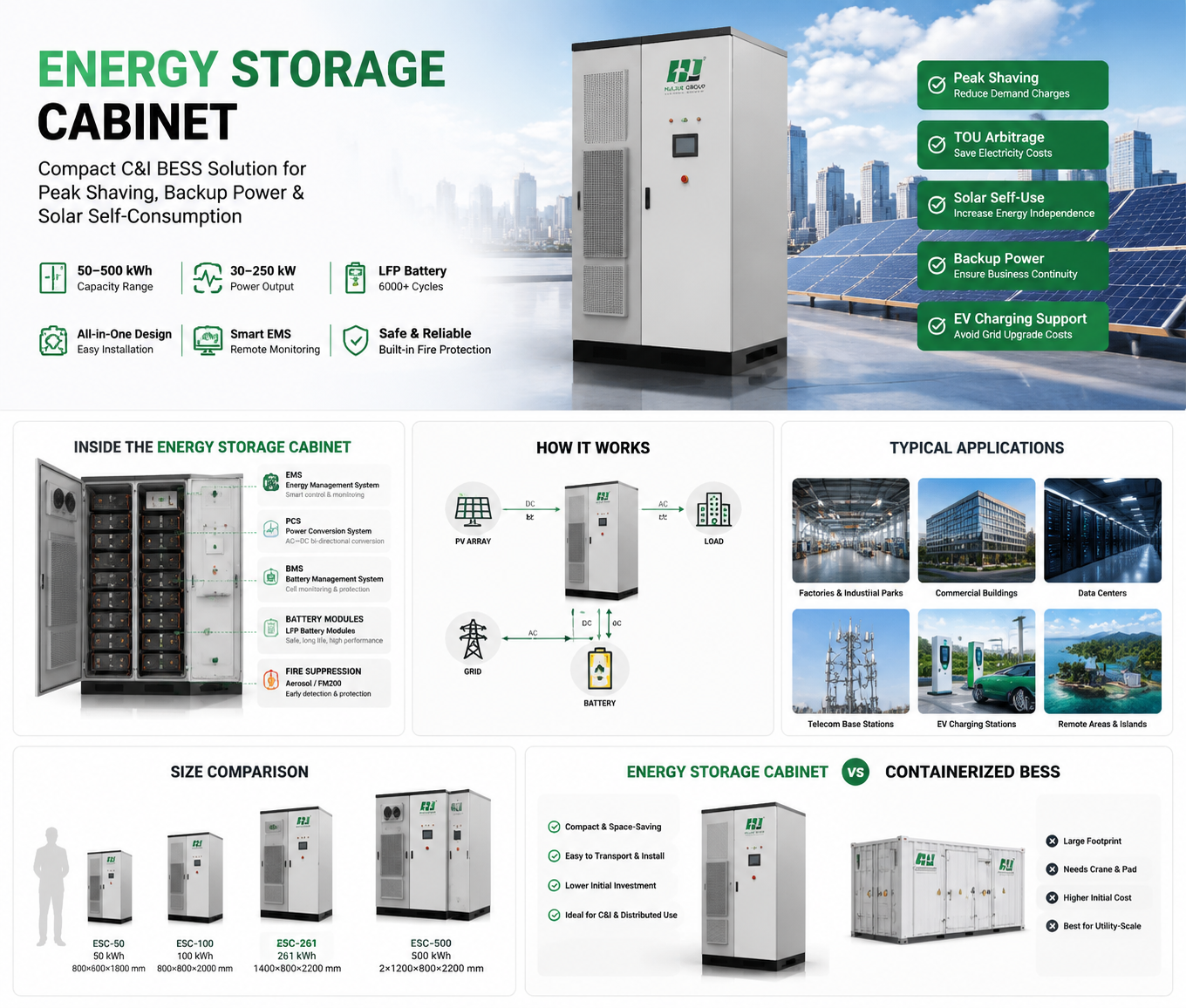
Quick Answer: An energy storage cabinet is a compact, self-contained BESS unit — typically 50–500 kWh — designed for commercial and industrial (C&I) peak shaving, backup power, and solar self-consumption. Unlike containerized BESS (1–5 MWh+), cabinets fit in electrical rooms, parking garages, or rooftop plant rooms. LFP-based cabinets cost $280–$450/kWh in 2026, with payback in 4–7 years through peak demand reduction and time-of-use arbitrage.
What Is an Energy Storage Cabinet?
An energy storage cabinet integrates LFP battery modules, a Battery Management System (BMS), Power Conversion System (PCS), Energy Management System (EMS), and safety systems into a single floor-standing enclosure — roughly the size of a server rack or large refrigerator. It’s the “smaller sibling” of containerized BESS, designed for installations where space is limited or a full container is overkill.
| Feature | Energy Storage Cabinet | Containerized BESS |
|---|---|---|
| Capacity range | 50–500 kWh | 500 kWh – 5 MWh+ |
| Footprint | 1–3 m² (floor-standing) | 10ft / 20ft / 40ft container |
| Installation location | Electrical room, garage, rooftop plant room | Outdoor pad, parking lot, field |
| Power output | 30–250 kW | 250 kW – 2 MW+ |
| Transport | Forklift / pallet jack | Truck / crane |
| Installation time | 1–2 days | 1–2 weeks |
| Best for | C&I buildings, retail, small factories, telecom | Utility-scale, large industrial, microgrids |
Standard Configurations & Specs
| Model | Capacity | Power | Voltage | Dimensions (W×D×H) | Weight | Typical Price |
|---|---|---|---|---|---|---|
| ESC-50 | 50 kWh | 30 kW | 400V AC | 800×600×1800 mm | 650 kg | $18,000–$24,000 |
| ESC-100 | 100 kWh | 50 kW | 400V AC | 800×800×2000 mm | 1,100 kg | $32,000–$42,000 |
| ESC-200 | 200 kWh | 100 kW | 400V AC | 1200×800×2200 mm | 2,100 kg | $60,000–$78,000 |
| ESC-261 | 261 kWh | 130 kW | 400V AC | 1400×800×2200 mm | 2,700 kg | $78,000–$98,000 |
| ESC-500 | 500 kWh | 250 kW | 400V AC | 2× 1200×800×2200 mm | 5,000 kg | $145,000–$185,000 |
All models use LFP cells, 6,000+ cycles at 80% DoD, IP54 enclosure, -20°C to +55°C operating range. Prices include battery, BMS, PCS, EMS, and fire suppression. Excludes installation and grid connection.
Why 261 kWh? The “261 kWh” capacity (seen in search data as “bess 261kwh“) corresponds to a popular configuration using 14 × 18.6 kWh LFP modules in a single cabinet — hitting the sweet spot for 200 kW peak shaving with 2-hour duration in C&I applications.
Core Components Inside the Cabinet
| Component | Function | Key Spec |
|---|---|---|
| LFP battery modules | Store energy | 3.2V cells, 18–20 kWh per module; 6,000 cycles; passive/active balancing |
| BMS (Battery Management System) | Monitor & protect cells | Cell-level voltage/temp monitoring; SOC/SOH estimation; overcharge/overdischarge protection |
| PCS (Power Conversion System) | AC↔DC conversion | Bi-directional; 96%+ efficiency; grid-forming/off-grid capable |
| EMS (Energy Management System) | Optimize charge/discharge | AI-based load forecasting; TOU arbitrage; peak shaving; remote monitoring via 4G/WiFi |
| Thermal management | Maintain battery temp | Air-cooled (≤200 kWh) or liquid-cooled (>200 kWh); maintains 15–35°C cell temp |
| Fire suppression | Safety | Aerosol or FM200 gas; smoke/heat detectors; automatic dump switch |
| AC distribution | Grid connection & load management | AC breaker, surge protection, CT for grid metering, backup load output |
5 Applications for Energy Storage Cabinets
| Application | How It Works | Typical Size | ROI Driver |
|---|---|---|---|
| Peak shaving | Discharge during peak demand to reduce demand charges | 100–261 kWh | Cut demand charges 30–50% |
| TOU arbitrage | Charge at night (low tariff); discharge during day (high tariff) | 100–200 kWh | Save $0.15–$0.30/kWh spread |
| Solar self-consumption | Store excess daytime solar for nighttime use | 50–200 kWh | Avoid exporting at low FIT rates |
| Backup power (UPS) | Instant switchover during grid outage (<20ms) | 50–100 kWh | Prevent production downtime |
| EV charging support | Buffer grid power for fast chargers | 100–261 kWh | Avoid grid upgrade costs |
Sizing Guide: How to Choose the Right Cabinet
4-Step Sizing Method
| Step | Action | Example |
|---|---|---|
| 1. Analyze load profile | Review 15-min interval data for 12 months; identify peak demand and duration | Factory peak: 180 kW for 2 hours daily |
| 2. Determine objective | Peak shaving? Backup? Solar shifting? This determines required discharge duration | Peak shaving: need 2-hour duration |
| 3. Calculate required capacity | Peak power × duration ÷ DoD ÷ efficiency | 180 kW × 2h ÷ 0.8 ÷ 0.92 = 489 kWh → ESC-500 |
| 4. Verify power rating | Cabinet PCS power ≥ peak demand to shave | ESC-500 has 250 kW PCS; need 180 kW → ✅ sufficient |
Common sizing mistake: Sizing only for energy (kWh) but forgetting power (kW). If your peak demand is 250 kW but your cabinet’s PCS is only 100 kW, you can only shave 100 kW — regardless of battery capacity. Always verify both ratings.
Cost Analysis & ROI
| Cost Component | 100 kWh Cabinet | 261 kWh Cabinet | 500 kWh Cabinet |
|---|---|---|---|
| Equipment (battery + PCS + EMS) | $32,000–$42,000 | $78,000–$98,000 | $145,000–$185,000 |
| Installation & electrical | $3,000–$5,000 | $6,000–$10,000 | $10,000–$18,000 |
| Grid connection & permits | $1,000–$2,000 | $2,000–$4,000 | $3,000–$6,000 |
| Total deployed cost | $36,000–$49,000 | $86,000–$112,000 | $158,000–$209,000 |
| Cost per kWh | $360–$490 | $330–$430 | $316–$418 |
ROI Example: 261 kWh Cabinet for Factory Peak Shaving
| Parameter | Value |
|---|---|
| Cabinet cost (deployed) | $98,000 |
| Peak demand reduced | 130 kW |
| Demand charge savings | $18/kW × 130 kW × 12 = $28,080/year |
| TOU arbitrage savings | $0.15/kWh × 261 kWh × 300 cycles = $11,745/year |
| Total annual savings | $39,825 |
| Maintenance cost | $1,200/year |
| Net annual savings | $38,625 |
| Payback period | 2.5 years |
Key insight: In markets with high demand charges ($15+/kW) — like many European countries and parts of the US — peak shaving alone can pay back a 261 kWh cabinet in under 3 years. Even without TOU arbitrage, the demand charge savings justify the investment.
Energy Storage Cabinet vs Other BESS Form Factors
| Form Factor | Capacity | $/kWh (2026) | Best For | Limitation |
|---|---|---|---|---|
| Rack-mounted (19″ rack) | 5–30 kWh | $400–$600 | Small commercial, telecom, residential | Limited scalability; manual thermal management |
| Cabinet (floor-standing) | 50–500 kWh | $330–$490 | C&I buildings, retail, small factories | Max ~500 kWh per unit; need multiple for larger |
| Containerized (10–40ft) | 500 kWh – 5 MWh | $280–$420 | Utility, large industrial, microgrids | Requires outdoor pad; crane installation |
| Skid-mounted | 200 kWh – 2 MWh | $300–$450 | Mining, temporary sites, military | Less weather protection than container |
Safety & Certifications
| Standard | What It Covers | Required For |
|---|---|---|
| UL 9540A | Thermal runaway fire propagation test | US market; increasingly required globally |
| IEC 62619 | Safety requirements for battery systems | EU and most international markets |
| IEC 62040 | UPS safety and performance | Backup power applications |
| UN 38.3 | Battery transport safety testing | Required for shipping lithium batteries internationally |
| CE marking | EU product safety compliance | European Economic Area |
Critical Safety Features to Verify
- Cell-level fusing: Each LFP cell has individual fuse; prevents cascade failure
- Thermal runaway containment: Cabinet designed to contain a single cell failure without propagation (UL 9540A tested)
- Automatic disconnect: Contactor disconnects battery from PCS on BMS alarm
- Emergency stop: Physical E-stop button on cabinet exterior
- Ventilation: Forced air or exhaust system to prevent gas accumulation
- Remote monitoring: Real-time alerts for temperature, smoke, gas detection
FAQ: Energy Storage Cabinets
Q1: What is an energy storage cabinet and how does it differ from a containerized BESS?
An energy storage cabinet is a compact, floor-standing BESS unit (50–500 kWh) designed for indoor installation in electrical rooms or plant rooms. A containerized BESS is housed in a standard shipping container (500 kWh – 5 MWh+) for outdoor installation. Cabinets are best for C&I buildings where space is limited; containers are better for utility-scale or large industrial sites.
Q2: How much does a 261 kWh energy storage cabinet cost?
A 261 kWh LFP energy storage cabinet costs $78,000–$98,000 for the equipment (battery, BMS, PCS, EMS, safety systems), plus $6,000–$10,000 for installation and $2,000–$4,000 for grid connection. Total deployed cost: $86,000–$112,000, or approximately $330–$430/kWh.
Q3: How long do LFP energy storage cabinets last?
LFP battery cabinets deliver 6,000+ cycles at 80% depth of discharge, translating to 10–15 years of daily cycling. The BMS extends battery life through intelligent charge management and temperature control. PCS and EMS electronics typically last 15+ years. At end of life, LFP cells can be recycled — recovering 95%+ of lithium, iron, and phosphate.
Q4: Can an energy storage cabinet work off-grid?
Yes. Modern cabinets with grid-forming PCS can operate in off-grid (island) mode, providing power independently from the grid. The EMS automatically switches between grid-connected and off-grid modes. For continuous off-grid operation, pair the cabinet with solar panels to charge the battery during the day. A 261 kWh cabinet with 100 kWp solar can power a small facility 24/7.
Q5: Do I need permits to install an energy storage cabinet?
Requirements vary by country and jurisdiction. In most markets, you need: (1) electrical permit for the installation, (2) grid interconnection approval from the utility, (3) fire safety review (especially for lithium batteries), and (4) building permit for structural loading. Your EPC contractor or equipment supplier should handle the application process. Typical approval timeline: 4–12 weeks.
Q6: How do I size an energy storage cabinet for peak shaving?
Four steps: (1) Analyze your 15-minute interval load data for 12 months to find peak demand and duration. (2) Determine how many hours of peak shaving you need (typically 2–4 hours). (3) Calculate required capacity: peak power × hours ÷ 0.8 (DoD) ÷ 0.92 (efficiency). (4) Verify the cabinet’s PCS power rating ≥ your peak demand to shave. When in doubt, consult with a supplier for a free sizing analysis.
Conclusion
Energy storage cabinets fill the gap between small residential batteries and large containerized BESS — delivering 50–500 kWh of LFP storage in a compact, indoor-installable package. For C&I buildings with demand charges, TOU tariffs, or solar self-consumption goals, a properly sized cabinet pays back in 2.5–7 years while providing backup power and grid independence as bonuses.
Looking for an energy storage cabinet for your commercial or industrial project? Contact Huijue for free sizing analysis and pricing. Explore our energy storage products or read our Complete BESS Guide and Containerized Solar Power Systems Guide.
Related: How to Choose a BESS Integrator | Solar Energy Storage Intermittency | Intelligent Power for Base Stations