
 chinahuijue@gmail.com
 +1 (702) 204-9855
Hybrid Power System for Telecom Base Stations: Solar, Wind, Battery and Diesel Solutions
As telecom networks continue to expand, many remote communication sites face increasing challenges in maintaining reliable and cost-effective power supply.
Traditional power solutions often rely heavily on unstable grids or diesel generators, resulting in high operating costs, frequent maintenance requirements, and limited backup capability.
A hybrid power system combining solar, wind, lithium battery storage, diesel backup, and intelligent energy management provides a reliable solution for new telecom sites and remote communication infrastructure.
Key challenges include:
• Unstable grid connections in remote areas
• High diesel fuel and transportation costs
• Difficult maintenance access for isolated sites
• Increasing power consumption from 5G communication equipment
By integrating renewable energy generation and advanced battery storage, hybrid telecom power systems help operators improve reliability, reduce operating costs, and achieve long-term sustainable power management.
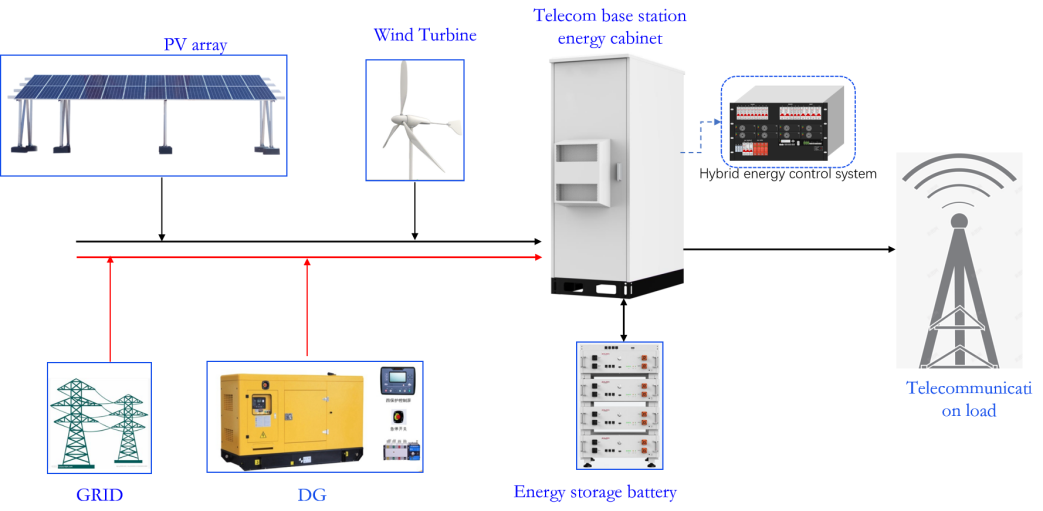
- System Architecture of Hybrid Telecom Power Solution
- Photovoltaic (PV) Array
- Wind Turbine (48V Small-Scale Wind Turbine)
- Energy Storage Lithium Battery System (Smart Lithium Battery/Standard Lithium Battery)
- Hybrid Energy Control Cabinet (Includes Rectification, PV, Inverter, Power Distribution, Monitoring)
- Diesel Generator Set (Silent Type, with ATS Automatic Transfer Switch)
- EMS/FSU Smart Monitoring Platform
- Core Product Line
(1)Energy Cabinet Series
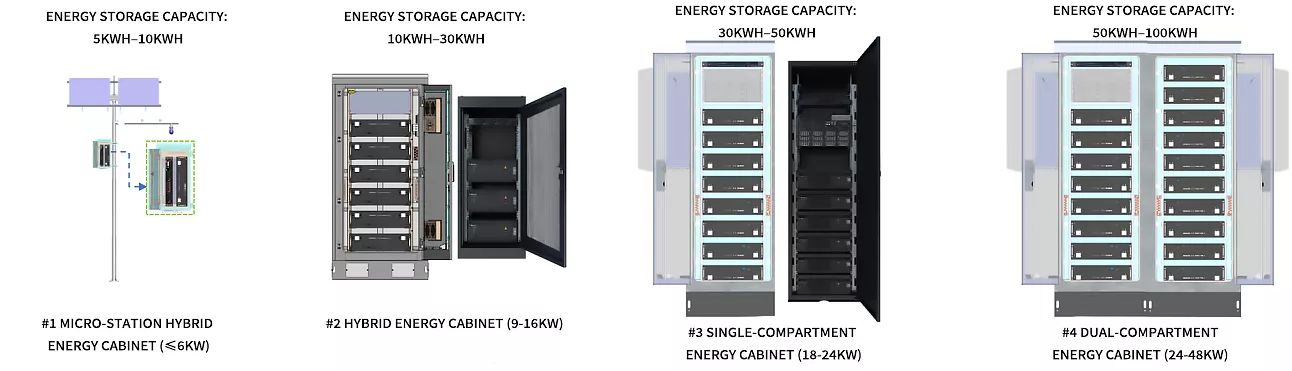
(a)Classified by capacity level (4 categories in total):
| Type | Power Range | Energy Storage Capacity | Suitable Applications |
| Hybrid Energy Cabinet (Micro Station) | ≤6 kW | 5~10 kWh | Micro base stations, edge sites |
| Hybrid Energy Cabinet (Small Station) | 9~16 kW | 10~30 kWh | Small and medium outdoor sites |
| Single-Compartment Energy Cabinet (Medium Station) | 18~24 kW | 30~50 kWh | Medium base stations |
| Dual-Compartment Energy Cabinet (Large Station) | 24~48 kW | 50~100 kWh | Large base stations, high-traffic sites |
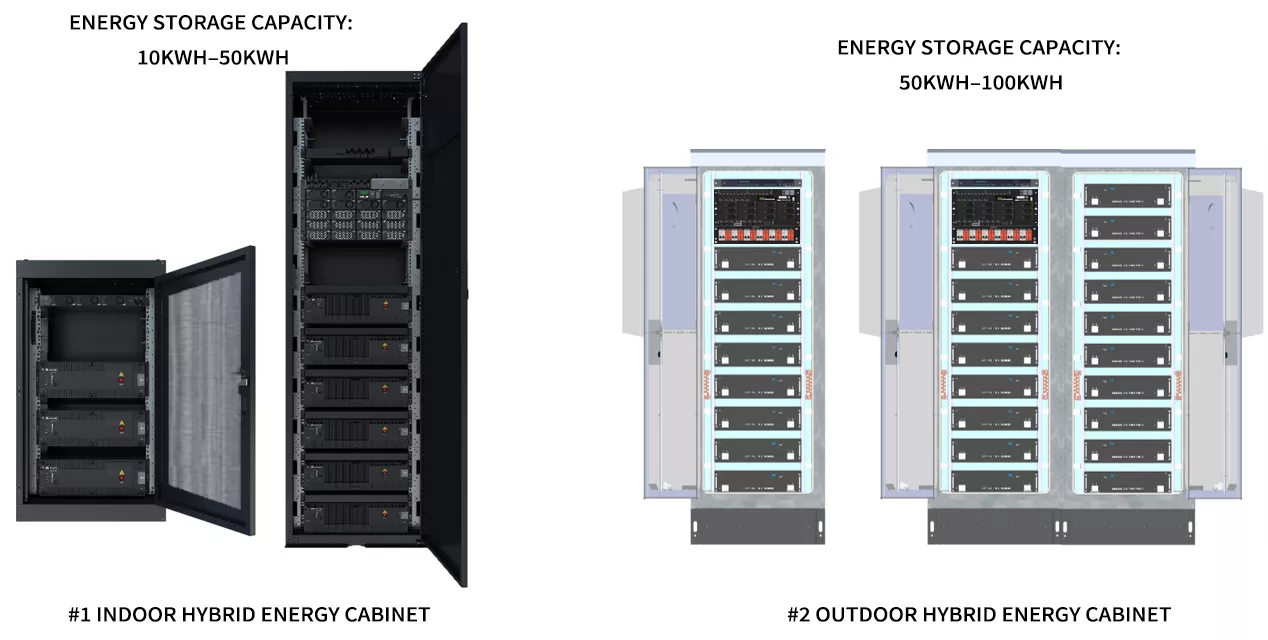
(b)By Installation Environment:
| Type | Power Range | Energy Storage Capacity | Installation Location |
| Indoor Hybrid Energy Cabinet | 6~36 kW | 10~50 kWh | Equipment rooms, indoor sites |
| Outdoor Hybrid Energy Cabinet | 6~36 kW | 50~100 kWh | Outdoor sites without equipment rooms |
Note: Some models support flexible capacity expansion, such as upgrading a 6kW system to 8kW by replacing the 4kW module.
(2)48V Hybrid Power System (DC Output)
- Power ratings: 9kW / 24kW / 36kW / 48kW
- Supports multi-source input: PV, utility grid, diesel generator
- Peak efficiency ≥94% (96% optional)
- Output voltage: 43.2–58V DC (default 53.5V)

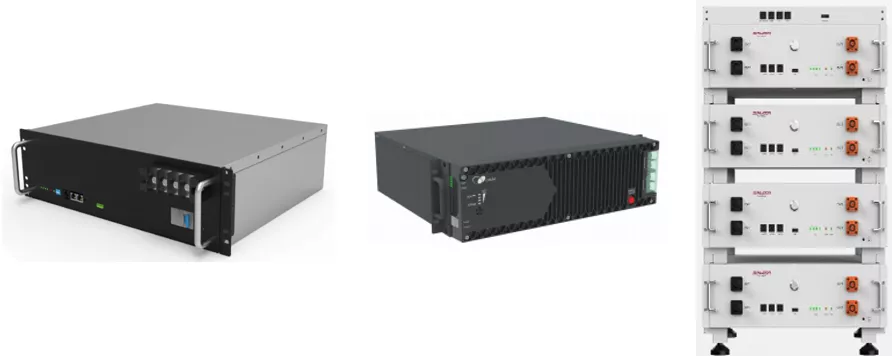
(3)Energy Storage Lithium Battery
- Smart Lithium Battery: Supports constant voltage output, bidirectional DC/DC conversion, integrated BMS, and mixed use of new and old batteries
- Standard Lithium Battery: Modular design, maintenance-free, supports parallel expansion
- Capacity Options: 100Ah, 200Ah, etc., delivering 4.8–10.24kWh per module
- Operating Temperature: Discharge -20°C to +45°C; Charge 0°C to +45°C
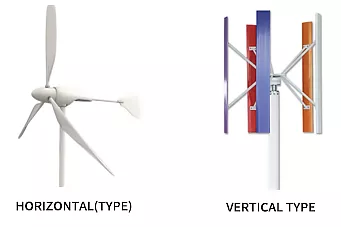
(4)Wind Power Generation Components (48V)
- Power: 600W / 1000W / 2000W
- Available in horizontal-axis and vertical-axis configurations
- Low start-up wind speed as low as 2.5m/s, suitable for wind resource areas such as islands and remote rural regions
(5)Photovoltaic System
- Component Type:
- P-type 500 Series (Hi-MO5, 540–560W, 21.7% efficiency)
- P-type 600 Series (Hi-MO X, 630–650W, 24.1% efficiency, BC technology)
- Installation methods: Ground-mounted (steel structure/truss/single column), rooftop-mounted (flat roof/color-coated steel sheet)
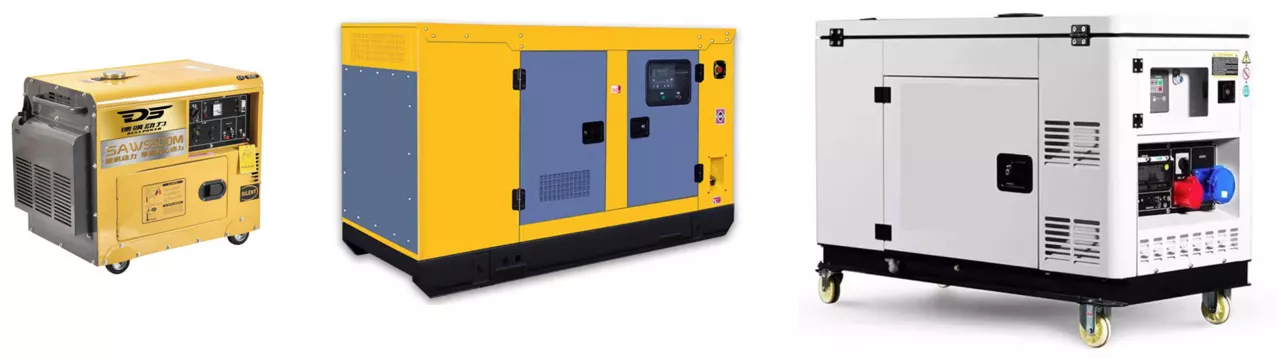
(6)Diesel Generator Set
- Power: 5kW – 30kW
- Quiet design with intelligent monitoring and remote management
- Supports automatic start/stop, ATS switching, and low emissions
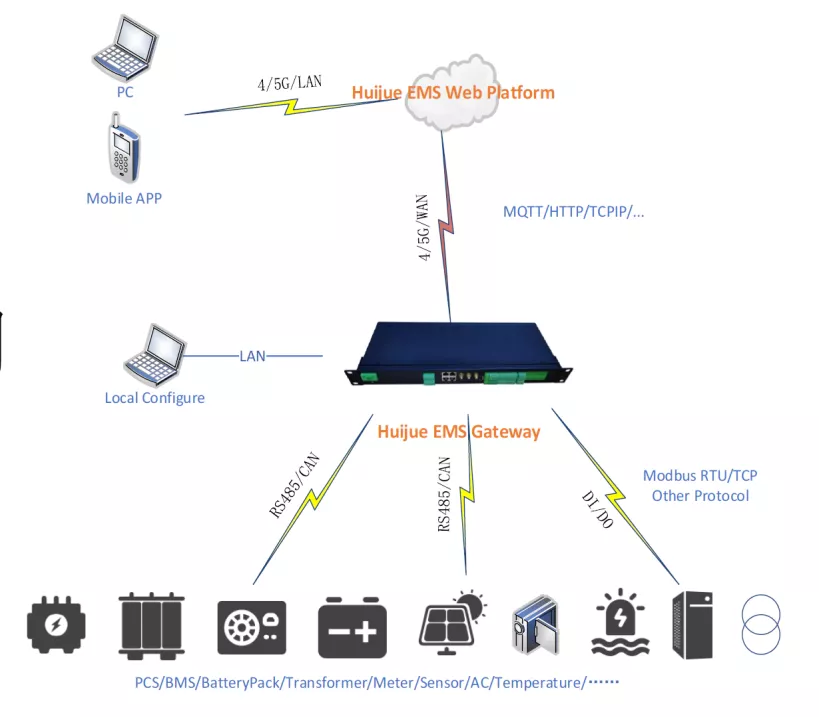
(7)EMS/FSU Monitoring System
- Supports 8 DI channels, 4 DO channels, and 8 RS485 channels
- Connects to smoke detectors, door contacts, water leak sensors, temperature/humidity sensors, and other devices
- Supports MQTT/HTTP/Modbus protocols for integration with cloud platforms
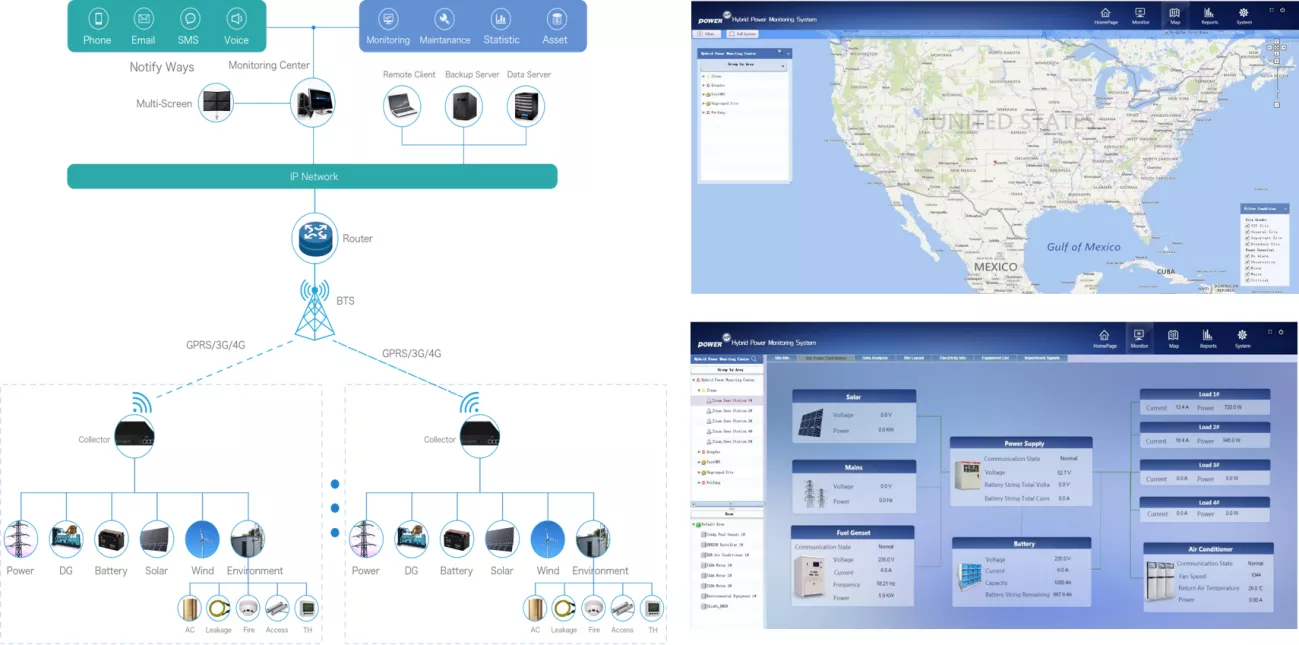
(8)Energy Management Platform (HJ-EMS)
- Enable site-level/network-level visual operations management
- Support load balancing, remote alerts, asset statistics, and multi-screen coordination
- Dual-platform management via mobile app + web interface
Frequently Asked Questions (FAQ)
1. What is a hybrid power system for telecom base stations?
A hybrid power system for telecom base stations is an integrated energy solution that combines multiple power sources, including solar PV, wind power, lithium battery storage, grid power, and diesel generators.
The system intelligently manages different energy sources to provide reliable and cost-effective power for communication sites, especially in remote areas with unstable grid access or no grid connection.
Typical components include:
- Solar photovoltaic (PV) system
- Small-scale wind turbine
- Lithium battery energy storage system
- Hybrid power control cabinet
- Diesel generator with ATS
- EMS/FSU monitoring platform
2. Why do telecom base stations need hybrid power systems?
Many telecom sites, especially remote communication stations, face challenges such as:
- Unstable grid power supply
- Frequent power outages
- High diesel fuel costs
- Difficult maintenance access
- Increasing electricity demand from 5G networks
A hybrid telecom power system improves energy reliability by combining renewable energy generation, battery storage, and backup power sources.
It helps telecom operators reduce operating costs while maintaining continuous communication services.
3. How does a hybrid telecom power system work?
A hybrid telecom power system automatically coordinates different energy sources according to availability and demand.
A typical operating priority is:
Solar → Wind → Battery → Grid → Diesel Generator
During the daytime, solar and wind energy supply the telecom load and charge the battery.
When renewable energy is insufficient, the battery provides backup power.
If the battery is depleted or a long outage occurs, the diesel generator can automatically start through the ATS system.
4. Can a hybrid power system work without grid electricity?
Yes.
Hybrid power systems can be designed for completely off-grid telecom sites.
Off-grid telecom power systems typically combine:
- Solar panels
- Wind turbines
- Lithium battery storage
- Diesel generator backup
- Intelligent energy management system
They are suitable for:
- Remote villages
- Islands
- Mountains
- Deserts
- Rural communication networks
- Emergency communication sites
5. What are the advantages of solar wind hybrid power systems for telecom towers?
Solar wind hybrid systems provide several advantages:
- Renewable energy utilization
- Reduced diesel fuel consumption
- Lower operating costs
- Longer backup duration
- Improved energy independence
- Suitable for remote environments
By combining solar and wind generation, the system can provide more stable renewable power because solar and wind resources complement each other.
6. What type of batteries are used in hybrid telecom power systems?
Modern hybrid telecom power systems mainly use lithium battery technology, especially Lithium Iron Phosphate (LiFePO4) batteries.
Advantages include:
- High safety performance
- Long cycle life
- High energy efficiency
- Low maintenance requirements
- Excellent temperature adaptability
Battery capacity can be customized according to:
- Telecom load power
- Required backup hours
- Installation conditions
- Expansion requirements
7. How long can a hybrid telecom power system provide backup power?
Backup duration depends on:
- Battery capacity
- Site power consumption
- Renewable energy availability
- System configuration
Small telecom sites may require several hours of backup, while larger communication stations can be designed for longer autonomy periods.
A properly configured lithium battery system can significantly extend backup time compared with traditional lead-acid batteries.
8. What is the difference between a hybrid power system and a traditional diesel generator system?
The main differences are:
| Hybrid Power System | Diesel Generator System |
|---|---|
| Uses renewable energy | Relies mainly on fuel |
| Lower operating cost | High fuel expenses |
| Less maintenance | Frequent maintenance |
| Lower emissions | Higher carbon emissions |
| Intelligent monitoring | Limited control |
Hybrid systems reduce diesel generator operating hours while improving overall energy efficiency.