
 chinahuijue@gmail.com
 +1 (702) 204-9855
Telecom Energy Storage Solutions: How Solar + Battery Systems Improve Base Station Backup Power
Many operators are upgrading existing sites with telecom energy storage solutions to improve backup power reliability and reduce operating costs. (especially tower equipment rooms/outdoor cabinet sites), achieve zero-investment upgrades to backup power capacity and energy savings through “photovoltaic + energy storage” solutions.
- Addressing pain points
- Lead-acid batteries offer limited backup time (only 2–3 hours)
- High battery replacement costs (approx. ¥4,000 per site annually)
- Lack of environmental monitoring leads to shortened battery life due to air conditioning failures
- Inadequate for planned outages (>3 hours)
- Solutions Classification
(1)DC Energy Storage Solutions
- Features:Direct connection to the 48V busbar, no modification to the original power supply system required.
- Advantages:
- Simple retrofitting, low cost
- Pure DC-DC conversion, high efficiency (>96%)
- Reserved PV interface for future expansion
- Supports peak shaving and valley filling (charging during off-peak hours, discharging during peak/spike hours)
(2)AC Energy Storage Solutions
- Core Equipment: Power Conversion System (PCS)
- Model: EPCS15 / EPCS30 (15kW / 30kW)
- Supports wide voltage input range of 150–750V, compatible with 280Ah large-capacity battery cells
- Built-in lightweight Energy Management System (EMS) supporting microgrid, self-generation and self-consumption modes, and more
- Applicable scenarios:Sites requiring simultaneous coverage of AC loads (e.g., air conditioning)
- Advantages:Greater energy storage capacity, higher peak-to-off-peak arbitrage profits
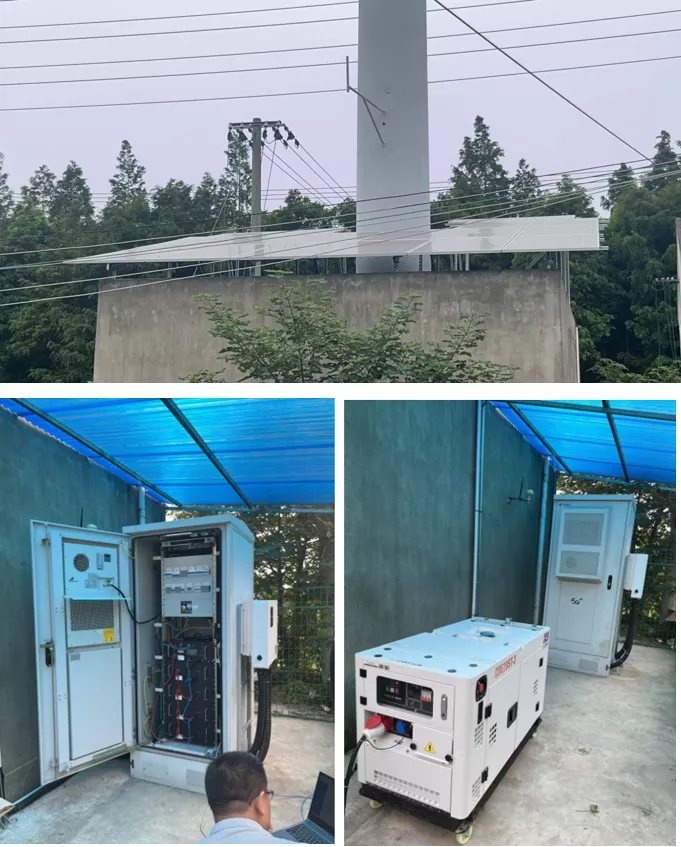
- Battery Selection (Existing Stations)
- Selecting the right battery energy storage system is critical for telecom applications where safety and lifecycle performance are essential. (280Ah)
- Energy density ≥165Wh/kg
- Cycle life up to 26,000 cycles (0.5C, 100% DOD)
- High safety (solid-liquid hybrid electrolyte, low fire/explosion risk)
- Standard Lithium Battery (100Ah/200Ah)
- Modular design, scalable up to 50kWh in parallel
- Business Model Highlights
- Zero Investment for Operators: Battery investment, operation & maintenance, and disposal costs are covered by the partner
- Electricity Cost Sharing: Enjoy approximately 3% discount on electricity rates
- Extended Backup Power Duration: Increased from 2–3 hours to up to 7 hours
- Data Access: Free provision of environmental and electricity consumption data interfaces
Safety Assurance System (Energy Storage Products)
- Multi-level battery cell safety monitoring
- High-efficiency thermal insulation + pressure relief valve + compartmentalized design
- Intelligent fire suppression (perfluorohexane targeted extinguishing)
- Liquid cooling thermal management (precise temperature differential control)
- End-to-end fire detection monitoring
Typical Application Scenario Solutions
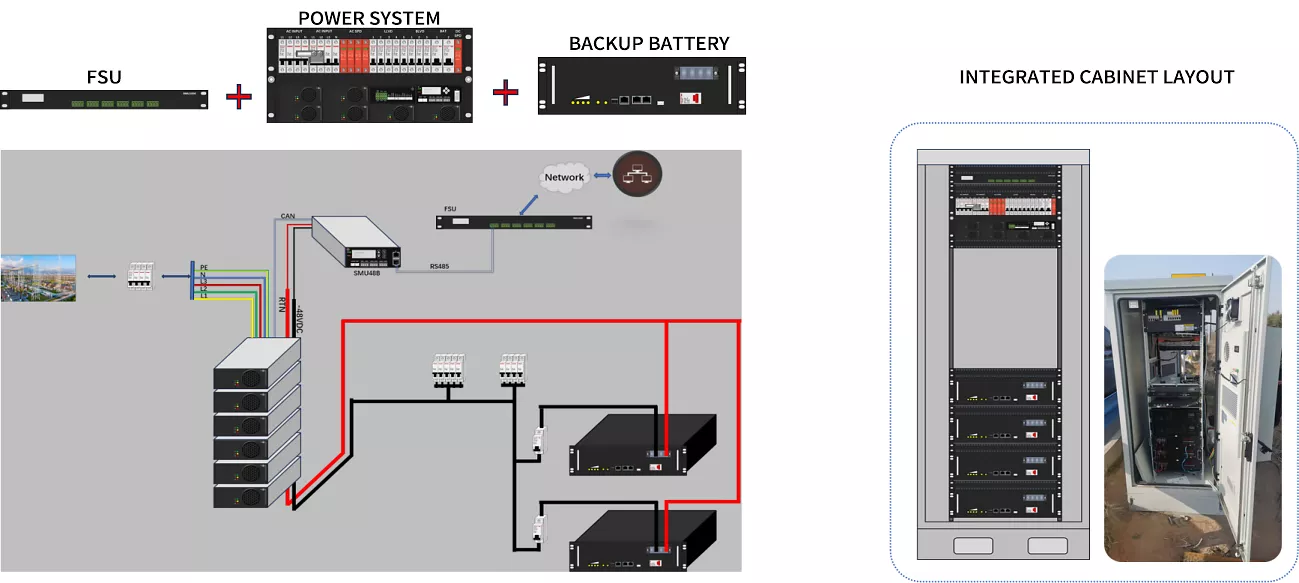
Scenario 1: Grid Power + Backup Power Storage
- Components: Mains power + Battery + FSU monitoring
- Function: Supplies power during mains operation; provides short-term backup power during mains outages
- Applications: Urban base stations, areas with stable power grids
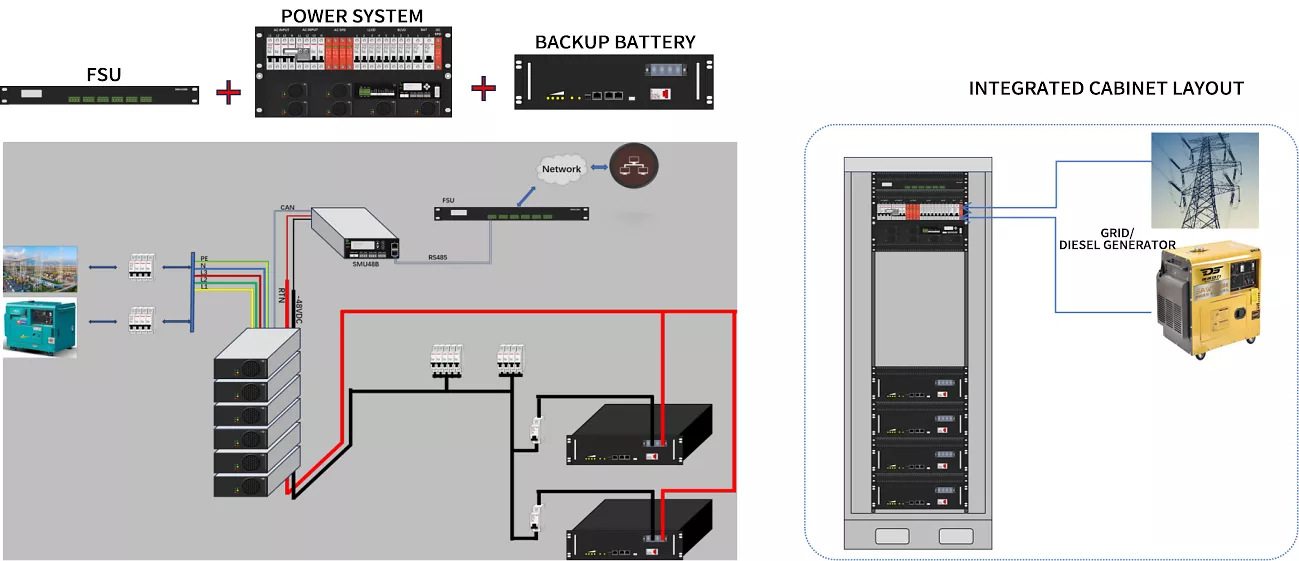
Scenario 2: Grid Power + Energy Storage + Diesel Generator
- Components: Mains power + Battery + Diesel generator + FSU
- Logic: Mains power → Battery → Diesel generator (three-tier protection)
- Application: Remote areas with mains power but occasional outages
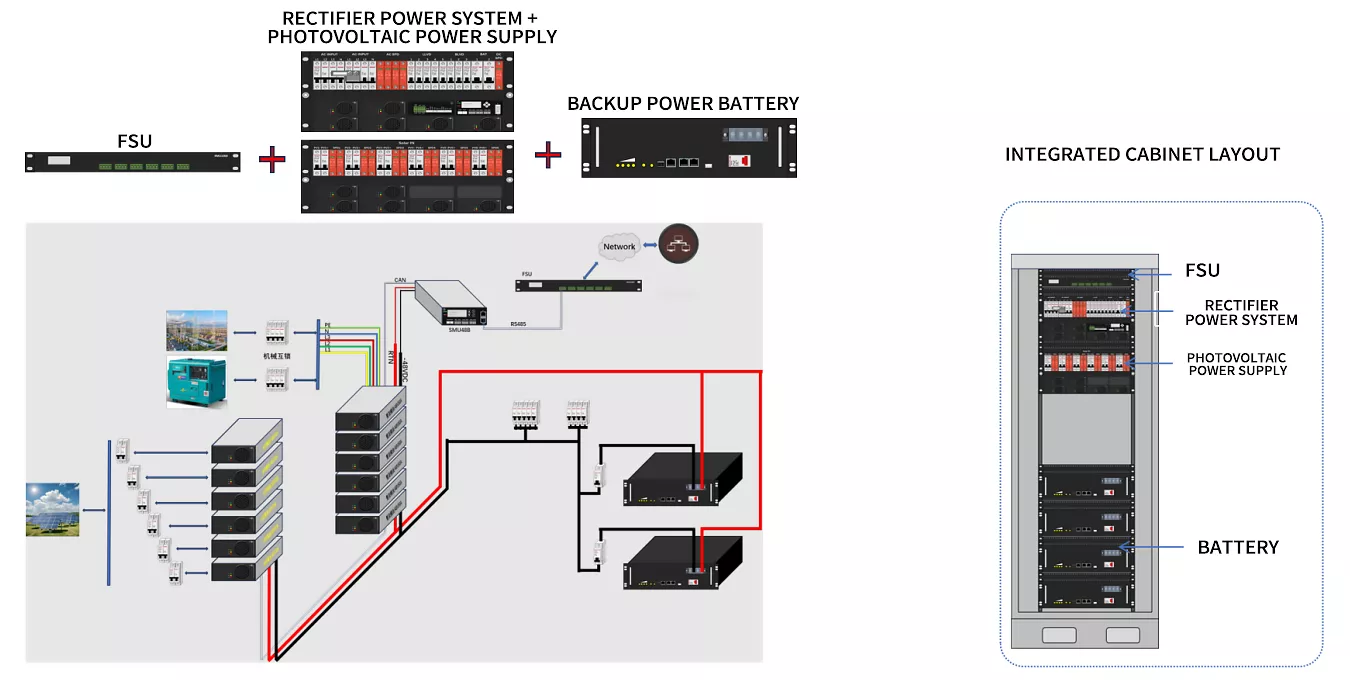
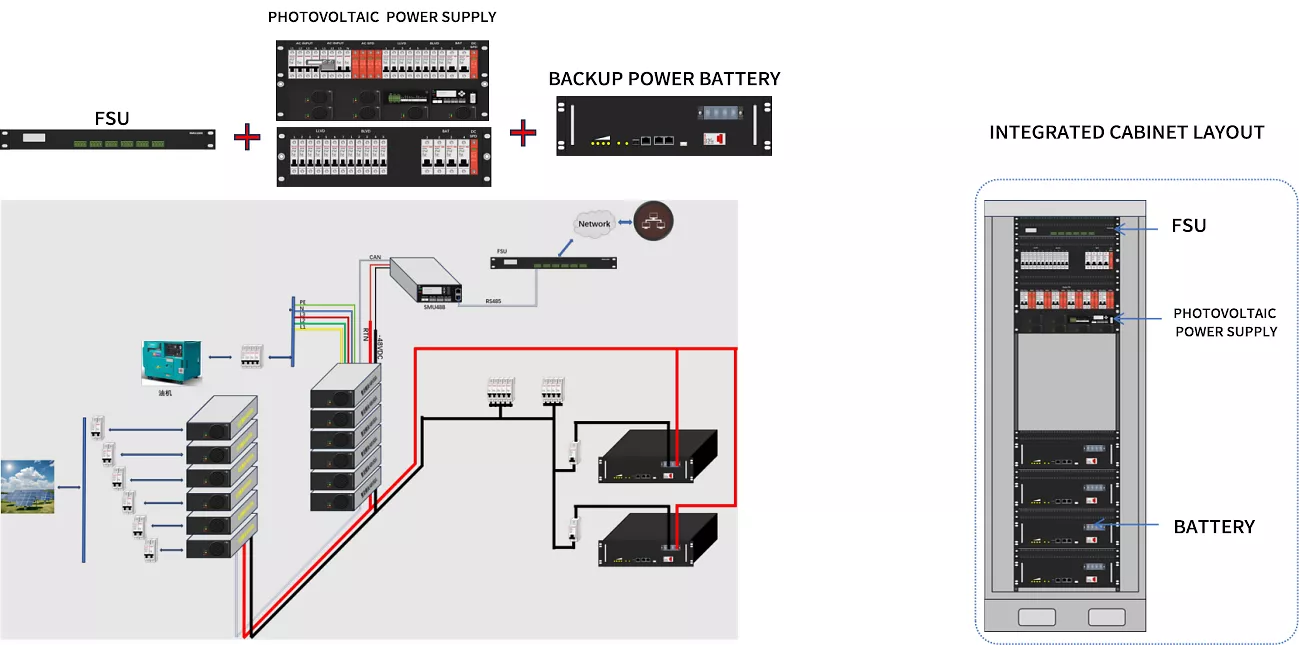
Scenario 3: Hybrid solar and storage systems are increasingly used in remote communication sites.(Full Hybrid)
- Energy Priority: PV > Grid Power > Battery > Diesel Generator
- Components: Rectifier Power Supply + PV Power Cabinet + Battery + Diesel Generator + FSU
- Suitable For: Areas without stable grid power and with ample sunlight (e.g., plateaus, islands)
Scenario 4: Photovoltaic + Energy Storage + Diesel Generator (Off-Grid Type)
- No grid connection; fully reliant on renewable energy + diesel generator backup
- Priority: Solar > Battery > Diesel generator (DC)
- Applicable for: Fully off-grid communication sites
Frequently Asked Questions (FAQ)
1. What is a telecom energy storage system?
A telecom energy storage system is a battery-based power solution designed to provide reliable backup power and energy management for communication base stations, telecom towers, and remote network sites.
Unlike traditional lead-acid batteries, modern telecom energy storage systems use advanced lithium battery technology combined with intelligent Battery Management Systems (BMS) and Energy Management Systems (EMS) to improve safety, efficiency, and backup duration.
These systems can support various applications, including:
- Telecom base station backup power
- 5G communication sites
- Remote network facilities
- Off-grid communication stations
- Hybrid solar telecom power systems
2. Why do telecom base stations need energy storage systems?
Traditional telecom backup power systems mainly rely on lead-acid batteries, which often have limitations such as:
- Short backup duration
- Frequent battery replacement
- High operation and maintenance costs
- Poor performance in extreme environments
With increasing power consumption from 5G networks and growing demand for reliable communication services, telecom operators require more efficient energy solutions.
Energy storage systems help telecom sites:
- Extend backup power time
- Reduce electricity costs
- Improve network reliability
- Support renewable energy integration
- Reduce dependence on diesel generators
3. How long can an energy storage system power a telecom base station?
The backup duration depends on several factors, including:
- Battery capacity
- Base station power consumption
- Load requirements
- Environmental conditions
For example, upgrading from traditional lead-acid batteries to lithium battery energy storage systems can extend backup time from approximately 2–3 hours to several hours or even more than 7 hours depending on system configuration.
For specific projects, the battery capacity should be calculated based on actual site load requirements.
4. What type of batteries are used for telecom energy storage systems?
Most modern telecom energy storage systems use lithium batteries, especially Lithium Iron Phosphate (LiFePO4) batteries, due to their:
- High safety performance
- Long cycle life
- Excellent thermal stability
- High energy efficiency
- Lower maintenance requirements
For telecom applications, battery selection usually depends on:
- Required backup time
- Installation environment
- Space limitations
- Operating temperature
- Expansion requirements
5. What is the difference between DC and AC energy storage solutions for telecom sites?
DC and AC energy storage systems are designed for different application scenarios.
DC Energy Storage Solution
DC systems directly connect to the 48V telecom power bus, making them suitable for existing communication sites.
Advantages:
- Simple retrofit installation
- Lower modification cost
- High conversion efficiency
- Easy integration with existing telecom power systems
- Supports future PV expansion
AC Energy Storage Solution
AC systems use Power Conversion Systems (PCS) and are suitable for sites requiring larger energy capacity or AC load support.
Advantages:
- Supports larger storage capacity
- Suitable for air conditioning and other AC loads
- Enables peak shaving and energy cost optimization
- Supports advanced energy management functions
6. Can solar energy be integrated with telecom energy storage?
Yes. Solar energy combined with battery storage is becoming an important solution for telecom sites, especially in remote areas.
A solar + storage telecom power system can:
- Generate clean electricity during the day
- Store excess solar energy in batteries
- Reduce grid electricity consumption
- Reduce diesel generator usage
- Provide reliable power in remote locations
Typical configurations include:
- Solar + Battery + Grid
- Solar + Battery + Diesel Generator
- Fully off-grid solar telecom power systems
7. Can energy storage replace diesel generators for telecom towers?
In some applications, energy storage systems can significantly reduce diesel generator usage, but whether they can completely replace generators depends on the project conditions.
Battery storage can replace or reduce diesel generator operation when:
- Solar resources are sufficient
- Battery capacity meets backup requirements
- Power demand is predictable
For remote areas with long periods of poor weather or extremely high reliability requirements, hybrid systems combining:
Solar + Battery + Diesel Generator
are often the most reliable solution.
8. What is the lifespan of a telecom energy storage battery?
The lifespan depends on battery chemistry, operating conditions, and charging/discharging cycles.
High-quality lithium iron phosphate (LiFePO4) batteries can typically provide:
- Thousands of charge cycles
- Long service life
- Stable performance under demanding conditions
Proper thermal management, Battery Management Systems (BMS), and regular monitoring can further extend battery lifespan.
9. How does EMS improve telecom energy storage performance?
An Energy Management System (EMS) enables intelligent monitoring and control of energy storage systems.
EMS functions include:
- Real-time energy monitoring
- Battery charging and discharging control
- Energy optimization
- Remote operation management
- Integration with renewable energy systems
By coordinating solar generation, battery storage, and grid power, EMS helps telecom operators improve energy efficiency and reduce operating costs.
10. What are the applications of telecom energy storage systems?
Telecom energy storage solutions are widely used in:
- 4G/5G base stations
- Communication towers
- Remote telecom sites
- Rural communication networks
- Emergency communication systems
- Island and off-grid communication stations
- Industrial communication infrastructure
They are especially valuable in areas where grid power is unstable or unavailable.
11. What should telecom operators consider when choosing an energy storage supplier?
When selecting a telecom energy storage supplier, consider:
Product Safety
Check:
- Battery safety design
- Thermal management system
- Fire protection system
- Battery monitoring capabilities
System Integration Capability
A reliable supplier should provide:
- Battery system design
- BMS and EMS integration
- Solar compatibility
- Customized solutions
Manufacturing and Service Capability
Important factors include:
- Production experience
- Quality certifications
- Project support
- After-sales service
12. Is a solar telecom power system suitable for remote areas?
Yes. Solar telecom power systems are especially suitable for remote locations where grid connection is difficult or expensive.
Typical applications include:
- Mountain areas
- Islands
- Deserts
- Rural regions
- Mining areas
- Emergency communication sites
These systems provide independent and reliable electricity without requiring complex grid infrastructure.
13. What is the difference between telecom energy storage and traditional backup batteries?
Traditional backup batteries mainly provide emergency power during outages.
Modern telecom energy storage systems provide much more:
| Traditional Backup Battery | Telecom Energy Storage System |
|---|---|
| Backup only | Backup + energy management |
| Limited monitoring | Intelligent monitoring |
| Higher maintenance | Lower maintenance |
| Shorter lifespan | Longer service life |
| No renewable integration | Supports solar integration |
Energy storage has evolved from a backup component into an intelligent energy management solution.
14. Can telecom energy storage systems support peak shaving?
Yes.
Energy storage systems can charge batteries during low electricity price periods and discharge during peak demand periods.
This helps telecom operators:
- Reduce electricity costs
- Optimize energy consumption
- Improve power utilization efficiency
For large telecom facilities, peak shaving can create significant long-term savings.
15. Why choose Huijue for telecom energy storage solutions?
Huijue provides integrated telecom energy storage solutions designed for modern communication infrastructure.
Our solutions include:
- DC and AC energy storage systems
- Solar telecom power solutions
- Hybrid power systems
- Battery energy storage systems
- Intelligent EMS management
With advanced battery technology, safety protection systems, and customized project support, Huijue helps telecom operators build safer, smarter, and more reliable power networks.