
 chinahuijue@gmail.com
 +1 (702) 204-9855
Outdoor Telecom Cabinets: The Enclosure Powering 5G, Edge, and Network Buildouts
5G did not get built in data centers. It got built on poles, rooftops, and roadside cabinets. The cabinet is the unglamorous unit that holds the radios, the power, and increasingly the battery that keeps a cell site alive when the grid does not.
Operators used to bolt equipment into a weatherproof box and walk away. That stopped working. Edge computing, Open RAN, and battery-backed sites pushed far more heat and far more critical load into enclosures that were never designed for it. The outdoor telecom cabinet is now a system decision, not a sheet-metal purchase.
For carriers, tower companies, and enterprises rolling out private networks, the enclosure is where deployment cost, reliability, and serviceability are actually won or lost. Our own Google Ads cabinet campaign, live since late July 2026, already shows buyers searching by enclosure form factor—”network cabinet,” “internet cabinet,” “outdoor telecom cabinet”—rather than by generic function. This guide covers what lives inside the box, how to spec the enclosure, and what the market behind it is doing in 2026.
Why the Cabinet Became the Unit of Deployment
The shift from macro to small cell changed everything about where equipment lives. A macro tower serves thousands from one structure. A 5G small cell serves a street corner from a cabinet the size of a fridge.
ABI Research has tracked small-cell deployments accelerating as carriers chase coverage that macros cannot reach—inside stadiums, along transit lines, up building faces. Each of those nodes needs power, cooling, and protection in a footprint that fits a sidewalk.
Edge computing made the problem harder in a useful way. Workloads that used to live in regional data centers now land a few meters from the user to cut latency. That hardware is perfectly happy in a cabinet rather than a raised-floor room.
Dell’Oro Group’s RAN coverage has noted that the capital intensity of 5G rollouts pushed operators toward standardized, repeatable site kits—cabinets included—so a technician can install the same enclosure in Oslo, Lagos, or Manila with minimal re-engineering. Standardization is how you deploy at scale without exploding opex.
The enclosure stopped being a box. It became the deployment unit, and that reframes the buying decision from “how cheap” to “how complete.”
What Actually Lives Inside an Outdoor Cabinet
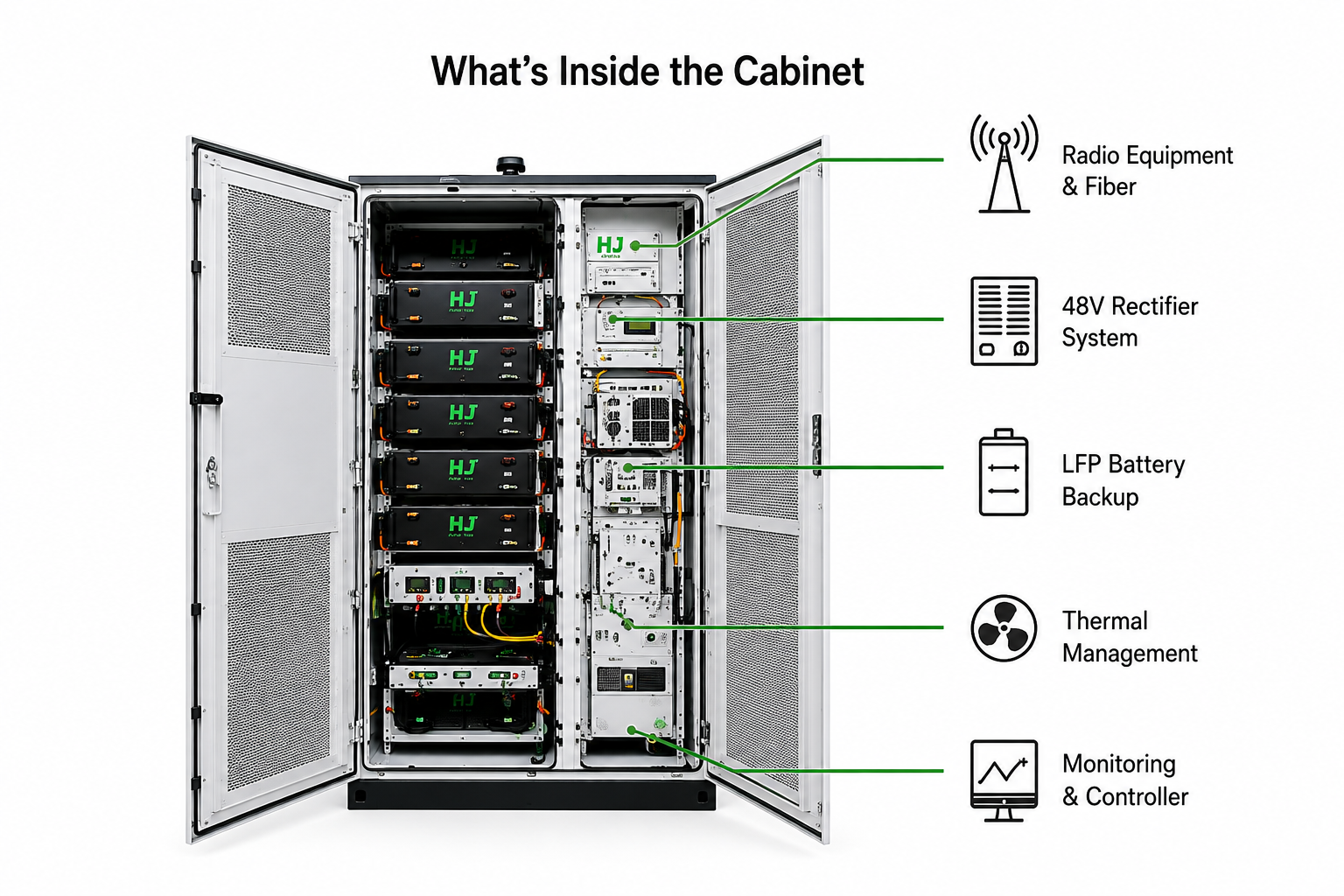
Lift the door and the layout is more deliberate than it looks. Top to bottom, a modern cabinet stacks radio equipment, power conversion, battery backup, and thermal management in a footprint engineered around heat and service access.
The radio section holds the RRU or active antenna unit and the fiber termination. Heat rises, so this sits high where airflow helps and where service techs can reach it without disturbing the power below.
Below it, the power section: a 48V rectifier system converting AC grid input to the nominal -48V DC that telecom equipment expects, plus distribution busbars and surge protection. This is the part most buyers under-spec, and the part that decides whether the site stays up.
The battery bay carries the backup energy. Lead-acid used to own this space. Lithium iron phosphate does now, for reasons the battery section covers. The bay is sized around required autonomy hours, not around whatever pack fit last time.
Thermal management sits at the bottom or on the door—a heat exchanger, air conditioner, or fan tray moving heat out without letting dust and rain in. The wrong choice here silently raises the enclosure’s energy draw for a decade.
Monitoring ties it together: a controller reading temperature, door status, battery state, and rectifier health, reporting back over the network. A cabinet with no telemetry is a cabinet nobody knows has failed until a site goes dark.
IP Ratings and Corrosion: The Spec That Gets Skipped
IP55 and IP65 sound like fine print. They decide whether a cabinet survives its first monsoon, and most buyers pick on price and regret it later.
IP55 keeps out dust and low-pressure water jets. IP65 adds protection against stronger jets and brief immersion pressure. For roadside and rooftop sites exposed to driving rain and hose-down maintenance, IP65 is the safer floor; IP55 works for sheltered or indoor-adjacent installs.
Corrosion defeats IP ratings over time. A cabinet in a coastal or industrial site faces salt and sulfide attack that eats gaskets and fasteners. Powder-coated aluminum and stainless hardware extend service life from a few years to a decade-plus.
ESTEL and other enclosure specialists publish IP55/IP65 product lines with coated heat exchangers precisely because corrosion, not impact, is the dominant field failure mode. The coating is what keeps the rating honest after year five.
Buyers who skip the corrosion spec to save a few percent on capex usually pay for it in year four, when a seized gasket lets water into a live battery bay. The cheap cabinet is rarely the cheap cabinet.
Thermal Management: Heat Exchanger vs Air Conditioner
Every watt of equipment turns into a watt of heat that has to leave the cabinet. How it leaves shapes energy use, reliability, and opex for the enclosure’s whole life.
Three options dominate. Fans are cheapest and draw the least power but pull dust and humidity straight through the cabinet—fine for cool, clean environments, risky in desert or coastal sites. Air conditioners close the loop and protect the interior, at the cost of hundreds of watts of continuous draw and a compressor that eventually fails. Heat exchangers split the difference: two air loops, one inside one outside, exchanging heat through a plate with no air mixing.
A heat exchanger protects the interior environment while using a fraction of an air conditioner’s power. For a cabinet running 500–1,500W of load, that difference is 200–600W saved continuously—real money when multiplied across thousands of sites.
The trade-off is temperature lift. A heat exchanger cannot cool the interior below ambient as aggressively as an active AC unit, so it suits moderate climates and moderate-density loads. High-density edge compute in a hot climate still wants an air conditioner or a hybrid: heat exchanger for most of the year, AC for the worst weeks.
| Method | Power Draw | Contamination Risk | Best For |
|---|---|---|---|
| Fan tray | 10–50W | High (open loop) | Cool, clean, low-density sites |
| Heat exchanger | 80–250W | Low (closed loop) | Moderate load, moderate climate |
| Air conditioner | 300–900W | Low (closed loop) | High density, hot climate |
| Hybrid (HX + AC) | 80–900W variable | Low (closed loop) | Mixed climate, variable load |
Spec the thermal method to the site, not to the supplier’s default. A desert edge node and a Nordic small cell need different answers, and a one-size enclosure is the one that fails the site with the hardest conditions.
Battery Backup: Why LFP Replaced Lead-Acid
Backup batteries used to mean valve-regulated lead-acid, the kind that loses capacity in heat and dies young. Lithium iron phosphate changed the math, and most operators have already made the switch.
LFP runs 6,000–8,000 cycles to 80% capacity versus 1,200–1,800 for lead-acid. In a cabinet cycled nightly or supporting frequent grid outages, that is the difference between replacing batteries every two years and every ten.
Weight matters in cabinets. Lead-acid packs are brutally heavy, stressing mounts and complicating installation on rooftops and poles. LFP delivers the same energy at roughly a third of the mass, which simplifies structural design and handling.
The IEA’s Global Energy Review 2026 pegged LFP at roughly 90% of battery storage deployments, a share that now reaches into telecom backup. BloombergNEF’s Q1 2026 cell price near $84/kWh pulled LFP below the lead-acid total-cost crossover for most cabinet applications.
Safety is the quiet driver. LFP’s higher thermal-decomposition threshold gives the cabinet’s monitoring and thermal systems more time to act before a fault escalates. For enclosures mounted next to homes and offices, that margin is why insurers and operators alike now default to LFP. The same chemistry that protects a cabinet energy storage unit protects a roadside cabinet.
| Parameter | Lead-Acid (VRLA) | LFP |
|---|---|---|
| Cycles to 80% capacity | 1,200–1,800 | 6,000–8,000 |
| Relative weight (same energy) | 3× | 1× |
| Thermal-decomposition threshold | ~210°C | ~270°C |
| Typical service life in cabinet | 2–4 years | 8–12 years |
| Cell price context (2026) | Higher total cost | ~$84/kWh (BloombergNEF Q1) |
Sizing the 48V Power System for a Site
A cabinet’s power system is sized around two numbers: the continuous load and the backup duration required during a grid outage. Everything else is detail built on top of those two.
A small-cell site with radio and transmission might draw 300–800W. An edge compute node with servers can pull 1,500–4,000W. Add the thermal management load on top—another 200–800W depending on climate and method.
The rectifier should cover continuous load plus charge the batteries, with headroom. A common rule sizes rectifier capacity at 1.2–1.5× the site’s steady draw so it can both run the equipment and replenish backup after an outage without running at the edge of its rating.
Backup duration sets battery size. Four hours of autonomy at 1,000W load means roughly 4 kWh of usable battery, which after depth-of-discharge limits translates to a 5–6 kWh nameplate pack. Operators in unstable grids often spec 8–12 hours, which is exactly where LFP’s weight advantage becomes decisive.
| Site Type | Steady Load | Rectifier Capacity | Battery (4h autonomy) |
|---|---|---|---|
| Small cell | 300–800W | 1–1.5kW | 2–4 kWh |
| Macro remote radio | 800–1,500W | 2–3kW | 5–8 kWh |
| Edge compute node | 1,500–4,000W | 5–6kW | 10–20 kWh |
| Private 5G (campus) | 1,000–3,000W | 4–5kW | 8–15 kWh |
Oversizing the rectifier is cheap insurance; undersizing it means the battery never fully recharges between outages, and the site loses autonomy precisely when the grid is least reliable. Round the rectifier up, not down. The physical envelope matters too—a 42U cabinet fits a different payload than an 8U or 15U unit, so the rack height has to be chosen alongside the power, not after it.
Where Cabinets Are Being Deployed: 5G, Edge, and Enterprise
The market behind these enclosures is not small. Grand View Research valued the base station antenna market at USD 11.2 billion in 2025, projecting USD 13.1 billion for 2026 and USD 30.0 billion by 2033 at a 12.6% CAGR—antennas are only useful when something houses and powers them.
Edge data centers are the parallel pull. GMI put the US edge data center market at USD 5.7 billion in 2025, and JLL projects the broader data center sector expanding at a 14% CAGR through 2030 as AI and latency-sensitive workloads sprawl outward from core regions.
Containerized and micro data centers—cabinet-scale by another name—were valued at USD 16.1 billion in 2025, climbing to USD 18.3 billion in 2026 and a projected USD 62.4 billion by 2033 at a 19.2% CAGR per Grand View Research. That trajectory is the same impulse: computing pushed to the network edge, housed in enclosures.
Enterprise buyers are the third front. Factories, ports, and campuses deploying private 5G want the same ruggedized cabinet model operators use, minus the carrier scale. Arizton sized the global data center market at USD 514.26 billion in 2025, a figure that understates how much of that spend now touches enclosure-level deployment.
The search behavior backs this up. Query data from our own cabinet campaign clusters around rack-unit specifications—8U, 9U, 15U, 30U, 42U, 47U—alongside “server cabinet,” “network switch cabinet,” and “network cabinet management.” Buyers are not typing “telecom equipment.” They are typing the exact enclosure they need, which means content and product pages built around cabinet form factors capture intent that generic categories miss.
The common thread is latency and resilience. Whether it is a carrier small cell, an edge cache, or a private network, the workload ends up in a cabinet near the user—and that cabinet has to power and protect it. Vertiv and Eaton built large businesses on exactly this need; the opportunity for agile suppliers is in the standardized, cost-engineered enclosures that carriers and enterprises now buy by the thousands.
What Buyers Should Demand From Cabinet Suppliers
Specifying an outdoor cabinet is specifying a small controlled environment. The questions below separate enclosures that survive a decade from ones that fail in three years.
Ask for the IP rating in writing with the test standard, not a verbal “weatherproof.” Push for the corrosion specification if the site is coastal or industrial. Require the thermal solution to match the site’s climate and load density rather than the supplier’s default.
Demand battery chemistry and cycle data—LFP with a documented 6,000-cycle curve, not a generic “long life” claim. Confirm the rectifier capacity covers load plus recharge headroom, and that the monitoring controller exposes temperature, door, battery, and rectifier telemetry over a standard protocol.
| Evaluation Criterion | What to Ask | Red Flag |
|---|---|---|
| Enclosure rating | IP55/IP65 with test standard in writing | “Weatherproof” with no certification |
| Corrosion protection | Coating, material, coastal rating | Bare steel, no corrosion spec |
| Thermal method | Matched to climate and load density | One default for every site |
| Battery chemistry | LFP, 6,000-cycle curve documented | “Long life” with no cycle data |
| Rectifier headroom | 1.2–1.5× steady load | Rectifier sized exactly to load |
| Monitoring | Temp, door, battery, rectifier telemetry | No remote status, local only |
Spare parts and regional stock are the question nobody asks until the site is down. A rectifier module failure during peak season can knock a node offline for weeks if the supplier ships from a single distant factory. Confirm critical spares—power modules, control boards, battery units—can ship within 48 hours from a regional warehouse. That capability is worth a price premium over the cheapest bid.
Frequently Asked Questions
What IP rating do outdoor telecom cabinets need?
IP55 suits sheltered installs; IP65 is the safer floor for roadside and rooftop sites exposed to driving rain and hose-down maintenance.
Heat exchanger or air conditioner for cabinet cooling?
Heat exchangers save 200–600W versus AC for moderate loads and climates. Use AC or hybrid only for high-density compute in hot environments.
Why is LFP replacing lead-acid in cabinets?
LFP delivers 6,000–8,000 cycles versus 1,200–1,800 for lead-acid, at a third of the weight, with a safer thermal profile for enclosures near occupied buildings.
How do I size the 48V rectifier and battery?
Size rectifier at 1.2–1.5× steady load to cover running plus recharge. Battery nameplate depends on required backup hours times load, with depth-of-discharge margin.
Can one cabinet host both 5G and edge compute?
Yes. Modern enclosures stack radio, 48V power, LFP backup, and server payloads, provided thermal management matches the combined heat load of the site.
If you are specifying outdoor telecom or network cabinets for a 5G, edge, or private-network deployment, our engineering team can help you match enclosure rating, thermal method, and 48V power sizing to your site conditions. Request a Consultation
This article is for informational purposes only and does not constitute engineering or procurement advice. Specifications, costs, and market figures vary by location, site conditions, and supplier.