
 chinahuijue@gmail.com
 +1 (702) 204-9855
The Cabinet That Powers and Stores: How Integrated Outdoor Enclosures Reshape Telecom and Storage
Published: August 7, 2026 | By Huijue Group Editorial Team
A cell site is no longer just a box that talks. It is becoming a small power plant — radios, power conversion, and batteries squeezed into one outdoor telecom cabinet. The shift is not an engineering fashion. It is what happens when grid reliability, energy prices, and carbon pledges all point the same direction.
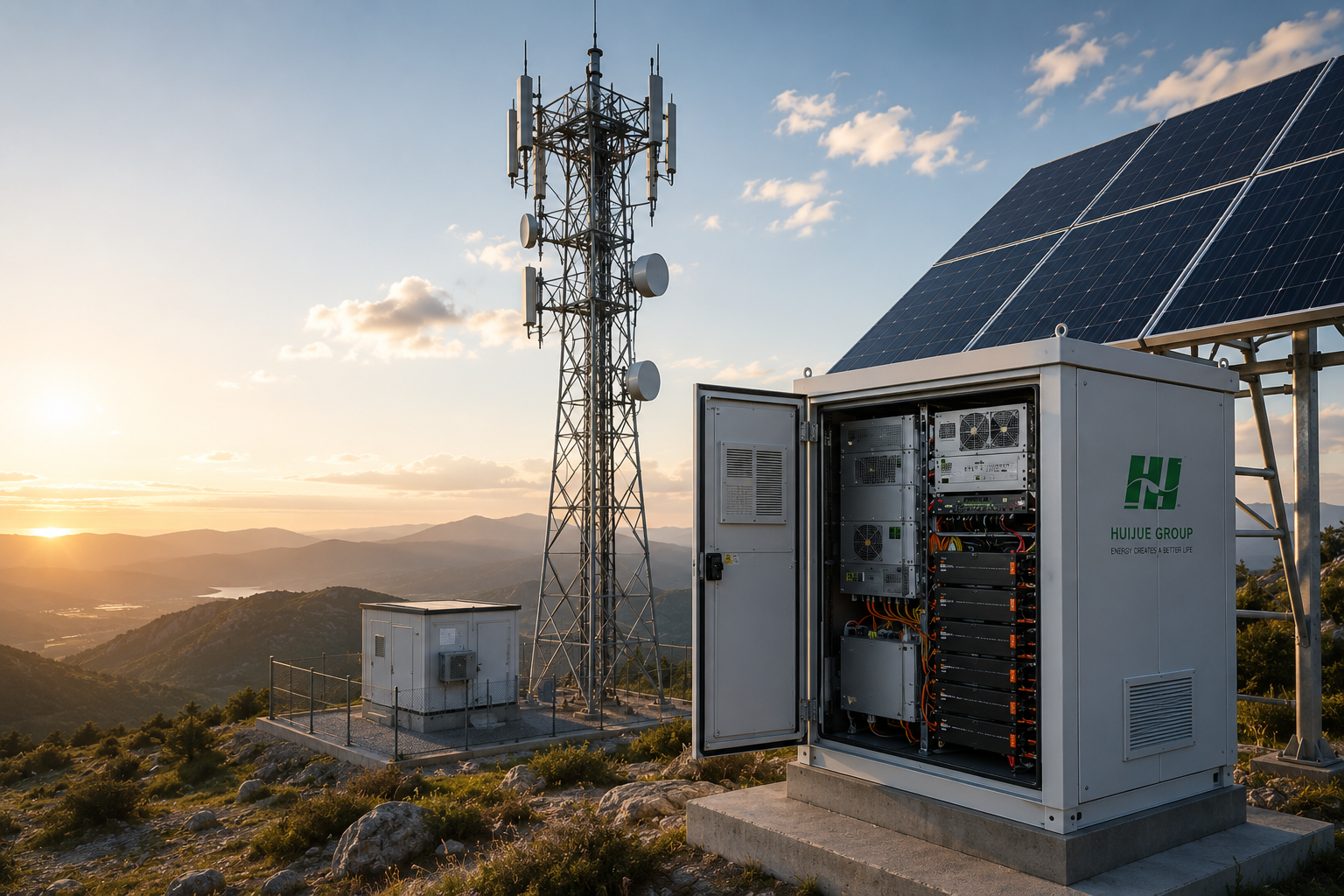
For two decades, operators kept remote and weak-grid sites alive with diesel generators parked next to the enclosure. That logic is breaking. The cost curve for solar-plus-storage has fallen while diesel and grid power have climbed. Moving backup energy from “a battery room beside the cabinet” into “the cabinet itself” is now the obvious next step.
Our own ad data shows the buyer has already made the connection. People searching for outdoor cabinets type solar storage battery, 50kwh solar battery, and lfp energy storage in the same sessions as network cabinet and internet cabinet. Buyers are shopping for the integrated thing. Most content still treats telecom cabinets and storage cabinets as separate categories — which is exactly the gap worth filling.
From Diesel Generators to Solar-Plus-Storage at the Site
Remote sites were never connected to clean grids. They ran on diesel because nothing else reached them. That math has inverted in the last two years, and the change is showing up first at the edges of the network rather than in city cores.
A 2026 analysis of off-grid telecom towers in Europe found the best-value architecture is now solar PV paired with LiFePO4 storage and a diesel backup trimmed to emergency-only use. Another 2026 field review of bad-grid regions sized typical hybrids at 5–15 kW of solar and 20–80 kWh of battery — enough to carry a site through the night and most outages without the generator firing.
Hybrid solar-and-battery systems for telecom towers are being specified from Africa to Southeast Asia for the same reason. The sun is free, the battery is now cheap enough to matter, and the diesel bill is the line item everyone wants off the books. When the backup source moves on-site, the cabinet is the natural place to put it.
Why Operators Are Putting Batteries Inside the Cabinet, Not Beside It
A separate battery shelter next to a cabinet looks simpler on a drawing. In the field it is a second enclosure to ship, site, cool, secure, and maintain — with its own cable run back to the power system and its own failure modes.
Integration collapses that overhead. One enclosure holds the radio, the 48V rectifier, and the LFP pack behind a single door. One thermal system manages the whole load. One controller sees every parameter. For a tower company rolling out thousands of sites, that simplicity is the product, not a footnote.
The cabinet also stops being a passive shell. It becomes an energy node — generating, storing, and dispatching on a schedule the operator can tune. That is a different asset class than a sheet-metal box with a rectifier bolted inside, and it changes how the site is financed and operated.
| Dimension | Integrated cabinet | Separate battery shelter |
|---|---|---|
| Site footprint | One enclosure | Two enclosures plus cable run |
| Thermal systems | One unified loop | Two independent loops |
| Maintenance interface | One controller, one vendor | Two systems, two vendors |
| Five-year opex | Lower (shared cooling, single site) | Higher (duplicate infrastructure) |
| Diesel displacement | High (solar + LFP sized in) | Partial (battery often undersized) |
The Economics Finally Work: LFP Price Meets Site Power Need
None of this pencils without cheap cells. It now does. BloombergNEF tracked lithium iron phosphate cell prices near USD 84 per kWh in early 2026, a level that pulls LFP below the total-cost crossover for most cabinet storage. The IEA’s Global Energy Review 2026 put LFP at roughly 90% of battery storage deployments, a share that now reaches into telecom backup.
The point is not “batteries got cheap.” The point is the cheap battery finally fits the cabinet. A pack that once cost more than the enclosure it sat in now costs less than the diesel it replaces over three years. That is the inflection that turns integration from a nice-to-have into a default spec on new sites.
Operators who ran the numbers two years ago walked away. Operators running them today sign. The curve moved, not the requirement — and the requirement was always “keep the site up without burning diesel.”
Net-Zero Pledges Turn Cabinets Into Carbon Decisions
Carbon used to be a corporate-report footnote. For European operators it is now a procurement filter. Orange’s 2024 white paper commits the group to net zero by 2040 — a 90% cut versus 2020 — with a 45% reduction targeted by 2030. Other major European carriers have set similar 2030 and 2040 horizons, and the deadlines are close enough to shape this year’s tenders.
Tower companies feel this first. Firms such as American Tower, Cellnex, Vantage Towers, and China Tower — the dominant players in a market Mordor Intelligence described as rapidly consolidating through 2026 — treat site energy as one of their largest operating costs and a primary emissions source. Replacing diesel with on-site solar and storage is the fastest lever they have, and it is a lever they control site by site.
An integrated cabinet is where that lever physically lands. Put the LFP and the PV input in the same box as the radio, and diesel runtime drops from baseline to emergency-only. The enclosure stops being a cost center and starts retiring emissions — which, for a carrier with a 2040 target, is the whole point.
Where the Integrated Cabinet Is Selling First
The pull is not uniform. It clusters where the pain is sharpest, and that clustering tells you which buyers are ready now versus which are still piloting.
Africa and parts of Southeast Asia lead on off-grid necessity — our search data runs heavy with solar and battery queries from Kenya, Nigeria, and the wider region. The Middle East, with Saudi Arabia’s Vision 2030 5G buildout, is specifying ruggedized integrated enclosures at scale. Europe is driven by net-zero commitments and volatile power prices. Edge-computing and private-5G campuses want the same box because their workloads, too, need power and protection near the user rather than in a distant data center.
| Region | Primary driver | Typical spec emphasis |
|---|---|---|
| Africa / SE Asia | Off-grid reliability | Solar + LFP autonomy, diesel backup |
| Middle East | Mega 5G buildout | Ruggedization, heat management |
| Europe | Net-zero + power price | PV input, carbon footprint, LFP |
| Edge / private 5G | Latency + resilience | Higher load, hybrid cooling |
What an Integrated Outdoor Cabinet Actually Contains
Lift the door on a modern integrated unit and the layering is deliberate. The radio section sits high, where airflow helps and service techs can reach it. Below it, the 48V rectifier converts grid or generator AC to the -48V DC the equipment expects, with distribution and surge protection on the same busbar.
The LFP bay carries the backup. Then come the parts a separate design tends to forget: an MPPT solar charge controller taking PV input, an energy-management controller deciding what draws from sun, battery, or grid, and a generator interface for seamless handoff when the sun and cells run out. A cabinet energy storage pack sized to the site’s autonomy hours is what makes the whole scheme credible.

Thermal management wraps the combined heat load — radio plus battery plus any edge compute — under one strategy. Monitoring ties temperature, door status, battery state, rectifier health, and PV yield into a single telemetry stream, so a site that loses sun does not also lose visibility.
| Layer | Component | Sizing note |
|---|---|---|
| Radio | RRU / AAU, fiber termination | Mounted high for airflow |
| Power | 48V rectifier, distro, surge | 1.2–1.5× steady load |
| Storage | LFP battery bay | 5–80 kWh by site |
| Generation | MPPT solar input, diesel port | Sized to autonomy hours |
| Thermal | HX / AC / hybrid | Matched to combined load |
| Control | EMS + monitoring | Sun / battery / grid logic |
What Buyers Should Look For in an Integrated Cabinet
Integration adds parts, so it adds things to verify. Ask how the energy-management controller prioritizes sources — sun first, battery as buffer, grid or generator last. Confirm the solar input and battery size are spec’d to your autonomy hours, not a vendor default. Check that the thermal system covers the combined radio-plus-battery heat, not just the radio section.
Demand the battery’s carbon story too. With EU battery passport rules taking effect in February 2027 for industrial cells above 2 kWh, traceable LFP with a documented footprint is moving from optional to expected for European buyers. A cabinet that cannot show its battery’s provenance will lose tenders it should have won — and the integrated design makes that paperwork either trivial or impossible depending on the supplier.
Frequently Asked Questions
What is an integrated outdoor telecom-and-storage cabinet?
One enclosure houses radios, 48V power, and LFP storage together, cutting footprint, wiring, and maintenance points versus separate shelters.
Can an integrated cabinet run on solar?
Yes. Most add an MPPT solar input and an optional diesel port, sizing the LFP pack for the site’s required autonomy hours.
How large is the LFP battery in an integrated cabinet?
Roughly 5–20 kWh for small cells, scaling to 20–80 kWh for remote or edge sites with longer backup needs.
Why do European operators favor integrated cabinets?
Net-zero pledges like Orange’s 2040 target push diesel replacement with on-site solar and LFP storage in one enclosure.
Does adding storage raise the cabinet’s cooling load?
Slightly, but LFP’s low heat output and a matched heat exchanger keep the combined thermal envelope manageable.
If you are specifying integrated outdoor cabinets that pair telecom power with LFP storage — for off-grid, edge, or net-zero-driven deployments — our engineering team can help you match solar input, battery autonomy, and thermal strategy to your sites. Request a Consultation
This article is for informational purposes only and does not constitute engineering or procurement advice. Specifications, costs, and market figures vary by location, site conditions, and supplier.